Afternoon Talks 1-3 of the Skerries Eco Festival 2023

In our series of blog posts about the 2023 Skerries Eco Festival, Sustainable Skerries committee member Evelyn Cottell sums up the first three of our nine wonderful Sunday Afternoon Talks . She writes:
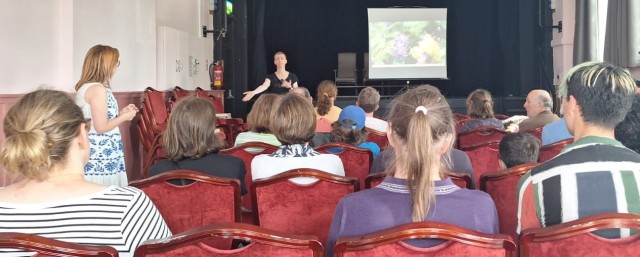
The Eco Talks session took place on Sunday 3rd September, in The Little Theatre. In the nearby Old Schoolhouse, ECO Fair stalls were in full swing, facilitating a flow of people in and out of the two events, according to personal time and interest. Events aimed to inform on a wide range of topics including conservation of energy; marine; river and birdlife; biodiversity, waste reduction & management, the work of Skerries Tidy Towns and on promotion of active travel. The extent of local group initiatives and activities, which are establishing strong roots, were presented. This session also aimed to inspire residents to take further action to protect and enhance our town’s natural beauty and sustainability.
Nine speakers, including local and external experts, gave short presentations, followed by Q & A’s. Here are my summaries of the first three:
Branches of Hope: How planting trees can help turn the tide of the climate crisis- Sabine McKenna
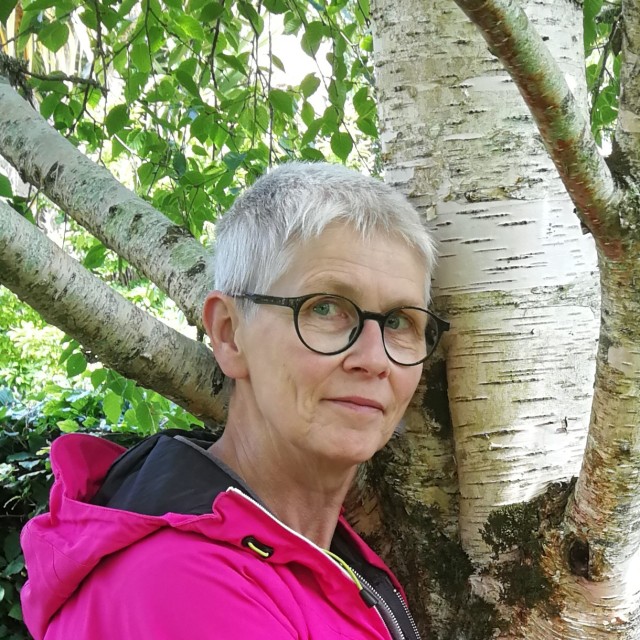
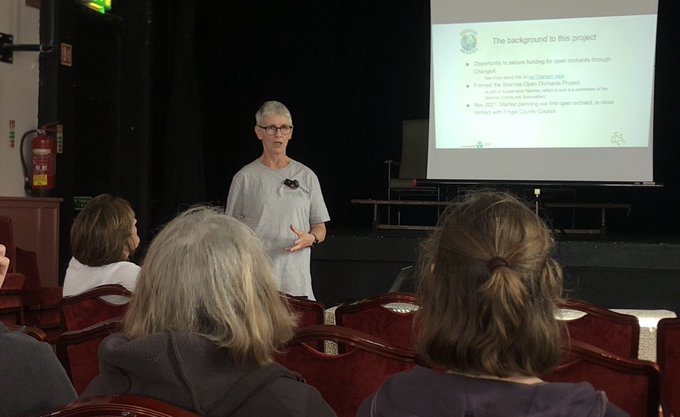
Sustainable Skerries chair Sabine McKenna opened the session with a subject close to her heart: The Skerries Open Orchards Project.
Sabine traced the development of the Skerries Open Orchards Project (SkOOP), one of the many initiatives of Sustainable Skerries (SuSk), from its beginnings in November 2021, when money became available from ChangeX/Accenture.
Over 100 trees had been planted by spring of 2023, in a total of seven mini orchards (this number has risen to 150 trees in ten orchards since). These trees will provide free fruit to local residents and greenery to the open spaces in our town, and there are other benefits too. A newly planted tree will offer some extra pollination opportunities and absorb a small amount of carbon dioxide as well as rainwater that might otherwise have stayed on the surface. And as the trees grow, so do these positive effects.
Thanks to the SkOOP team and smaller groups of local residents in each area, the young trees are now thriving in Kelly’s Bay (near the bus stop), at the Ballast Pit pedestrian crossing, in Mourne View (x2), in Skerries Rock (The Lawn and The Vale), in Selskar Court, in St. Patricks Close, Ardgillan View, Downside, Townparks / Newtown Parks and Greenlawns. They are not just apple trees, but also pear, plum, damson and haze. Sabine stressed that this would not be possible without the local volunteers who guard and water and weed the trees, nor without the support from Fingal County Council.
The existing mini orchards encourage further use of green spaces and provide opportunities for residents, old and new, to meet and work together towards enhancing and protecting their natural environment. Sustainable Skerries are looking forward to hearing from people who are interested in setting up a mini orchard in their own area.
Would you like to help? Let us know at www.SustainableSkerries.com/orchards or write to sustskerries@gmail.com
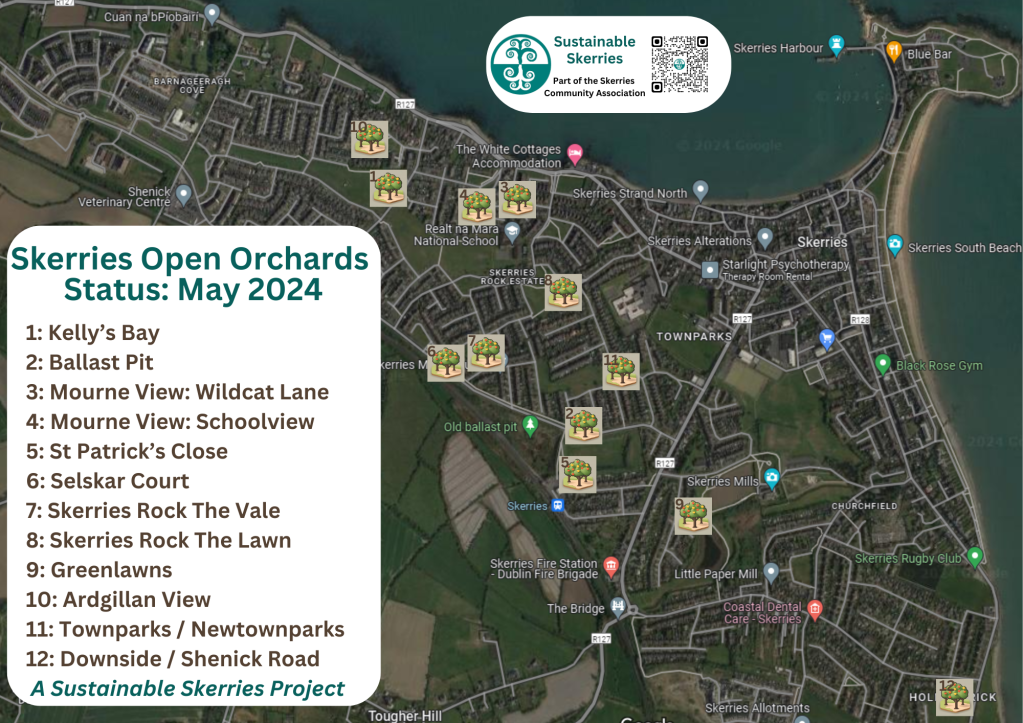
- Skerries Open Orchards Project – Sabine McKenna ⬅ Click to open in new tab
‘Re-wiggling’ the Townparks Stream- Charlie Heasman (SuSk, & Skerries Mills Community Garden)
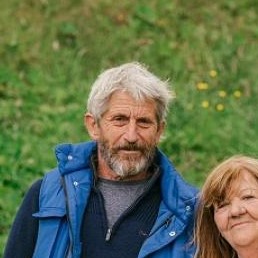
Second speaker of the afternoon was Charlie Heasman, best known for his local work on biodiversity, including conservation work on the rare Carder bee and establishing the Skerries wild meadows and the Skerries Mills Community garden. However, in keeping with the festival’s water theme, Charlie presented a fascinating talk on “‘Re-wiggling’ the Townparks Stream”.
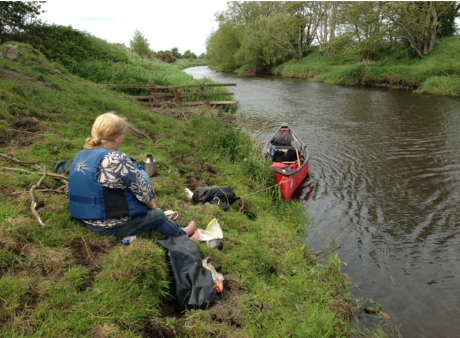
Several aerial maps and photos were shown of 3 rivers- Broadmeadows (Dunshaughlin/Swords/Malahide); the Boyne (Kildare/Meath/Louth) and Skerries only stream- the Townparks Mill Stream (known locally as the Brook). Familiar with all 3 water courses, and having canoed the course of the Boyne with his wife Marion, he pointed out how few curves and bends there are on these rivers. Historically, many rivers here and in UK have been artificially straightened (Approx. 60% in UK– BBC2 documentary, The Lakes with Simon Reeve), in order to drain farmland as rapidly as possible after heavy rain. Unfortunately, this can have disastrous consequences for towns and villages downstream. These natural floodplains normally hold and release flood water slowly thus mitigating the flow; by speeding up water runoff during and after heavy rain the incidence of flash flooding further downriver is dramatically increased.
This has also come at a significant cost to the environment. In its natural state (subject to topography) a river will have fast and slow sections; pools and rapids; curves and eddies, all providing different habitats for different types of aquatic life. The Boyne was no exception before it was canalised, work starting in 1969. Salmon and trout in particular need fast, well oxygenated gravel beds on which to spawn; the “improvement” works destroyed these beds and today salmon and sea trout are no longer found in the upper reaches of the river above Trim.
Restoring rivers by ‘re-wiggling’ adds curves to slow down the flow, allows the river to deposit its sediment on the banks and reduces the risk of flooding downstream. ‘Re-wiggling ‘also creates a greater level of habitat diversity, making rivers more hospitable to more species. Adding vegetation, trees and natural flood management measures can all help increase biodiversity. So nature needs its randomness, and natural rivers are healthy rivers. An ecological study of the Townparks Mill stream area, commissioned by Fingal County Council and carried out by Coiscéim Consulting (Ecology and Hydromorphology Services), included as assessment of the suitability of re-wiggling the Brook. Their report is due in the near future.
- Update May 2024: Coiscéim Consulting have recently published their report “Skerries Town Parks Biodiversity Action Plan 2024-2026”
Pedal Power: Tips on Bike Repairs, Safety, and All-weather cycling- Michael McKenna (Skerries Cycling Initiative)
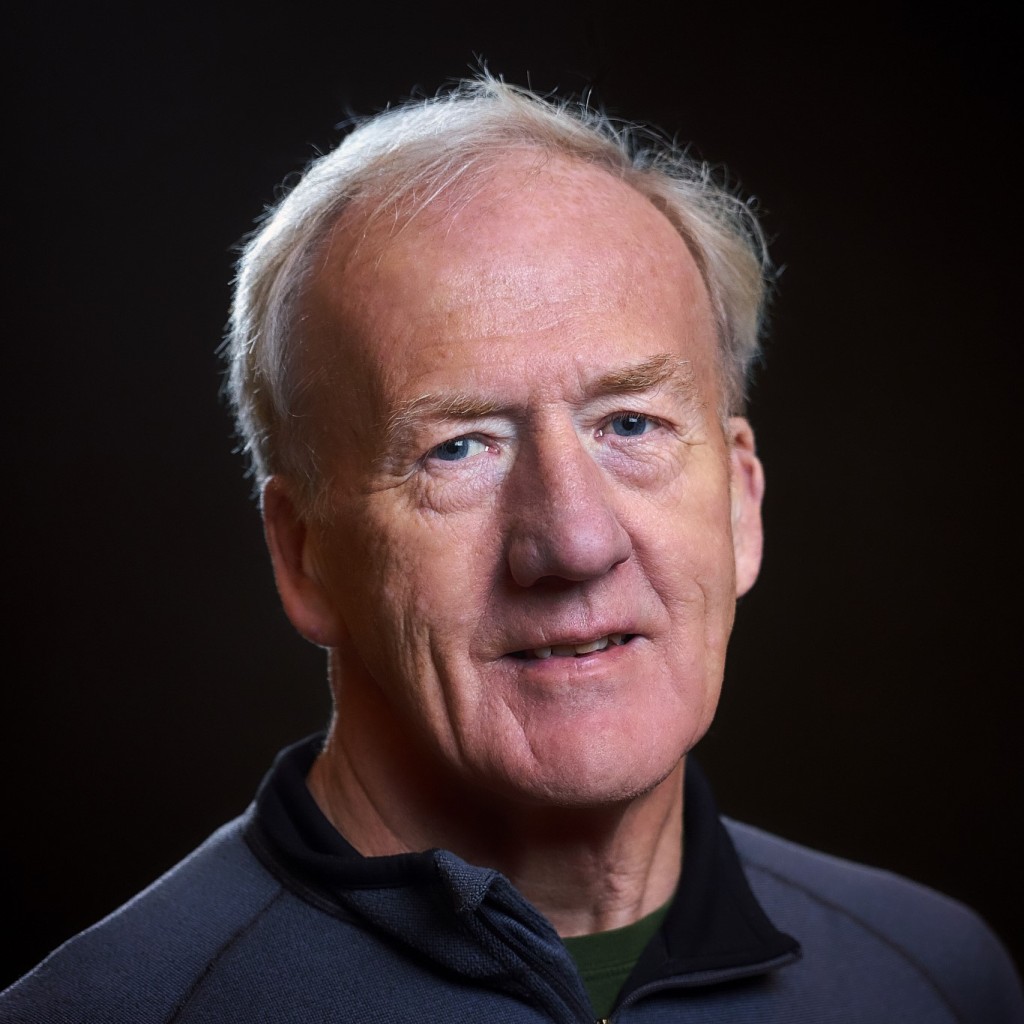
Michael McKenna gave a practical talk on “Pedal Power: Tips on Bike Repairs, Safety, and All-weather cycling”. This presentation nicely complimented the concurrent Bike Repair Workshop, at the Skerries Cycling Initiative (SCI) Bike Shed, behind the Old Schoolhouse.
The objectives of SCI are to (i) develop safer routes to schools, shops, train station and neighbouring towns and (ii) engage with Active Travel and Greenway projects. Michael’s presentation focussed on key practical aspects of cycling safely. These include the safe functioning of all parts of the bike itself (e.g. Saddle, brakes, lights, gears, chain, foot straps, wheels & tyres), using the bicycle “M” check model schematic (www.cycleright.ie). The next safety aspect is “BEING SEEN”- an arms distance from the road edge and in poor light, by wearing bright clothes and lights. And twinning “BEING SEEN” is “BE SEEING”, i.e. observe and anticipate when cycling, practise looking behind and using hand signals, without wobbling, and communicate clearly with other road users via hand signals and eye contact. Avoid blind zones by never moving up / staying on the inside of long vehicles when turning left. Carry a rain jacket and for longer journeys, a repair kit / spare tube / or contact number to call. And finally, wear a properly fitting bike helmet. Michael finished by briefing on the Community Bike Workshop, which he runs, to provide a local place to get help with any bike issues. Here tools are available to use freely and parts are accessible at reasonable costs or no cost at all! He encourages “learning by doing”- fixing brakes, punctures, chains, pedals, gears etc. A final, but much appreciated function of Bike Workshops is to re-home donated bikes.
Can you help or do you need help? Emails skerriescycling@gmail.com to become part of the Bike Shop WhatsApp group. Follow on FB skerriescyclinginitiative
- Update: Due to the impossibility of securing insurance cover for bicycle repair unless a qualified and insured bicycle mechanic is carrying out the repairs, SCI will not be in a position to run the workshop on a regular basis. SCI may however, be able to organise occasional workshops in partnership with a fulltime bike repair entity such as a bike shop or a social enterprise which have their own insurance cover.
- In the months after the Festival, SCI, with funding from Fingal County Council, engaged the Irish Centre for Cycling to provide a five lesson course for adult cyclists. The course was held during December 2023 and Jan 2024. We were delighted that several international protection applicants were able to successfully participate in the course.
- Pedal Power: Tips on Bike Repairs, Safety, and All-Weather Cycling. – Michael McKenna (Skerries Cycling Initiative ) ⬅ Click to open in new tab
Stay tuned to our blog as posts about more of those valuable talks will be published over the next while!
Sustainable Skerries and the Skerries Cycling Initiative are committees of the Skerries Community Association.
 Sustainable Skerries