Afternoon Talks 4-6 of the 2023 Skerries Eco Festival
In our series of blog posts about the 2023 Skerries Eco Festival, Sustainable Skerries committee member Evelyn Cottell sums up talks number four to six of our nine wonderful Sunday Afternoon Talks . She writes:
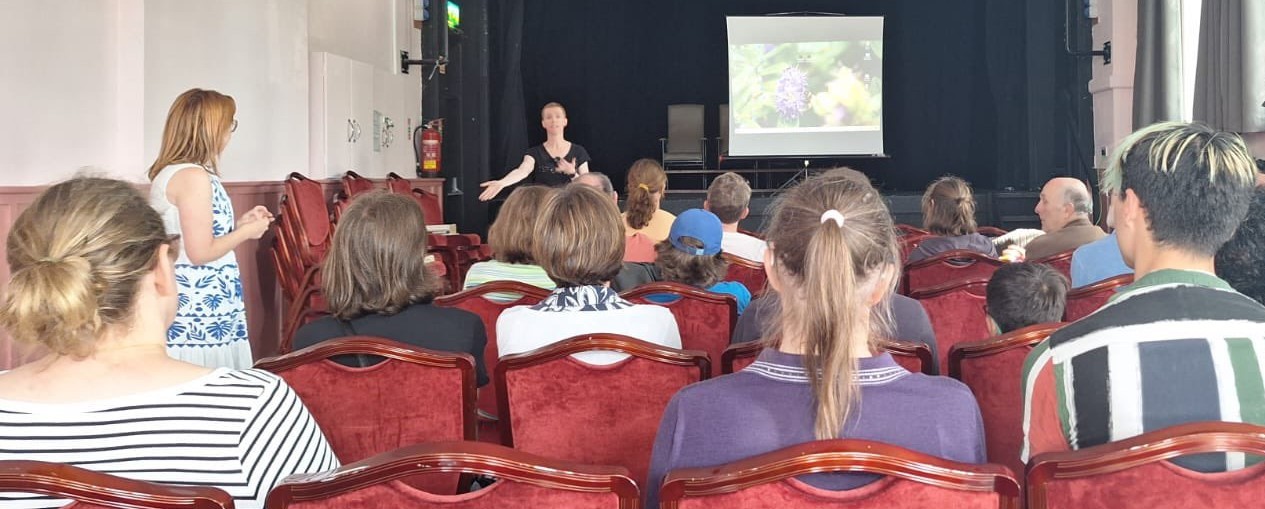
The ECO Talks session took place on Sunday 3rd September 2023 in The Little Theatre. In the nearby Old Schoolhouse, ECO Fair stalls were in full swing, facilitating a flow of people in and out of the two events, according to personal time and interest.
Events aimed to inform on a wide range of topics including conservation of energy; marine; river and birdlife; biodiversity, waste reduction & management, the work of Skerries Tidy Towns and on promotion of active travel.
The extent of local group initiatives and activities, which are establishing strong roots, were presented. This session also aimed to inspire residents to take further action to protect and enhance our town’s natural beauty and sustainability.
Nine speakers, including local and external experts, gave short presentations, followed by Q & A’s.
We covered the first three talks (on the Skerries Mini Orchards, on rewilding the Mill Stream and one with bike repair & cycling tips, in a previous blog post, Afternoon Talks 1-3 of the Skerries Eco Festival 2023.
Here is my summary of the next three talks:
Why I quit my job and started the world’s first eco toy store- Sharon Keilthy (jiminy.ie)
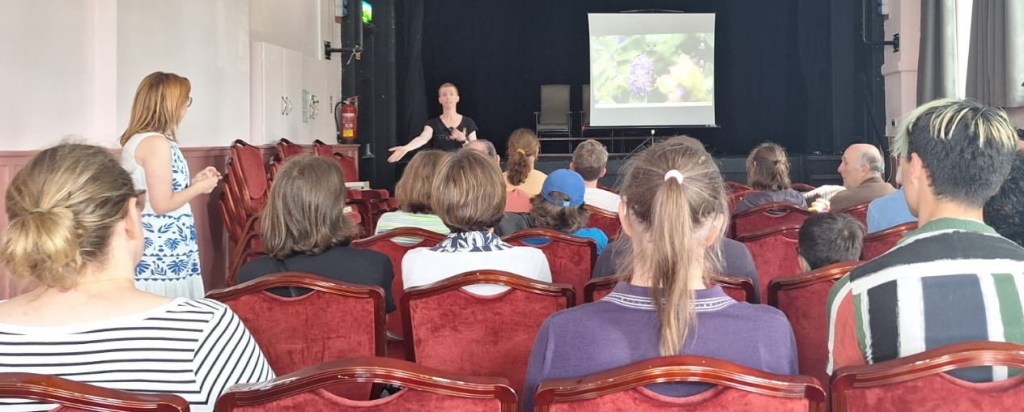
Sharon Keilthy of jiminy.ie impressed the audience with her personal story on why she quit her job and started the world’s first eco toy store. While out shopping for an “Eco friendly, made in Europe” present for her daughter’s birthday, she failed to find what she went looking for, and so was inspired to set up her own business. She spoke passionately, conveying a depth of research and knowledge of the plastic toy industry. 90% of toys are made from virgin plastic (originating from petroleum), and transported a 22,000km from China. Surprisingly, 90% of the carbon footprint from toys come from the plastic and not the transport process. Sharon uses plastic free materials, made from sawdust and recycled cups in her toys, all made in Europe. Of the 4 big Global toy makers, Lego appear to be the only one who are serious about sustainability, with a pledge to be totally sustainable by 2023. It is not surprising with her vision and drive that Sharon is currently engaging with some of the top toy makers in the world including Mattel.
Update:
Since setting up her business in 2018 Sharon has learnt much about what makes a toy sustainable. She shares this knowledge and experience, engaging regularly with key toy business communities and committees, including:
- The Women in Toys Sustainability Learning Community (Co-founder)
- Sustainable Toys Action Consulting (Co-founder)
- The Toy Association (USA)- (Committee member)
- Otis College, LA, Toy design students (Guest lecturer)
- Sustainability monthly columnist for Spielwarenmesse’s Spirit of Play magazine and Sustainability member for their Toy Award judging panel 2024.
In January 2024 Sharon gave a presentation at the world’s largest toy trade fair- Spielwarenmesse, in Nurnberg, Germany- “Sustainability is becoming mainstream in the toy industry-are you ready?” Here she gave her view on 8 main business cases for sustainability: 1. Moral – sustainability is the right thing to do; 2. Profit – if sustainability maximises profitability; 3. Competition – to retain market share there is the need to match or beat competitors’ sustainability levels; 4. Funding – banks or investors need to see sustainability to lend businesses money; 5. Risk – sustainability avoids/reduces risks to business continuity; 6. Talent – people want to work for sustainable businesses; 7. Brand/reputation – society will judge on our sustainability; 8. Regulation – regulators like the EU will mandate or incentivise sustainability.
Indeed the 8 business cases could be applied to businesses beyond the toy industry. There are 2 EU regulations upcoming that should have positive impacts on sustainability:
- Corporate Sustainability Reporting Directive (CSRD) – like an annual financial report but for sustainability.
- Ecodesign for Sustainable Products Regulation (ESPR) -expected to be effective 2026.
Ecodesign for Sustainable Products Regulation for toys at a glance:
- Requirements / incentives to improve products’ sustainability including carbon footprint, use of post-consumer recycled materials, durability, reparability (e.g., availability of spare parts and repair services), and recyclability;
- Better labelling / information to help shoppers and business buyers choose more sustainable products and get them repaired (including a Digital Product Passport and the EU Ecolabel);
- Potentially mandating ‘green’ public procurement;
- Making it illegal to destroy unsold goods
It is wonderful & inspirational to see a local Irishwoman make such a positive impact on the global toy industry.
A Cleaner, Greener Town- Maeve McGann and Emer McLoughlin (Skerries Tidy Towns)

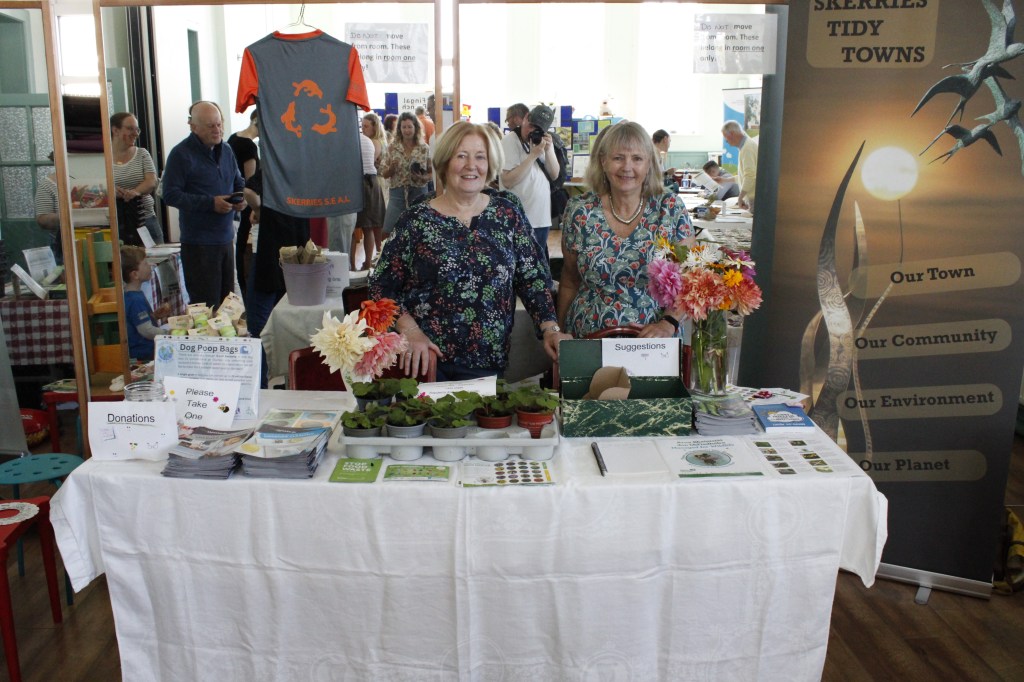
Skerries Tidy Towns (STT) committee representatives took the floor, to educate and encourage on “A Cleaner, Greener Town”. Like Sustainable Skerries, Skerries Tidy Towns is one of the many committees of the Skerries Community Association.
With the changing nature of the national Tidy Towns competition, STT lobbied to have a name change. A subtext was added eventually– Tidy Towns, caring for our environment. The aims of TT’s competition is “to improve the local environment, making it a more attractive, cleaner and sustainable place to live”.
Tidiness and Litter control of a town’s environment has been synonymous with the competition, (still accounting for the section with the largest number of marks assigned-90). Maeve rightly pointed out though, that when we reflect fully on litter (including dog poo on our beaches-please BAG IT. BIN IT) and specifically on the detrimental impact that plastics, (in all its forms-micro and macro) has on sea life, plastic litter control should be right up there in terms of protecting our marine environment. Examples of the great work STT do include the “Adopt a Patch” and SEAL (Skerries-Everyone-Against-Litter) schemes, with weekly litter picks. Removal of litter and dumping from the Mill stream (or Brook), has been managed, since the beginning of COVID, by its nearby resident, Dara Mac Domhnaill and his team of “Stream Huggers”, working as a subgroup of STT.
Nature & Biodiversity and Sustainability are now key environmental sections of the TT competition (55 marks each). Biodiversity can be defined as the variety of all living things and their interactions. It supports all life on earth. Without biodiversity, our entire support systems for human and animal life would collapse. What can we do to protect biodiversity?….Avoid using chemical sprays; leave space in our gardens for wildlife; allow gaps in walls and fences for hedgehogs to pass through; keep some undisturbed leaves in Springtime, so that insects can shelter until the weather warms up. What has STT done in terms of biodiversity? They have worked with Fingal County Council over several years to reduce the cutting of grass in specific areas of the town, while retaining the cutting regimes for its playing fields. STT support “NO MOW MAY”, to allow the dandelions (providing a unique and limited source of pollen in early summer) to bloom in gardens and grass verges. Additional Biodiversity activities include the establishment of native pollinator friendly wildflower corridors and corners in the town, and wildflower seed and native tree planting around the stream.
Sustainability can be defined as any theme or project where a negative impact of the environment can be reduced (e.g. food and clothes waste, water conservation through use of water butts). STT measures to address Sustainability include the use of compostable cups by all coffee shops in the town. But there is acknowledgement that we have some way to go to rid the town of disposable cups. Meanwhile, the “Keep Cup” campaign is encouraged, to bring your own cup to the coffee shop, as is re-usable water bottle use, to reduce plastic waste. Many cafes and bars have signed up to refill water bottles for free. In the past, STT supplied water butts to anyone who adopted a flower pot or window box. Indeed, you can install a water butt in your own garden to conserve water during heavy rains and drought. The Tidy towns group supports Voice Irelands initiatives of 2nd hand shops. They report that clothes production releases 1.2 billion tones on greenhouse gas emissions every year. So change the way you think about shopping- don’t think you have to buy the latest fashion and don’t get distracted- shop for what you only need for your wardrobe. The same applies for food waste…buy only what you need, eat what you buy, keep food fresh and avoid the bin. This advice is not only sustainable for the environment but also for your purse or pocket.
Other key TT sections include Engagement with the community (schools, businesses, and 3rd parties), Streetscape, Public Parks and Buildings. Examples of STT’s heritage preservation are the beautiful limestone kerbs and cobblestones; conservation of the quality of many old shopfronts in the town; preservation of heritage buildings such as the thatched cottages of Skerries. Fingal County Council and Abarta heritage have collaborated on an audio guide for Skerries- www.abartaheritage.ie. Under the Greenspaces & Landscaping section, STT have planting native trees, wildflowers and plants. When it comes to community sustainability, use recycling facilities, and don’t leave empty boxes or bags behind. Never litter. Clean the kerb outside your house or premises. Use 2nd hand shops when you can. We all have a personal responsibility to our town and planet.
New Skerries Tidy Town volunteers are welcome at Quay Street shed, where they tend to meet at 2 pm on a Monday. Email maevemcgann@gmail.com or email to tidytowns@skerriesca.com or follow on their Facebook page.
The presentation displays best on a computer. You can also open it at this link: Link to presentation
Protecting our Marine Environment- Michael Walsh (Coastwatch Ireland, Fingal Branch)

Michael Walsh, representing another key environmental conservation organisation – Coastwatch Ireland (Fingal branch), took the floor to talk on “Protecting our Marine Environment”. This was a timely presentation, as Coastwatch Irelands annual citizen science shore survey is carried out from 15th September to 15th October. Michael guided us through the survey form, how to find and book a survey area (a 500 meter stretch of coastline), how to access trainings and reference materials (online and in person) and how to execute and submit survey findings. The survey covers several fields, including type of hinterland and inflows to sea (with nitrate and nitrite testing). A large section on biodiversity, including plant and intertidal seaweed types, invasive alien species, intertidal fish and invertebrates (e.g. sea anemones, clams, barnacles, limpets, crabs, shrimps), marine bivalves (e.g. cockles, muscles, oysters, razor shells) litter, waste and pollution. The public launch of findings of the autumn survey 2023 took place online on 4th December Survey Results | Coastwatch Europe. All accessible survey sites along Skerries coastline were surveyed this year. (Estimated to be between 30-40, as it’s difficult to determine where Skerries starts and ends).
 Sustainable Skerries