Less Guilt More Money
Or in full: How to Feel Less Guilty About Climate Change and Make Some Money
- Guest Post by Adrian Kelly, Skerries Sustainable Energy Community Initiative
Are you feeling guilty about the climate catastrophe and feeling powerless to do anything about it? Well did you know you’re not really “power”less and shock horror you can actually gain financially by taking more control of your “power” Society’s challenge of getting to net zero carbon emissions is almost entirely dependent on decarbonising the electricity grid and shifting the electricity grid to renewables. But all of this starts at home.
Here’s six steps to feeling less guilty about the state of the climate with the added benefit of making yourself some extra money for you and your family.
Step 1 – Reduce your Electricity Use in General
Feel less guilty: Burning less fossil fuel to power your lifestyle.
Make Money: Your electricity bills will reduce, important as electricity prices rise over time and financial supports from government for electricity bills may no longer be available.
Be conscious of how and when your family using electricity. But focus on the big electricity guzzlers such as appliances (use eco modes), electric showers (don’t stay too long), kettles (boil only what you need) ovens (use air fryers instead). Before next winter switch your lighting to LED. With a smart meter you can access your electricity data for every 30 minute period from ESB networks by signing up here: https://www.esbnetworks.ie/services/manage-my-meter/view-my-smart-meter-usage
If you are working on step 1 – well done! Feels good eh? Now let’s keep going, we can do much better!



Step 2 – Use Less Electricity at the Evening Peak
Feel less guilty: Peak electricity is almost entirely fossil fuelled, and you are helping reduce electricity prices.
Make Money: Get paid vouchers regularly by ESB Networks for reducing power when they ask you to.
Particularly in winter, the period between 5PM – 7PM is the most expensive for grid operators as this is the time everyone turns on lights, ovens. So, build on step 1, try to drastically reduce your use in this period. You almost certainly don’t your washing machine or dishwashers running at this time, although your air fryer is harder to avoid using! Can you delay a post work or exercise electric shower until after 7PM? Sure, you can! ESB offer an incentive scheme to periodically reduce your electricity use during stressed periods. They text you, you reduce your use, complete a one-question survey and they email you a voucher. So, you can get rewarded for conscientious electricity use.
https://www.esbnetworks.ie/services/manage-my-energy-use/beat-the-peak-programme/
Feeling less guilty and getting paid for it and we’re only at step 2!
Step 3 – Shift your Electricity Use to the Middle of the Night
Feel less guilty: Electricity in the middle of the night is much more likely to be renewable wind energy that would be wasted otherwise.
Make Money: With a time of use tariff electricity used in the middle of the night is about 25% of the cost of daytime electricity. Especially important for EV drivers.
Illustrative example of electricity uses in Ireland during a typical December day and April day. The more electricity used the more expensive it is for everybody so its best if we can sift evening peak load to the middle of the night Source for Data: EirGrid
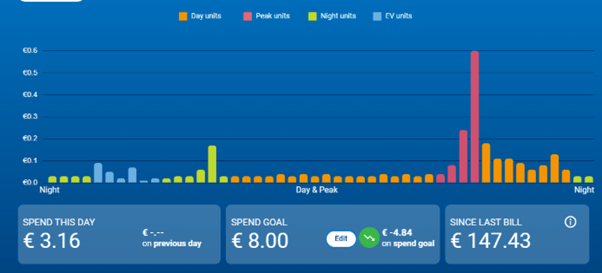
Electricity (unfortunately) has to be consumed exactly when it’s produced (mostly) so the grid is always in a constant state of equilibrium. Luckily, people are habitual and generally use electricity at the same times every day. However, this poses a challenge for maximising use of renewable generation. The sun doesn’t always shine, and the wind doesn’t always blow hard when we need it (5-7 PM in winters remember?). It’s an open secret that we waste massive amounts of electricity at night when the wind is strong, and demand is low. You can help this situation by shifting your use of electricity from daytime to nighttime. Set appliance timers to come on between 2 AM-5AM. Electricity supply companies incentivise this shifting by offering tariffs that are expensive between 5-7 PM (about 40-50c) and cheap between 2-5 AM (5-10c).If you have an EV or hybrid car and do significant driving, you might want to consider a time-of-use tariff set to charge at night to avail of the cheaper rate. Even if you don’t use a time of use your charger to come on during the night to use this excess wind energy.
The cost of charging a 77 kWh EV (a VW ID4) from 0-100% over four nights (25% per night) at 7c per kWh is €5.88. Thats about €0.01 per km (assuming a 400-500 km range).
The equivalent spend for a patrol car is between €0.11 per km or €0.08 c for a diesel car, according to the SEAI statistics.
Example of a time of use tariff and energy use. Source Bord Gais Energy
Now you’re becoming an active electricity user, but you can do even better!
Step 4 – Use the Sun to Power your Home
Feel less guilty: Power your home directly from free, clean solar energy, becoming less dependent on fossil fuel powered grid electricity.
Make Money: While the initial outlay can be considerable, the cost savings period is reducing, when compared to continuously rising higher electricity prices.
You’ve probably seen black solar PV panels covering the roofs of Ireland in the past couple years and wondered what’s the deal? While we don’t get year-round sun we do get daylight for most waking hours for 6 months of the year. With reduced cost of PV technology and incentives and a range of very good installers, installing rooftop PV is economical with payback periods of less than 10-12 years typically (and lower depending on how you maximise the use of the panels). An 8-10 panel system will cover most electricity use for most houses, especially from March-October. The systems can also be configured to heat immersion hot water systems when over producing so you have always on hot water. Once installed you don’t need to think about it (except to use your heavy-duty appliances when it’s sunny) but you can track usage with cool phone apps.
At this stage you are using clean free energy to power your home but there’s also an added benefit.
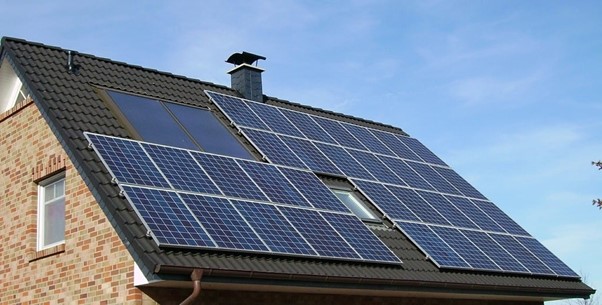
Solar PV panels on a rooftop Source CC
Step 5 – Get Paid for your Excess Solar Electricity
Feel less guilty: The excess solar power you produce is not wasted, sent back to the grid and likely to be used locally to power their homes and businesses.
Make Money: You get paid directly by your electricity supplier via credits on your bills every quarter. Handy when the winter bills arrive.
that electricity produced always has to be consumed instantaneously? Unlike the wind power at night which cannot be used if there is no demand, domestic solar production has no such issue as everybody is up and using electricity in the middle of the day. Any excess electricity you produce gets automatically sent back out to the grid and you now actually get paid for it. At the moment the price is somewhere between 15c-20c per kWh sent out, depending on your supplier. This is typically aggregated and paid as a credit on your electricity bill every quarter. So if you have 8 solar panels fully producing for an hour you get about €0.56 back. Not bad but scale that out over multiple hours, multiple days during summer and the savings add up to hundreds of euros. This will be useful in winter isn’t shining and your electricity use is higher. The more you can produce, the shorter your payback period for the installation will be!
Step 6 – Store your Energy
Feel less guilty: Become entirely self-sufficient and less reliant on fossil fuel grid, with your home powered by clean energy, even when the sun isn’t shining.
Make Money: Over the long run, your electricity bills will reduce, and you will be less exposed to electricity price hikes and reductions in the revenue from the excess production.
Your final step to becoming a true electricity prosumer (producer-consumer) is to put it all together with a domestic battery system. Most solar PV installers will offer the option to install a domestic battery system with your PV system. These systems allow you to use your excess solar energy to charge a battery in your home (before sent to the grid) and discharge it when the sun isn’t shining, or during expensive periods (5PM-7PM) if you use a smart . For example, if you have an EV and rooftop solar PV system with a battery you could charge up your battery with excess solar energy during the midday solar peak, and then when the sun goes down, discharge the battery to charge some of your car battery (if you do this in the middle of the night it’s likely you will charge your car from fully renewable sources). In winter if you are of-use tariff the battery can be set to charge in the middle of the night at a lower cost and to discharge between 5-7 PM which offsets the difference in electricity price, and maximises clean energy use. Battery systems will increase your revenue, as it will reduce the amount of money you spend on electricity, but they do cost more so will likely increase your payback period for the entire system. The precise revenue, costs and payback times are dependent on well you optimise your energy use in your home. Additionally, batteries can provide resilience your home. By installing a switch on the battery, it can be used to power your home during grid outage periods.
So, there you have it…6 steps to maximising your use of clean electricity in the home, reducing your electricity costs, and doing your bit for the environment and the next generations while feeling less dread. While your home might seem small, relative to the world, taking a stepwise approach harnesses the power of collective efficacy – where small steps taken by everybody add up to a sustainable, resilient energy system. An energy system we are not just a part of, but in control of.
So, which step are you on?
Be part of the community oin the SSECI WhatsApp chat for Q&A, advice and helpful hints: https://bit.ly/SSECI-Chat
Facebook: https://www.facebook.com/groups/skerriesseci/
Email: skerries.seci@gmail.com
 Sustainable Skerries