Annual Meetings 2025 and 2026
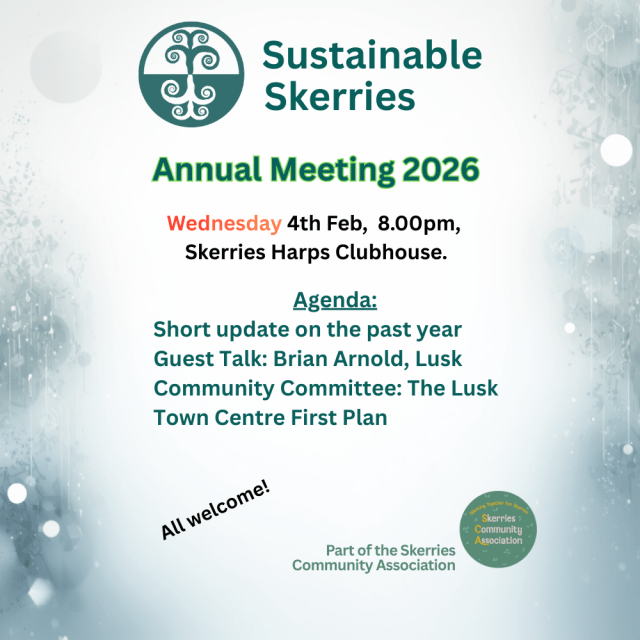
We are inviting all interested to join us for the 2026 Annual Meeting on Wed 4 February 2026, from 8 pm, in the Skerries Harps Clubhouse. The evening will consist of an illustrated look back on our work (we = Sustainable Skerries, a committee of the Skerries Community Association) over the last twelve months and a presentation on the Lusk Town Centre First process by Lusk Community Association chair, Brian Arnold. Given that our own Skerries Town Centre First process is about to kick off, that should be very interesting! There will be time for chats afterwards, and nibbles have been promised.
Here are the draft minutes of the 2025 meeting:
Sustainable Skerries Annual Meeting
28th January 2025, 8pm GAA Club Skerries
- Introduction
Sabine McKenna, the outgoing chair of Sustainable Skerries introduced videos of what Sustainable Skerries has been doing over the last year: The Skerries Sustainability Ripple Effect (the video for Pride of Place award, for which Sustainable Skerries was nominated by Fingal County Council in 2025) and Skerries Eco Festival 2024. She recommended subscribing to Sustainable Skerries and Fingal County Council’s YouTube channels for further videos. She then gave an overview of the meeting agenda and introduced the guest speaker Adrian Kelly from Skerries Sustainable Energy Community Initiative.
- Adrian Kelly – “Sustainable Energy and You, Production and Consumption of Energy in Ireland”
Adrian introduced the Skerries Sustainable Energy Community Initiative (SSECI), which like Sustainable Skerries is a subcommittee of the Skerries Community Association. He invited everyone interested to join their WhatsApp chat group, where people can ask questions and get useful information on sustainable energy.
Adrian then explained the focus of the talk – on how each person can optimise their energy use for a sustainable future, linking the macro picture of electricity in Ireland to individual home energy use. He explained where Ireland’s electricity comes from, primarily from renewables (c.40% in October 2024) and natural gas (c. 48% in October 2024). Natural gas price is a key driver of electricity prices in Ireland. He explained the rationale for moving more electricity generation to offshore wind (energy demand is growing, renewable energy use has plateaued at c.40%, onshore wind development is constrained by network grid capacity and planning gridlock, and demand centres are at the coast).
He then explained how electricity demand rises over the day, peaking between 5 pm and 7 pm. Much of the renewable energy generated at non-peak times (e.g., during the night) is currently wasted. So, what can we do about this? We need to flatten and reduce the electricity demand curve.
Adrian explained that solar panels can be used to decarbonise electricity use in the home during the day, serving to reduce the demand curve. He discussed some of the considerations involved in getting these, with further information available in the SSECI WhatsApp chat group.
He then explained how smart meters provide data on electricity usage (which is available to everyone with a smart meter even if not on a smart meter tariff (see https://www.esbnetworks.ie/existing-connections/meters-and-readings/my-smart-data). This can be used to analyse where your energy is being used and support behavioural change, even without using a smart meter tariff (by moving electricity usage to off-peak times where possible). He then explained the different types of smart meter tariffs and the considerations involved in choosing one. The idea behind these is to flatten the demand curve by encouraging more usage of electricity outside of current peak times through price incentives. For example, EV owners can benefit from smart meter tariffs by charging their cars at cheap rates during the night. There was concern in the audience that people can’t switch back to a fixed tariff from a smart meter tariff. Plans should be carefully researched before switching. There was also concern expressed about electrical appliance failure causing fire during the night, another audience member responded that this was highly unlikely with modern appliances given EU safety standards.
Adrian then noted the ESB “Is this a good time” programme, where people receive texts when the grid is stressed to reduce use, with rewards (e-vouchers) available for participation. He encouraged everyone to sign up for this.
He provided a list of useful links for further information (see slides).
Further audience discussion focused on the benefits of solar panels (including the addition of a battery and a switch to allow off-grid usage if the grid is down, noting these are non-standard and have additional costs). EVS can charge a house also in a power outage with the right equipment.
On smart tariffs, communication from providers is essential as take-up has been slow.
Sabine thanked Adrian for his excellent talk and said the slides would be distributed after the meeting.
- Sustainable Skerries Committee Formalities
Sabine thanked three members who left the committee during the year – Ernestine Woelger, Evelyn Cottell, and Sarah-Jane Cullinane. She welcomed new members Katie Lattimore and Sara Reddy. New members are always welcome. Regarding finances, the accounts form part of the SCA accounts and will be available for the SCA annual meeting.
- Committee Overview
The leads for each work area provided updates on their work during the year:
- Biodiversity – Charlie and Marion Heasman
- Open Orchards and Online Presence – Sabine McKenna
- Water Project – Helen Scullion
- Pride of Place, Eco-Festival, Cuppa for Climate – Sara Reddy
- Forest School – Breda Naddy
- Beach Box and Consultations – Miriam Sweeney
The new chair, Katie Lattimore, introduced herself and spoke about how excited she is to take on this role and she is looking forward to working with everyone.
- Launch of the Skerries Eco Town Booklet
The idea behind this booklet is to share sustainability information widely throughout the town, as so much happens throughout the year. Sara Reddy led this piece of work. Sustainable Skerries is very grateful for the sponsorship from Gerry’s store and the Progressive Credit Union. Sean Staunton, Progressive Credit Union manager, spoke about the credit union’s commitment to sustainability, with a community fund available to support sustainability initiatives. He highlighted that Progressive Credit Union will launch low-cost loans for home energy retrofits shortly. Sabine noted that the Eco Town Booklet is available for attendees and will be distributed more widely soon.
- AOB/Discussion
The Sustainable Skerries Committee thanked Sabine for her wonderful job chairing the committee for the past4 and a half years and made a small presentation.
Sabine encouraged everyone to join the Sustainable Skerries WhatsApp chat group if not a member already.
The following were also raised in the discussion
- There is a new working group in the town considering sustainable transport, set up by the SCA
- The new library will have a maker space, the Sustainable Skerries Committee is looking for someone to lead organising repair cafes
- Janette Scott, the FCC community officer, highlighted funding available for International Women’s Day (8th March) events.
- Janette also highlighted that groups in the town can register with the Public Participation Network (PPN), if they haven’t already, and the PPN newsletter will return soon.
 Sustainable Skerries