Festival Blog: Saturday: Water Management in Skerries Walk and Talk
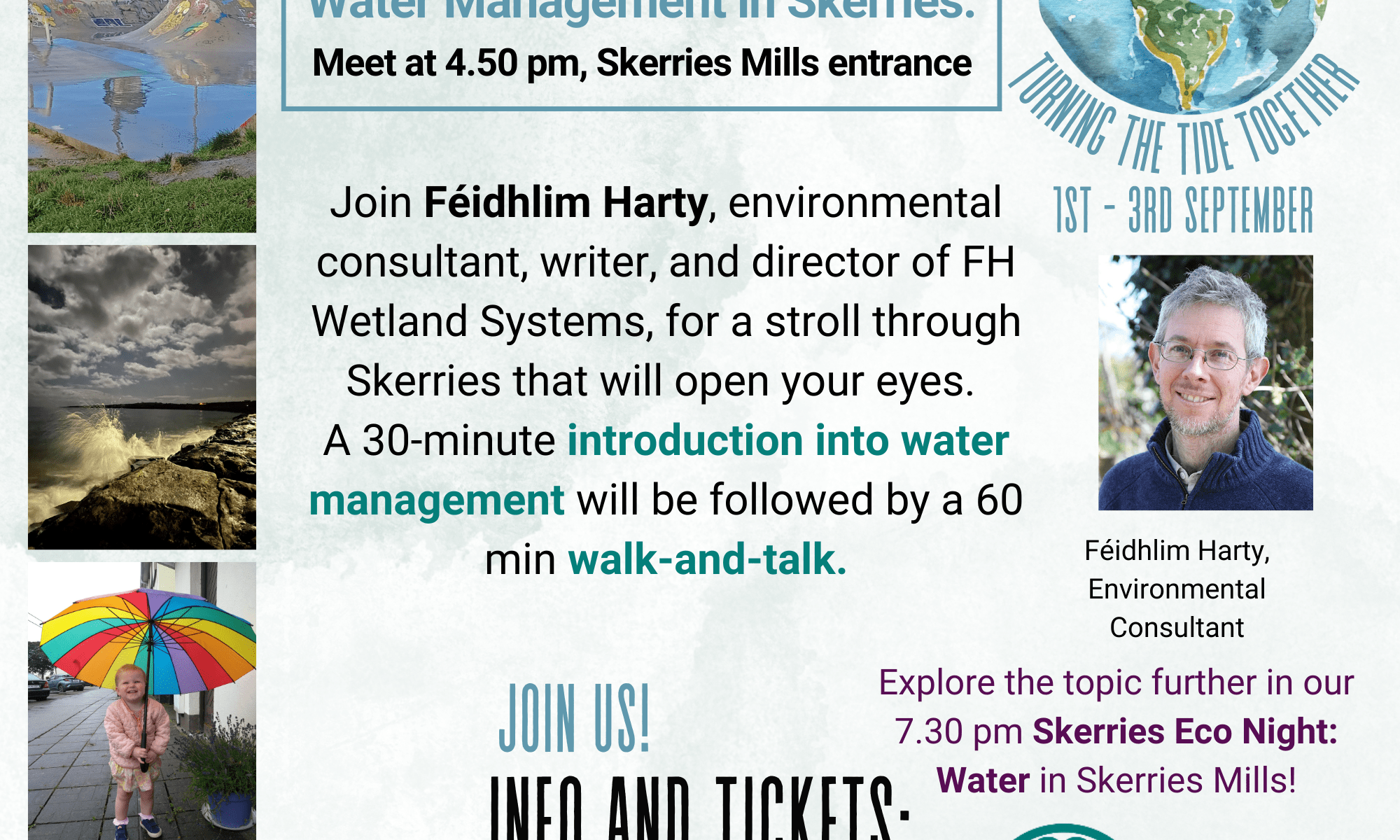
Continuing our series of blogs about individual events at the recent Skerries Eco Festival, Dara Mac Domhnaill, himself actively protecting the biodiversity and water quality of the Mill Stream as part of the local group “Stream Huggers,” gives us an insightful summary of the Saturday afternoon walk and talk. He writes:
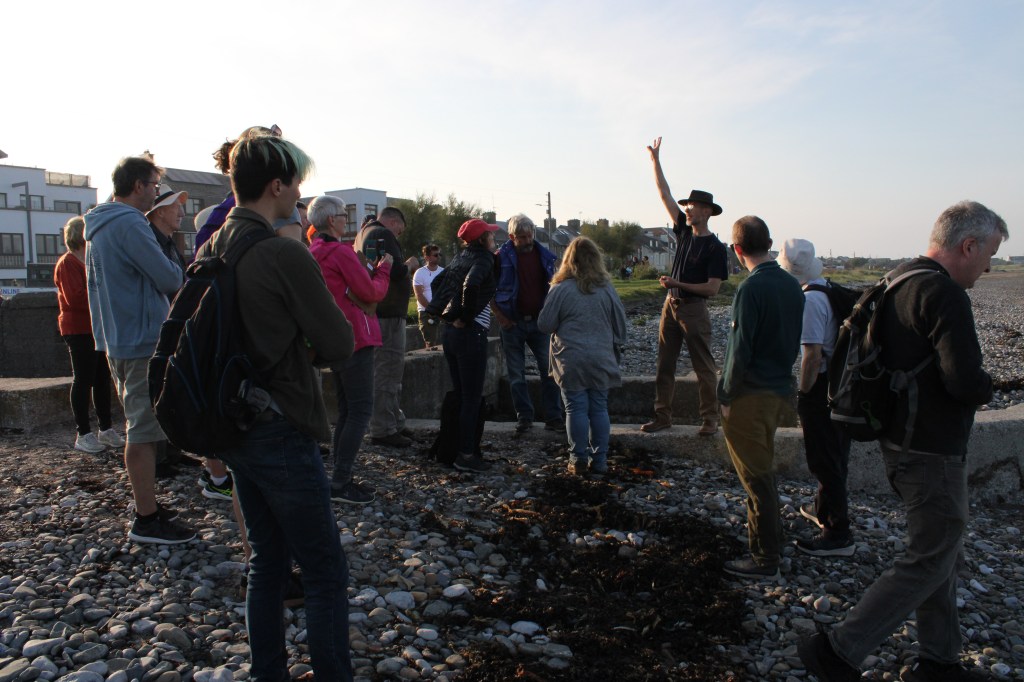
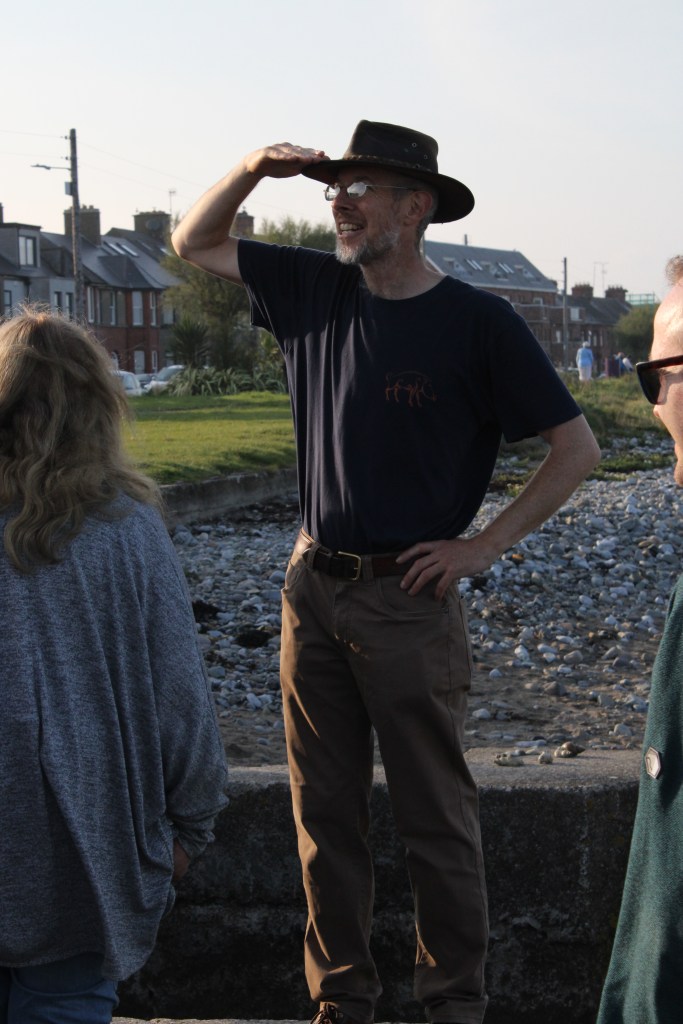
As part of the recent water themed inaugural Skerries Eco Festival 2023 Féidhlim Harty (writer, environmentalist and consultant of FH Wetland Systems) gave a talk on Floods, Droughts, Quality & Biodiversity – Water Management in Skerries in Skerries Mills followed by a tour of the lower stretch of the Mill stream (or the Brook as it is called locally) from Skerries Mills to the sea at the South Strand, with the assistance of local guides.
The slides for the talk can be viewed here.
In his talk Féidhlim provided photos of some examples of polluted waterbodies before showing some examples of measures taken to deal with such issues including pond creation and willow planting.
Féidhlim then talked through some of the many possibilities available to reduce water pollution and enhance biodiversity on farmland:
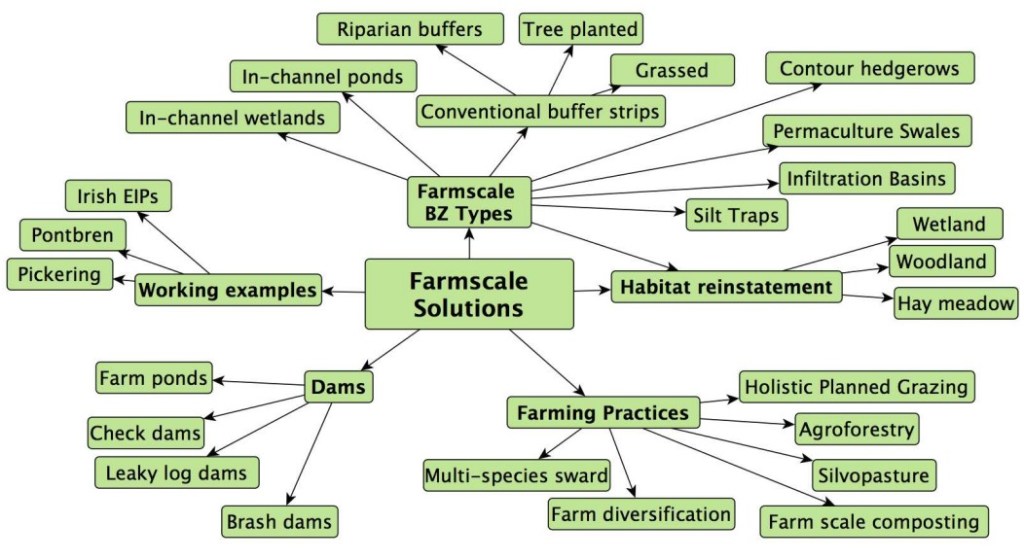
There was a specific focus on drains and how to create these.
The next focus was on what can be done to improve water quality, conserve water and reduce flooding in the domestic and urban context.
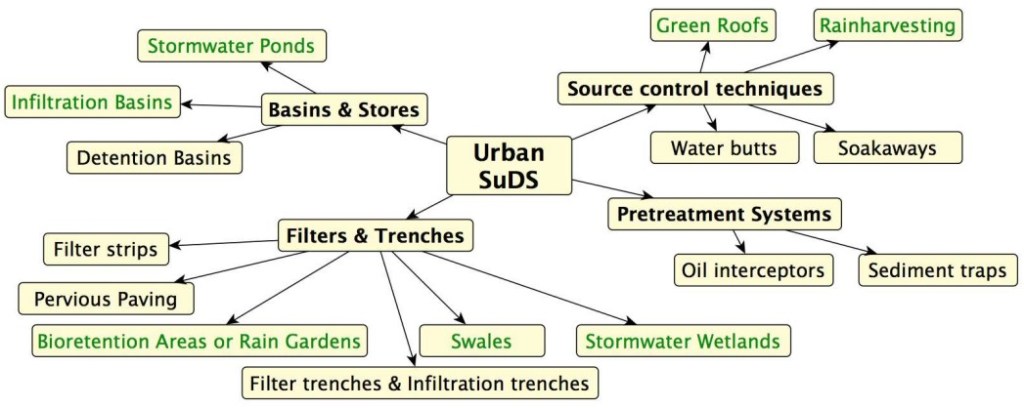
The focus here was on drainage beside roads as well as on the use of water butts and rain gardens in domestic settings.
There was some discussion of water quality in the Mill Stream. The EPA do not monitor the stream but have given it a Poor status based on modelling. However local volunteers have found that nitrates and phosphates levels are well within allowable limits. This work is done using test kits provided by Freshwater Watch.
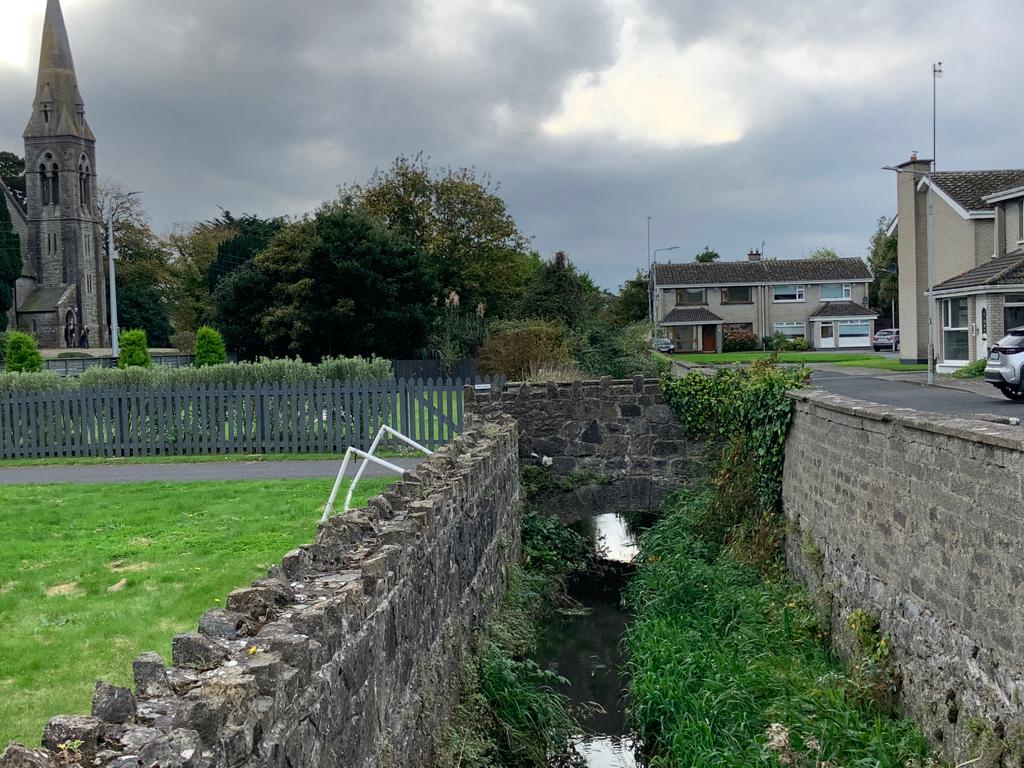
At the conclusion of the talk the group left to tour the lower stretch of the Mill stream between Skerries Mills and the sea. The entire walk was characterized by enthusiastic interest and curiosity about the stream and issues surrounding it. Féidhlim noted that the gravel on the stream bed under the foot bridge looked healthy.
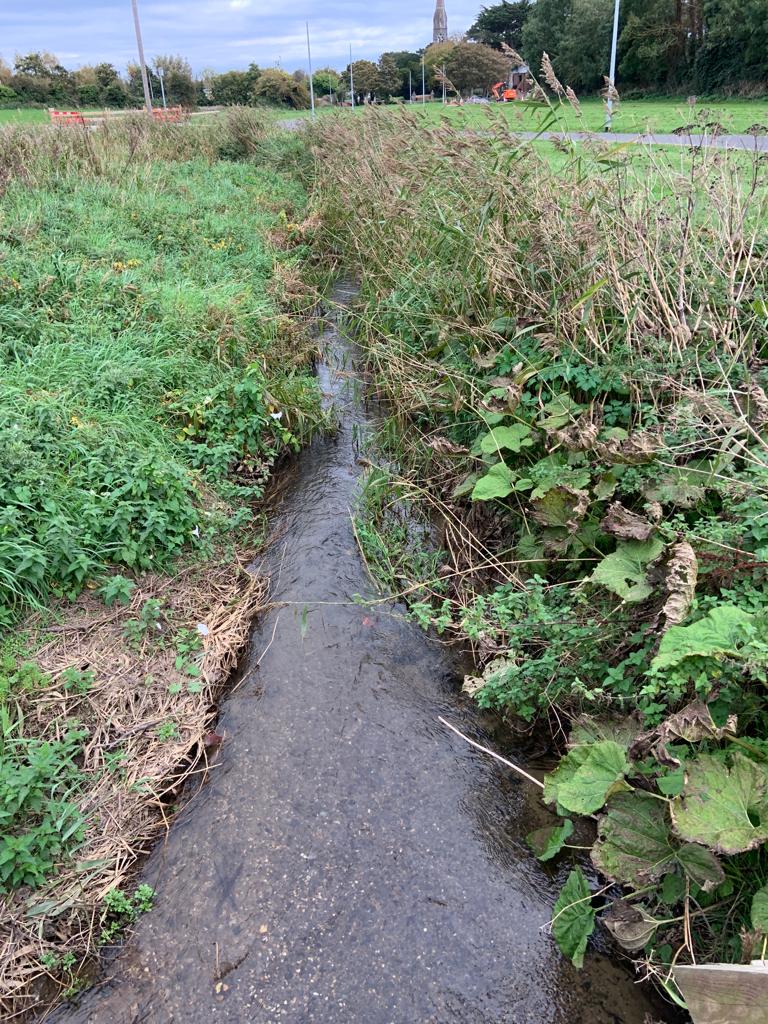
There was some discussion of the annual flailing of the bank vegetation by Fingal County Council. Féidhlim said that clusters of willow planted on the banks in this area would help with water filtration, as well as helping biodiversity and providing visual amenity for people.

There was a lot of discussion of reintroducing a meander in the lower stream area opposite skatepark. Charlie Heasman would be advocating this at a short talk the following day and it is a possibility it will be a recommendation in an ecological study of the town park commissioned by FCC and currently being prepared by Coiscéim Consulting. There has been some flooding at the nearby road area and there was a lot of discussion among attendees on this subject. See recommendation 7 below for Féidhlim’s thoughts on this topic.
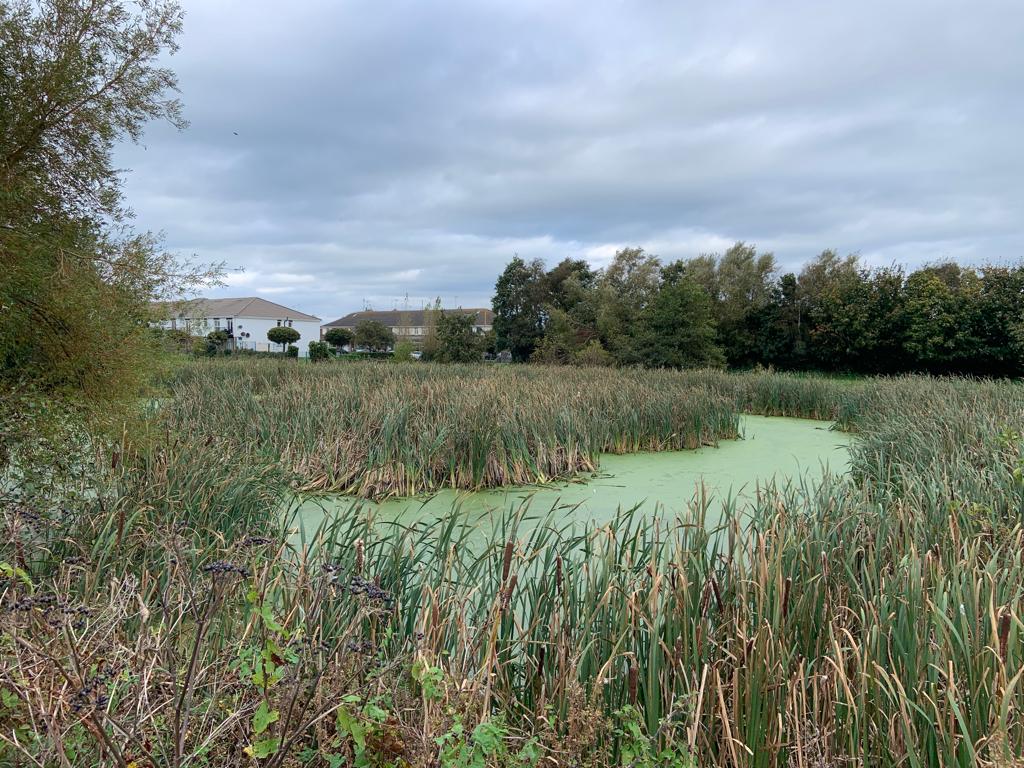
We visited the Kybe pond where the pond was covered in green, but this is duckweed rather than algae. Freshwater Watch water tests indicate good water quality. That said it is not desirable that the entire pond surface should be covered like this as it prevents light reaching the pond bed. The duckweed will die off in winter and would require mechanical removal otherwise.
We then followed the stream to the sea. In the stretch in front of the Maltings planting of common reed (Phragmites australis) and possibly bulrush (Typha latifolia), yellow iris (Iris pseudacorus) and bur-reed (Sparganium erectum) would benefit water quality and biodiversity.
Féidhlim suggested the addition of common reed (Phragmites australis) in the stretch nearest the sea would be beneficial for water quality there.
Féidhlim said that overall while the EU and national policy are moving in the direction of rewarding farmers for measures designed to improve water quality, flood management, biodiversity, carbon storage and sustainability that there is still plenty of scope for communities and activists to try and influence farmers in these directions in the coming years.
Some suggestions for Skerries
Following his visit to Skerries Féidhlim made the following suggestions for how water quality could be improved in Skerries
- Conduct a river safari to identify all piped inputs along the river within Skerries itself and to check these for potential misconnections (black water or grey water inputs into the stormwater drains). Map these and identify solutions for repair and/or filtration.
- Liaise with local farming community to assess availability of low-lying land which could be used for riparian or in-channel buffer zones – either wooded or with marsh filter plants. Also with the farming community is the potential to offer tree planting and/or hedgerow planting. This is particularly useful if planted along the contours of fields so that any runoff water passes through a curtain of vegetation at ground surface and through a curtain of roots below.
- Liaise with FCC to assess availability of low-lying land which could be used for riparian or in-channel buffer zones or stormwater wetlands; particularly upstream of the roundabout which is reported to be a low-lying area.
- Assess the potential for rain planters, stormwater wetlands, green roofs, rainwater harvesting, rain gardens / bioretention areas, stormwater ponds etc for catching stormwater runoff from paved and roof surfaces before it ever gets to the stormwater sewers or the river. This will help minimise storm surge diversion of foul sewage around the sewage treatment system in wet weather (protecting the water quality in the bay) and protect the river directly by filtering direct road runoff to the river.
- Assess the degree of treatment at the sewage treatment system and explore the opportunities for adding in a reed bed or constructed wetland or willow filter to improve the final water quality prior to pumping out into the bay.
- Introduce a habitat management process for local farmers and landowners to provide ponds, in-channel wetlands, hedgerows, woodland pockets etc. for holding and filtering water; also, for promoting farm-scale composting for building soil carbon and drought resilience across the catchment.
- If meandering the river as proposed, consider lowering the land in this area considerably to act as a flood plain as well as meander. This will improve habitat and reduce the potential for flooding of houses between here and the sea by providing storage volume. Also, explore the potential for raising the water level across the new meanders at the same time by using a raised stone riffle area at the downgradient end of the field (near the bridge by the Kybe Pond). This should only be done after assessing the topography of the stream bed back up along the stream and ensuring that existing gravel stream bed areas will not be inundated by standing water due to the works. A flood studies report may also be needed, as might an ecological AA (appropriate assessment) and possibly a NIS (Natura Impact Statement) and liaison with IFI, NPWS and OPW.
- There are many ways to engage the local community too – through regular talks, walks, speaker days, ecology field trips, citizen science events, bio blitz events, beach, and river clean-ups, Coastwatch participation, bat walks, bird walks, insect and plant identification events, young scientist projects, farmer walks and events, local business events, TidyTowns events etc. There is a very strong start already with the Stream Huggers 😊
Local activists, such as the Stream Huggers, Sustainable Skerries, and Skerries Tidy Towns, will be discussing these recommendations to see what is feasible and realistic and what should be prioritised in conjunction with the Local Authority Water Programme (LAWPRO), Fingal County Council and other bodies. A key next step is the expected ecological report from Coiscéim Consulting on the town park and the recommendations it will have for the stream, ponds, and environs.
Dara Mac Domhnaill, October 2023
 Sustainable Skerries