The Lie of the Land: A morning with John Gibbons
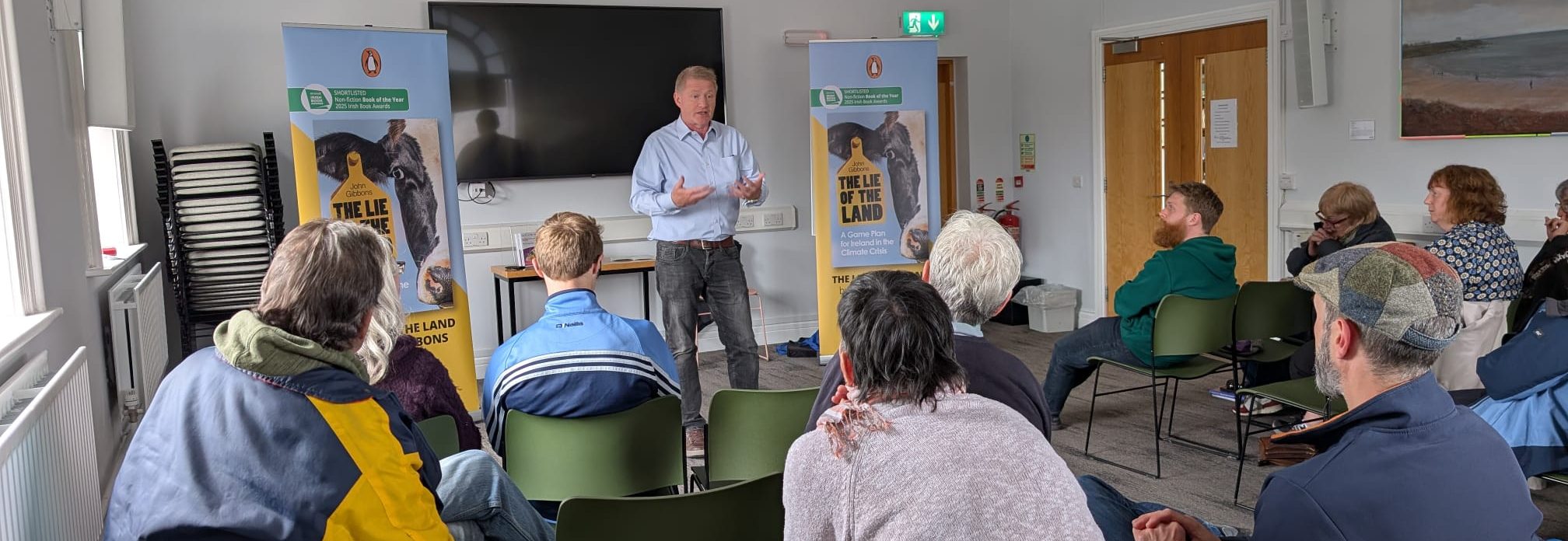
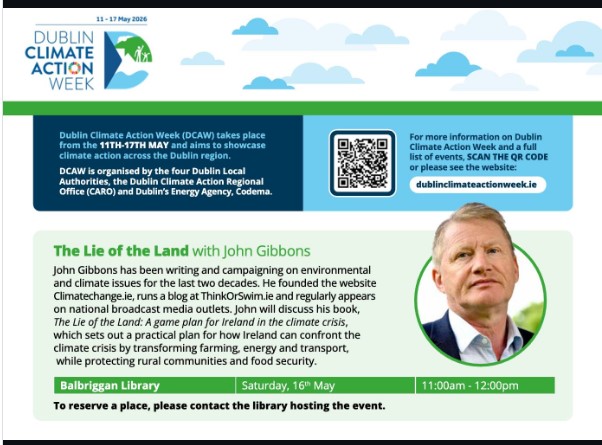
Yesterday, Saturday 16 May 2026, the author of this blog post (Sabine McKenna) went over to Balbriggan to listen to John Gibbons, journalist and author of The Lie of the Land (2025). The talk was announced as follows: “John Gibbons has been writing and campaigning on environmental and climate issues for the last two decades. He founded the website Climatechange.ie, runs a blog at ThinkOrSwim.ie and regularly appears on national broadcast media outlets. John will discuss his book, The Lie of the Land: A game plan for Ireland in the climate crisis, which sets out a practical game plan for how Ireland can confront the climate crisis by transforming farming, energy and transport, while protecting rural communities and food security.” Here are Sabine’s thoughts. You may wish to follow her on Instagram, where she has started the account Climate Thoughts from Ireland.
If I was to summarise John Gibbons’ talk in Balbriggan Library yesterday, 16 May 2026, in three words, it would be these:
- Food.
- Energy.
- Community.
“The Lie of the Land,” John’s 2025 book, has a Friesian cow on its cover. Two banners frame him as he talks, with no notes nor slides, for some 90 minutes, commanding the full attention of his audience.
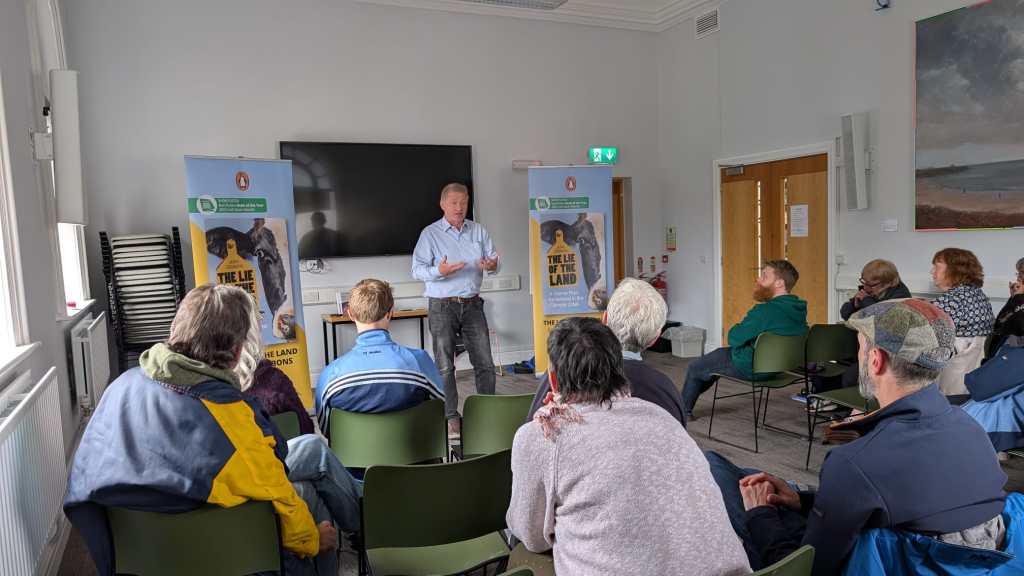
The cow is there to indicate the importance of animal agriculture to his central argument regarding food. Which is, as I understand it, that we, Ireland, are making a huge mistake in having allowed, and continuing to allow, so much of our land to be used for animal husbandry. This comes at a huge cost. John says that about 90% of agricultural produce is exported.
Rather than simply “feeding the world”, as is sometimes claimed publicly, this system relies heavily on imported feed, including grain and soy, often from parts of the world where land could otherwise support local food systems. This feed is then transformed into food, such as steak and dairy, for the international middle classes, John explains.
At a profit, he argues, which goes to larger corporations, not to small farmers – most farmers are barely making enough to get by.
All this happens not only at a huge environmental cost, it also contributes to increasing food insecurity here in Ireland. If my memory serves, John said that there used to be around 600 horticultural (veg and fruit) growers in Ireland – this is now down to some 60. We act as though international shipping is guaranteed. We rely on food imports for nearly all categories.
John is learning how to grow fruit and veg himself and recommends we all do so. He does not say this in an alarmist way, but he does point to a real risk that Ireland could face food shortages in the decades ahead. He also linked intensive animal agriculture to water pollution and biodiversity loss, reminding us that we are not separate from nature, but part of the living systems we are damaging.
And we are facing energy shortages, possibly.
Renewable energy might be able to come to the rescue there, and also help significantly in reducing CO2 and CO2-equivalent emissions. One hopeful note was John’s emphasis on how rapidly renewable energy has grown, and how central wind and solar could be to a different future.
John points out that bottom trawling of our seas causes a lot more damage to maritime wildlife than wind energy is likely to; with the added benefit that wind turbines actually protect the sea bed as the large trawlers cannot fish among them. “We need to stop burning stuff,” he says – a clear and simple message. He adds that it is not so much the individual who is at fault but the system. If there is no real alternative to the gas-burning central heating, then the individual can feel bad about continuing to use it, but will still do so.
And here we come to the third word – community. He mentioned for instance practical community-level changes, including the need for local authorities to make space for allotments and for society to rebuild the link between agriculture and the food we actually eat. When asked about the perceived backlash against environmental initiatives and pro-sustainability projects, which is tempting many eco activists to withdraw from public debate and focus on the private, John is very clear in his response. He says that it is only together with others that we can have any serious impact. We need to change the system if we want things to change. And that, I think, is the main message I take with me – while it is hard to keep going, it is also the only thing we can do, unless we are to give up. And neither John nor his audience on the day seem willing to take that way out.
PS: Our next event
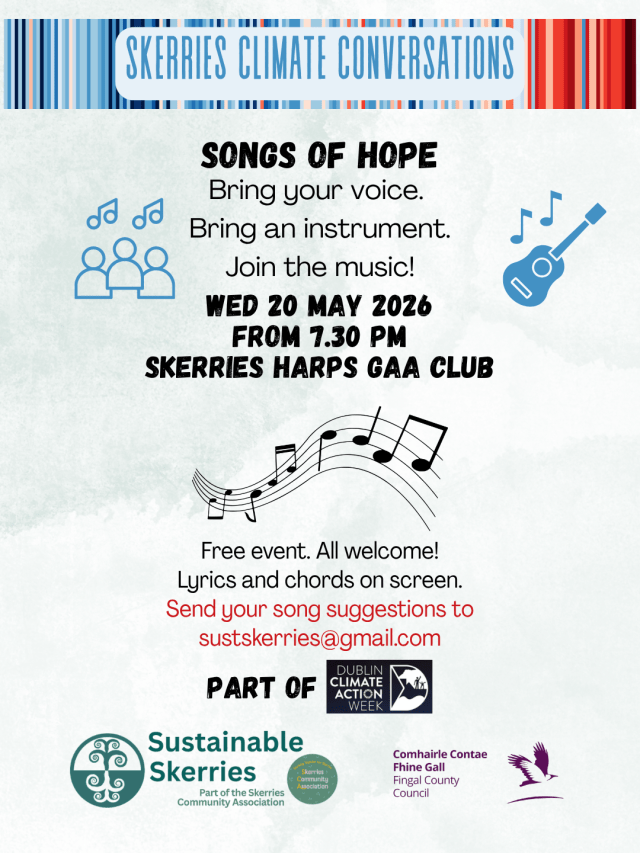
20 May 2026: Skerries Climate Conversations – Songs of Hope. 7.30 pm, Skerries Harps GAA Clubhouse


Pingback: Sustainable Skerries Submission on Climate Action Plan 2026 Priorities | Sustainable Skerries