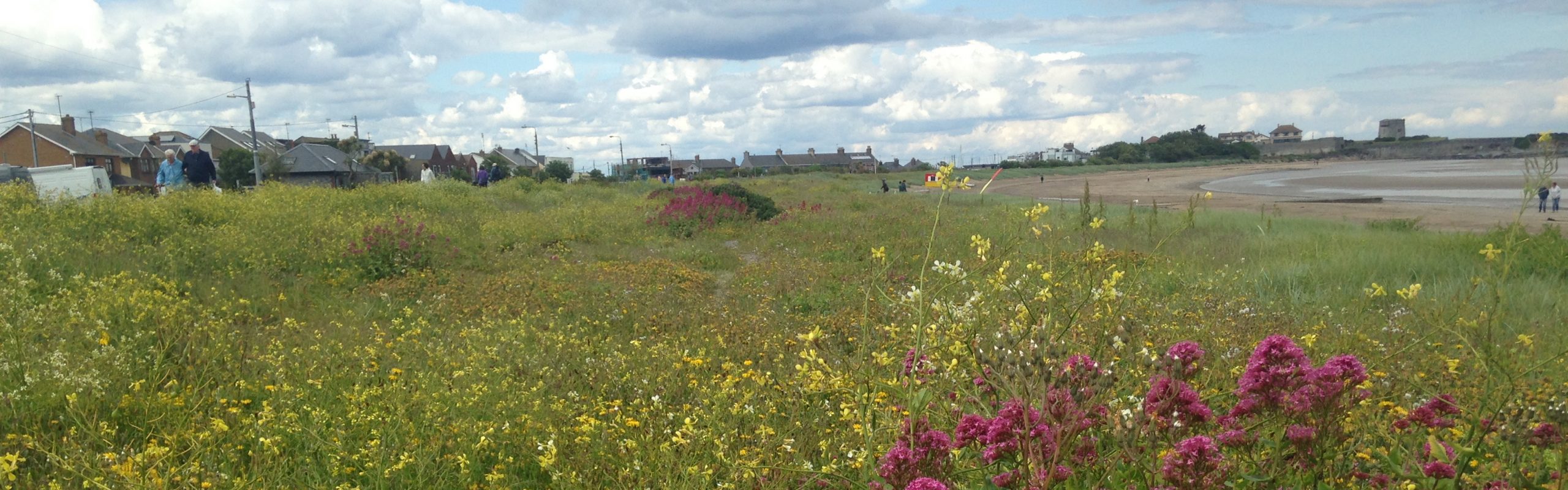
Food and Climate: What Really Matters?
Individual choices, bigger levers and the food system around us
Climate action can feel both urgent and strangely paralysing. The problem is enormous, while the difference we can make ourselves can seem very small. So where is it actually worth putting our effort?
That is one of the questions behind our monthly Skerries Climate Conversations: a chance to look at the evidence together, ask questions, exchange ideas and find practical actions that really make a difference.
And there is one thing nearly all of us do several times every day: eat.
Food really does matter. In a European Commission analysis of household consumption footprints, the average Irish footprint in 2021 was estimated at 8.9 tonnes of CO₂ equivalent (CO₂e) per person, of which 3.2 tonnes, or about 36%, came from food. This is a consumption-based estimate, so it includes the emissions embodied in what we consume rather than simply dividing Ireland’s national emissions by its population. It is also worth noting that 2021 was still an unusual Covid-affected year, particularly for travel. SEI
That does not mean food is the only climate issue, or even the most important one for every individual. How much we drive or fly, how our homes are heated, what we buy and many other factors matter enormously too. But food has one interesting characteristic: we get another chance to make a choice every day.
That was the subject of our September Skerries Climate Conversation.
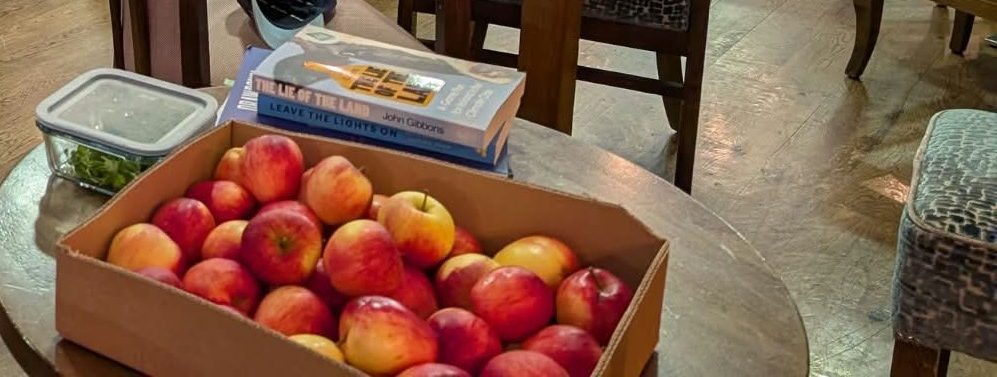
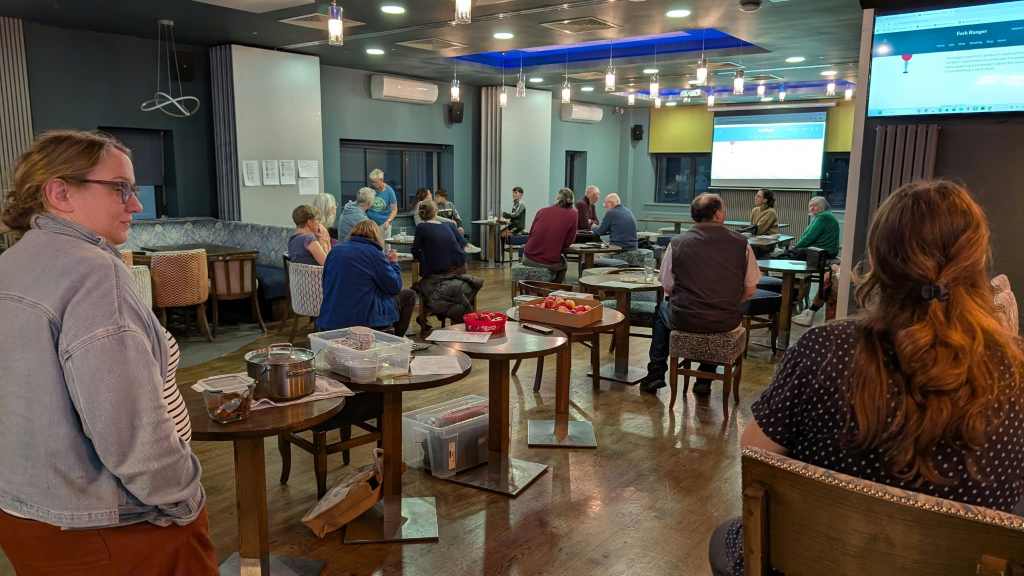
Food to taste, and food for thought
There was food to taste as well as food for thought.
Sustainable Skerries members and friends brought along easy plant-based tasters, including wholemeal pasta with tomato, tofu and chickpeas, Vietnamese butternut squash curry, and marinated tempeh. The response was encouraging. One mother came with her two sons, who were impressed enough to promise that they would each make one of the recipes at home. (We are still awaiting photographic evidence, by the way! 😁)
Here are the recipes – click to expand!
Pasta with Tomato Sauce
Wholemeal pasta with tomato, tofu and chickpea sauce
Ingredients
- Wholemeal pasta
- Onion
- Garlic
- Firm tofu
- 1 tin chopped tomatoes
- 1 tin chickpeas, drained
- Seasoning to taste
Method
- Cook the pasta.
- Chop and soften the onion and garlic in a pan.
- Crumble the tofu into the pan and cook for a few minutes.
- Add the tinned tomatoes.
- Add the drained chickpeas.
- Simmer until everything is hot and the flavours have combined.
- Season to taste and serve with the pasta.
Marinated Air Fried Tempeh (goes well with nearly any veg or salad)
Marinated air-fried tempeh
For one 200–250 g block of tempeh:
- 2 tbsp soy sauce or tamari
- 1 tbsp maple syrup or honey
- 1 tbsp rice vinegar or lime juice
- 1 tsp sesame oil
- 1 small clove garlic, crushed
- 1 tsp grated ginger
- Optional chilli flakes or smoked paprika
Method
- Slice the tempeh into strips.
- Mix the marinade and coat the tempeh thoroughly.
- Leave for at least 30 minutes if possible.
- Air-fry at about 190°C for 8–12 minutes, turning halfway, until browned and slightly crisp at the edges.
Vietnamese Butternut Squash Curry
Vietnamese butternut squash curry
Adapted from a recipe from the Happy Pear Happy Heart course.
Ingredients
- 3 cloves garlic
- Thumb-sized piece fresh ginger
- 1 medium butternut squash / pumpkin, about 1.5 kg
- 2 × 400 ml tins light coconut milk
- Juice of 2 limes
- 2 tbsp honey
- 2 tbsp curry powder
- 4 tbsp tamari or soy sauce
- 300 g tempeh, or alternatively firm tofu/mushrooms
- ½ head pak choi
- 6 scallions
- Fresh coriander
Method
- Heat oven to about 180°C.
- Cut the squash into bite-sized pieces and roast for roughly 20 minutes.
- Blend the coconut milk, ginger, garlic, lime juice, honey, curry powder and tamari/soy sauce.
- Cut the tempeh into pieces, coat with some of the sauce and bake for about 15 minutes, stirring once.
- Bring the remaining sauce to the boil in a large saucepan, then reduce to a simmer.
- Add the roasted squash and cooked tempeh and simmer for about 10 minutes.
- Add finely chopped pak choi for the final 2–3 minutes.
- Finish with sliced scallions and fresh coriander.
Alongside the eating, there were plenty of facts to digest.
Test yourself: How would you rank these?
Much of our discussion was based on the excellent Fork Ranger Compass for Eating Sustainably. Before scrolling down, how would you rank the following in terms of their climate impact?
- More seasonal
- Talk to friends and get them to eat less beef
- Less dairy
- More local
- Less food waste
- Sustainable seafood
- Less packaging
- Replace beef
- More organic
- Less pork
- More nuts, legumes and whole grains
- Less chicken and eggs
Ready?
Fork Ranger puts them into five groups:
Most impact
- Replace beef
Very high impact
- Less food waste
- Talk to friends
Major impact
- Less pork
- Less dairy
- More nuts, legumes and whole grains
Smaller, but meaningful impact
- Sustainable seafood
- Less chicken and eggs
- More organic
- More seasonal
Minimal climate impact
- More local
- Less packaging
NB: Fork Ranger updated this Compass in December 2025. They are also careful to point out that it is primarily a climate-focused guide for sustainable eating, and that a priority list for sustainable farming would look different. ForkRanger
Does this surprise you? Obviously, choosing local, seasonal or organic food is important, especially for biodiversity, food security, local livelihoods etc. And Fairtrade can help improve social justice, impacting livelihoods and working conditions. Packaging matters for waste and resource use. But: For climate action, if you are reducing beef, eating more plant-based foods and wasting less food, you are already doing a lot.
In a nutshell:
Don’t demand perfection from every individual food choice. Know which decisions have the biggest climate impact, then consider the other things that matter to you as well.
Beef matters most… why???
Beef has a particularly high climate impact because cattle are ruminants and produce methane as part of digestion, as well as requiring considerable land and feed. Admittedly, Irish beef production is relatively efficient compared with beef production in many parts of the world. Teagasc reports an average emissions intensity of approximately 17.7 kg CO₂e per kg of Irish beef carcass, compared with about 18 kg in Western Europe and approximately 47 kg globally. Teagasc
But lower-carbon beef still has high emissions compared to chicken, beans, lentils, tofu and other protein-rich foods. Fork Ranger cites a 2016 study which found that replacing beef in a typical Western diet reduced its carbon footprint by around 21%, with plant-based replacements producing still larger reductions. ForkRanger
So eating less beef is one of the clearest food-related climate choices available to us. Maybe we could start with replacing one portion of beef a week with chicken – or even with plant-based food!
Chickpeas, tofu and tempeh may sound unfamiliar to some people. They did to some of us once too. However, a few good recipes can change that surprisingly quickly. And then tell somebody about the ones that worked for you!!! If another person also starts making high-impact changes, that’s even more CO2e saved. ForkRanger
Less food waste matters, too
Food waste is near the top of Fork Ranger’s list. Project Drawdown (a highly influential, non-profit organization and research database dedicated to reversing global warming) also identifies reducing food loss and waste as a highly recommended climate solution. Producing food that is ultimately discarded means that all the emissions associated with growing, processing and transporting it have also been generated unnecessarily. Project Drawdown®
- Eat the leftovers.
- Freeze the bread.
- Check the fridge before shopping.
- Use the slightly tired vegetables.
- And save money at the same time.
The choices we have matter, too
Our choices are shaped by what farmers can viably produce, what shops stock, what gets discounted and promoted, how food is marketed, what information appears on packaging, and what agricultural and food policies support.
Retailers are not simply passive observers of consumer demand.
Bord Bia research published this year found that 36% of consumers say promotions and loyalty incentives influence their fresh-produce shopping. In August 2026, Aldi, Dunnes Stores, Lidl, Marks & Spencer, SuperValu/Centra and Tesco committed to a new voluntary Horticulture Grower-Retail Charter, covering fair engagement with growers, clearer promotion of Irish produce, longer-term relationships, realistic approaches to production costs, and collaboration to reduce food loss and waste. Bord Bia
It will be worth watching what difference that voluntary commitment makes in practice.
Could Ireland produce more of its own fruit and vegetables?
Irish horticulture currently uses less than 0.4% of utilised agricultural land, while Ireland imports more than €1 billion worth of horticultural food products each year. Of course, some of those imports, such as bananas and citrus fruit, cannot realistically be replaced by Irish production. But many others can. In 2024 alone, Ireland imported 56,000 tonnes of apples, 45,000 tonnes of onions, 29,000 tonnes of carrots and turnips, 28,000 tonnes of tomatoes and 21,000 tonnes of cabbage. CSO Teagasc explicitly identifies horticulture as an opportunity for agricultural diversification, capable of generating relatively high revenues from a small land base and with lower emissions than traditional ruminant-based systems. Teagasc
Expanding viable Irish horticulture is possible if consumers, growers, retailers and policymakers to pull in the same direction.
So?
So we are consumers, of course, but we are not only consumers. What we buy sends signals. So does what we ask supermarkets to stock. So does supporting growers and producers whose practices we value.
As voters, we can respond to consultations. We can ask questions. We can support policies that make sustainable choices easier rather than expecting everyone to navigate a complicated food system alone. We can ask elected representatives how food, farming, biodiversity and climate policy fit together.
You can start here: Ask yourself this week:
Could you replace one beef meal this week?
Could you cook one meal centred on beans, lentils, chickpeas, tofu or tempeh?
Could you rescue something from your fridge rather than throwing it away?
Then, if it works, do it again. And tell somebody.
Let’s keep the conversation going!
If you would like to explore further:
- Fork Ranger has an excellent website, free app and Instagram account explaining sustainable food choices without expecting everyone to become perfect overnight. Its current Compass is a particularly useful starting point. Explore the Fork Ranger Compass
- Project Drawdown is an international climate-solutions research organisation. Start with Project Drawdown Food Solutions
- GIY is an excellent Irish resource if you would like to reconnect with where food comes from by growing some of your own, or simply learn more about seasonal food and cooking. GROW HQ
By the way: Ireland’s Climate Ambassador programme, coordinated by An Taisce, is currently accepting applications for 2027. No previous climate expertise is required. Send us an email to sustskerries@gmail.com if you’d like more information, Sabine (one of our committee members) is part of the 2026 Climate Ambassador programme. Climate Ambassador
Here are some books we recommend:
- Frank Holleman, Fork Ranger: Solving Climate Change with Food
- John Gibbons, The Lie of the Land
- Paul Hawken (ed.), Drawdown: The Most Comprehensive Plan Ever Proposed to Reverse Global Warming
- Elizabeth Dunn and Jiaying Zhao, Leave the Lights On: How Joyful Decisions Can Save Our Species
What’s next in Skerries?
Our next Skerries Climate Conversation is:
Not All Doom and Gloom: Why Climate Action is Such a Positive Thing
Wednesday 21 October, 7.30 pm
Skerries Harps GAA Clubhouse
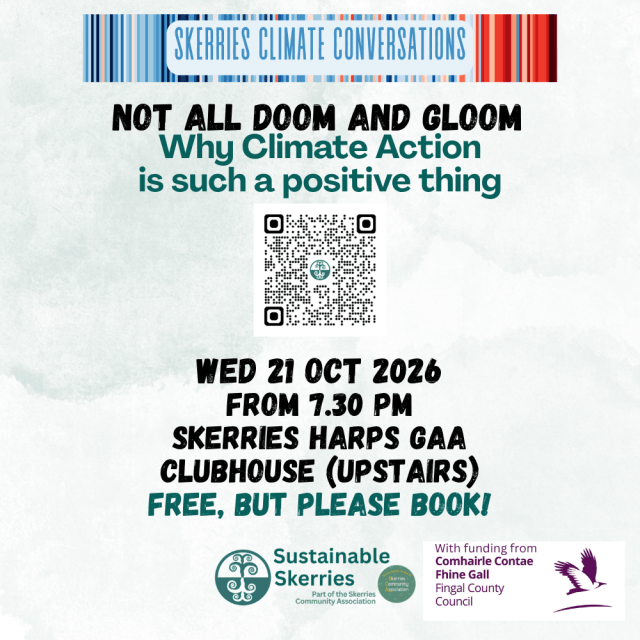
We’ll watch specially selected highlights from a Project Drawdown conversation between climate scientist Katharine Hayhoe and Project Drawdown Executive Director Jonathan Foley, then discuss what their ideas mean for climate action here in Skerries. Sign up here!
And yes, after that we are already thinking about Christmas for our November Climate Conversations. Not too early. Just in time to allow you to make more sustainable choices! December may involve a pub quiz with an eco twist…. Make sure you’ll know about it by subscribing to our Sustainable Skerries newsletter and following us on Facebook and / or Instagram
This event was supported by Fingal County Council.

