After the Mary Robinson Climate and Nature Conference 2026: Bringing Climate and Nature Conversations Home to Skerries

Written by Sabine McKenna, 13 July 2026.
I am a member of the Sustainable Skerries committee, but this article reflects my own views, not agreed committee policy.
What if one of the best ways to respond to the climate crisis is to come together locally around food: growing it, sharing it, protecting it, and doing what we can to make sure everyone in our community has access to food that is healthy for people and planet?
That was one of the ideas I brought home from the Mary Robinson Climate and Nature Conference 2026 in Ballina. The conference explored climate justice, biodiversity, food security, community resilience and local action, and left me thinking about what these ideas could mean here in Skerries.
The full theme of this year’s conference was Food and Care: A Meitheal for Our Time. How could I resist going, given that food is one of my central areas of focus in climate action? And as one of An Taisce’s 2026 Climate Ambassadors, I had an additional reason to make the effort and attend.
What is a meitheal?
Meitheal is an Irish word, pronounced roughly MEH-hul or MEH-hell. It means neighbours coming together to help with shared work.
Mary Robinson described it as “the spirit of co-operation and sharing between neighbours”. Traditionally, it might have meant helping each other to save the hay before the weather turned.
Today, we can bring that same spirit to any work that needs doing and is best done in community, including work relating to climate action, local food, biodiversity and community resilience.
Why this matters here
On a lovely July day here in Skerries, one could be forgiven for thinking that all seems well in the world. And yet, every day we are made sharply aware of just how much that is not so. What is a balmy summer afternoon in Skerries is an uncomfortably hot day in other parts of Ireland and a life-threatening heatwave in large areas of continental Europe.
We have already begun having to adjust to more extreme weather in Ireland: heavy downpours alternating with long dry spells, and stronger winds that have already taken their toll on our trees. The fact that the situation is worse in other parts of the world does not make things better.
The conference organisers promised a lot:
The conference will ask a simple but powerful question: what will become possible when researchers, community groups, farmers, climate scientists, biodiversity experts, artists, and carers work side by side, listening to one another as equals?
This will not be a conference of passive audiences. It will be a gathering of participants, where every voice would be needed and welcomed.
From the conference notification on the Mary Robinson Centre website.
And the conference delivered. From the opening address by Mary Robinson herself to the final breakout rooms nearly two days later, it was full-on and sparked many thoughts and ideas.
One of the best aspects was the group of attendees. Whoever you ended up chatting to seemed to be involved in interesting climate, biodiversity, food or community projects, and there was a real openness to discussing the conference, those projects, and a host of other matters.
We must keep having the conversation
Food must be central to this. Many of us are already aware of the climate crisis, and of the fact that it is much closer to an emergency than ordinary public discussion often suggests. But the conference also brought home the vulnerability of our food system.
Ireland produces a great deal of food, yet much of our agricultural system is export-focused, while much of what we eat depends on imports, long supply chains and systems outside local control. Feeding ourselves better, more locally and more resiliently is possible. But it is not something that will happen by accident.

What made the conference different from a simple list of climate facts was the way food was discussed not only as a source of emissions or vulnerability, but as a place where care, community, land, health, skills and justice meet.
That is why the word meitheal mattered. Food security is not only a national policy question, though it is certainly that. It is also a community question.
Who grows food? Who has access to land? Who knows how to grow, cook, preserve and share food? Who is included in the conversation? And how do we make sure that the value created by local work, local knowledge and local care does not simply leak away?
It would be too much for this article to go into details about all the parts of the conference, given that I heard more than a dozen keynote speakers and at least as many during the breakout sessions… But some of the speakers and their organisations are mentioned at the very end, including some links. Now it is time to bring the thoughts and insights prompted during those two days into the ongoing conversations here in Skerries, in our own community, where they can strengthen work already underway and perhaps inspire new ideas whose time has come.
Community wealth building: what could it mean for Skerries?
One of the most striking examples at the conference came, perhaps unexpectedly, from Bohemian FC. Through Bohemian Cooperatives and their community wealth building work, the club is showing how a local institution can move from concern to practical projects: food, shared resources, skills, bikes, local ownership and community benefit.
For me, this raised one of the biggest questions to bring home to Skerries: if a football club can begin this kind of work in Dublin, what could a town like Skerries do through the community structures, skills, groups and relationships we already have?
This is not about copying Dublin 7. It is about noticing that practical climate and community work can begin from the institutions people already know and trust.
Much of our community work depends on grants, and grants matter. But if every new idea needs fresh funding from scratch, we will always be starting again. Community wealth building asks a different question: can today’s funding create assets, skills, venues, tools, relationships or expertise that make the next action easier?
We already have some of that here. The Skerries Community Centre, for example, is home to many sports, arts and cultural clubs, the Day Care Centre, and around 120 preschoolers every day in Sticky Fingers Montessori. Many clubs and schools are engaged in similar activities, renting out rooms and making activities possible in our town while creating an income.
The Skerries Community Association, with its committees and associated groups, including the Skerries Sustainable Energy Community Initiative, Sustainable Skerries, Tidy Towns, the Cycling Initiative and many more, is already close to this kind of civic activity. In some ways, we may be better placed than a football club to think about what community wealth building could mean in a whole town. So the opportunity is there.
What could we do, or do more of, to build true community wealth here in Skerries?
- Community-based skills and enterprise courses, even ones that could be translated into real local jobs, like they do in Bohemians?
- More local food growing and sharing, building on the experience of Skerries Mills Community Garden and Skerries Allotments?
- Stronger links between schools, local commercial growers, cafés and restaurants, local farmers and community groups? School meals come to mind as one area, and maybe even the Meals on Wheels.
- Revisiting community-supported agriculture? Sustainable Skerries was involved in setting this up long before my time. Has its time come again?
- More sharing and repair systems, perhaps even a Library of Things? Could this be part of the Skerries Town Centre First process?
- In short: How could we keep more value, skills and care circulating locally?
By the way, this may be a very good time to have these conversations in a more and more structured way, given that we’re about to start the process for the next Fingal Development Plan. Wouldn’t it be fantastic if we, across all our differences, could form a vision for Skerries that would then feed, bottom-up, into the County Plan?
If you have ideas, views, thoughts or comments, then:
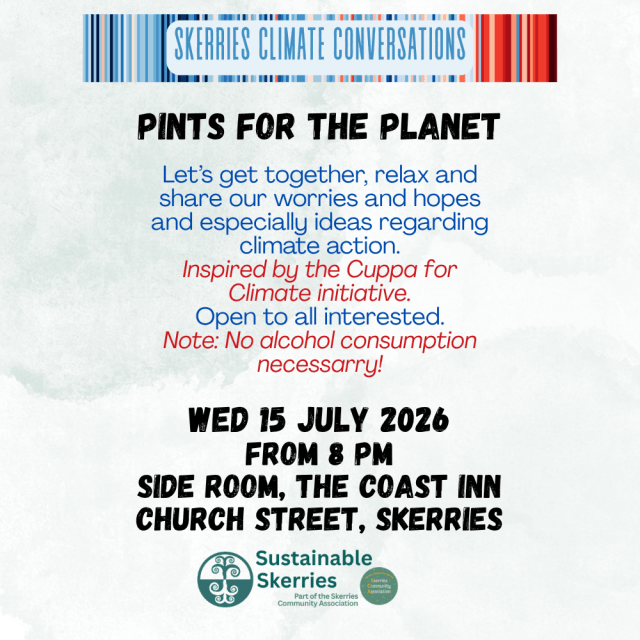
💚 Come to one of our events. The monthly Skerries Climate Conversations are particularly good for this. They usually take place once a month, often on a Wednesday evening.
💚 Send us an email: sustskerries@gmail.com
💚 Follow us on Instagram and Facebook, and comment on our posts.
We are all in this together. In this beautiful town. In this fascinating, multi-layered community. And in this climate chaos, alas.
Together, we can do our best to mitigate its extent and adapt to its consequences. And after the conference, if not long before, I for one am convinced that the multitude of possible solutions can be enriching and energising.
Here’s to the coming together, the meitheal of Skerries.
Some useful links I brought home, and why you might find them of interest
Mary Robinson Climate and Nature Conference 2026
The conference page gives the full context for this year’s theme, Food and Care: A Meitheal for Our Time, and lists the speakers, programme and supporting ideas. https://maryrobinsoncentre.ie/conference-2026/
Bohemian Cooperatives
A fascinating example of community wealth building linked to a football club, including ideas such as community-supported agriculture, a Library of Things, bike sharing, skills, education and environmental justice. https://bohemians.coop/home/
Listen to Seán McCabe, who was one of the main speakers at the conference, on the Climate Ambassador podcast:
https://climateambassador.ie/podcast/
Community Gardens Ireland
Useful for anyone interested in community gardens, local growing, policy and practical support for food-growing spaces. https://cgireland.org/
By the way, our local community garden has its own web page, full of glorious images, videos & information, now: https://www.skerriesmillscommunitygarden.ie/
EPA Food Waste Prevention and Stop Food Waste
The EPA’s food waste prevention page is a useful overview of why food waste matters for climate, resources and national policy. The EPA notes that Ireland wastes about 835,000 tonnes of food each year, and that food waste generates an estimated 8% to 10% of global greenhouse gas emissions. It also links to Stop Food Waste, the EPA-managed national campaign to reduce household food waste in Ireland.
https://www.epa.ie/our-services/monitoring–assessment/circular-economy/food-waste/
Odile Le Bolloch of the EPA spoke powerfully at the conference about how food waste needs both systems change and household action: better policy, better supply chains, better public understanding, and also better habits in our own kitchens.
Dr Rupa Marya and deep medicine
Dr Rupa Marya, one of the keynote speakers, is a physician, author and passionate advocate for deep medicine: a way of understanding health that connects our bodies to the land, our food systems and our communities.
This conversation on the GIY Food Matters podcast is a good starting point:
The wider GIY Food Matters podcast is also relevant:
https://giy.ie/blogs/food-matters-podcast
ACT Studio / Accelerating Change Together
ACT Studio, based in the West of Ireland, is a social enterprise of architects, urbanists and policy specialists working on the green transition in the built and natural environment. Their work connects climate action with design, community, town centres, coastal resilience and practical local change.
Fair Seas
Fair Seas campaigns for better protection of Ireland’s seas. Jack O’Donovan was one of the speakers at the conference, and his talk opened up a new way of thinking about the sea, marine protection, coastal communities and the hidden richness of life below the surface.
Their YouTube channel includes videos on seagrass, marine protected areas and Ireland’s coastal waters:
https://www.youtube.com/@fairseasireland
An Taisce Climate Ambassadors
The Climate Ambassador programme supports people across Ireland to communicate about climate change and take action in their own communities.
https://climateambassador.ie/climate-ambassadors/leinster/
Podcast:
https://climateambassador.ie/podcast/
Talamh Beo
Talamh Beo translates as “Living Soil”. It is an organisation of farmers, growers and citizens advocating for agroecology, food sovereignty and a better food system in Ireland. Non-farmers can also join and support their work.
Airfield Estate, Dundrum
Not just an online site, but a visit tip especially for those of us in Skerries who are interested in local food, food education and practical examples: Airfield Estate in Dundrum describes itself as 38 acres of farm, gardens and family fun, and its mission is “to inspire and enable informed food choices”. It also says it wants to support Dublin in becoming a leading Sustainable Food City, with a focus on sustainable food production and consumption.
Claire MacEvilly, Airfield’s CEO, spoke at one of the breakout sessions about their work around food, farming, education and sustainable choices.
UCC Office of Sustainability and Climate Action
The UCC Office of Sustainability and Climate Action is useful background for anyone interested in how institutions can organise sustainability and climate action across education, research, operations and community engagement.
https://www.ucc.ie/en/sustainability-climate-action/
Some Instagram accounts worth following
@talamhbeo
Irish farmers, growers and citizens advocating for agroecology, food sovereignty and fairer food systems. Especially relevant if you are interested in the future of farming, soil, food and land use.
@projdandelion
Project Dandelion is a women-led, but not women-only, global climate justice campaign. It is useful for hopeful, justice-focused climate communication and for connecting climate action with wider social issues. Mary Robinson was involved in setting it up and still plays a significant role.
@maryrobinsoncentre
The Mary Robinson Centre in Ballina shares work connected with human rights, climate justice, biodiversity loss and Mary Robinson’s legacy.
@acceleratingchangetogether
ACT Studio shares examples of regenerative design, community-led climate adaptation, resilient urbanism and climate action in the built environment.
@fairseasireland
Fair Seas shares marine conservation, ocean protection and coastal community content, including material on seagrass and marine protected areas.
Two podcasts you might find useful
Climate Ambassador podcast:
https://climateambassador.ie/podcast/
GIY Food Matters podcast:

