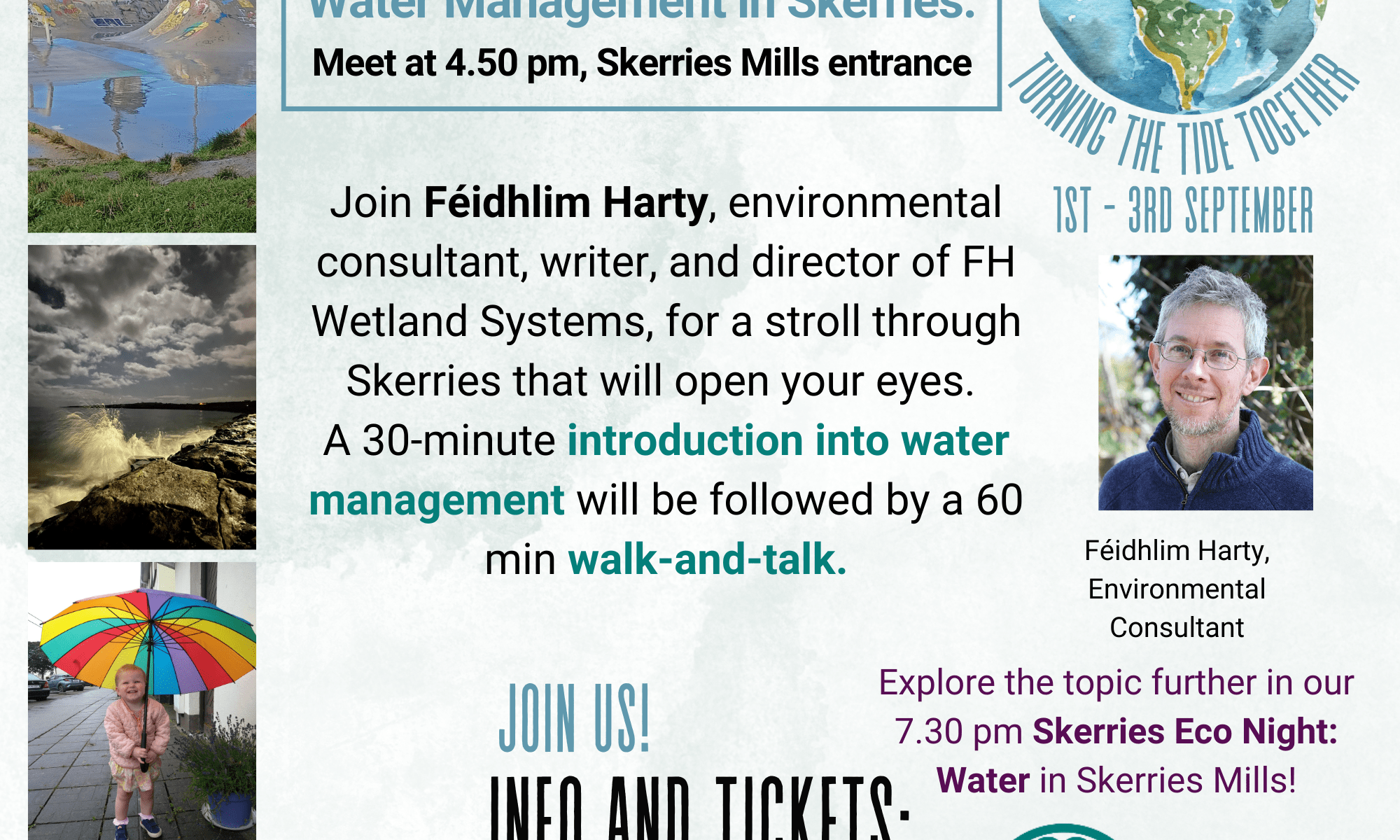
Continuing our series of blogs about individual events at the recent Skerries Eco Festival, Dara Mac Domhnaill, himself actively protecting the biodiversity and water quality of the Mill Stream as part of the local group “Stream Huggers,” gives us an insightful summary of the Saturday afternoon walk and talk. He writes:
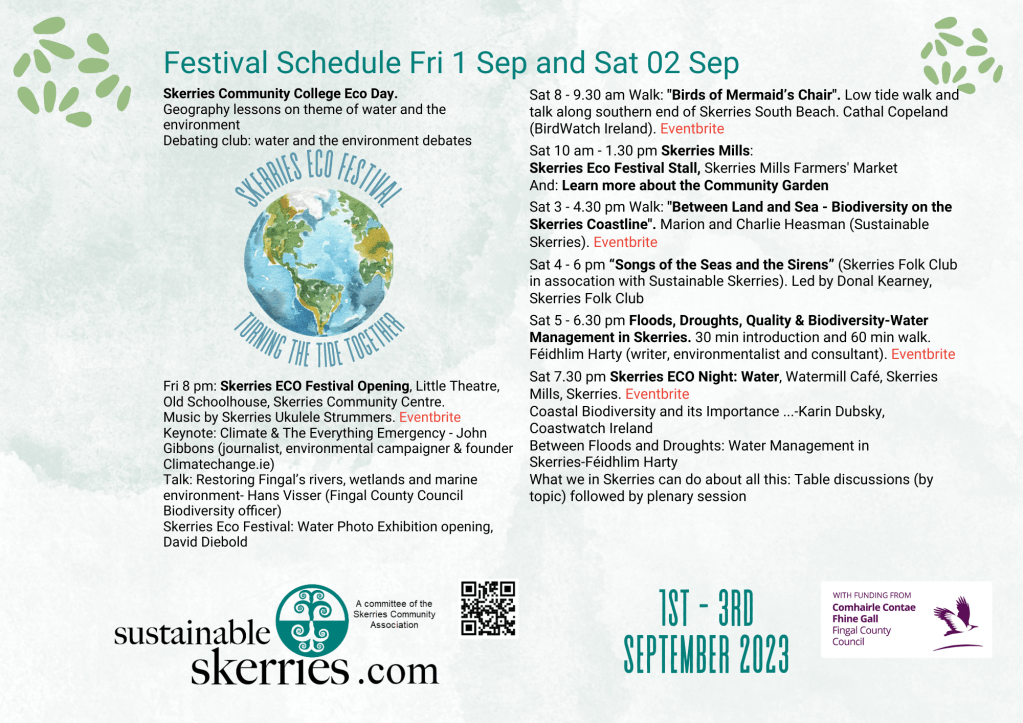
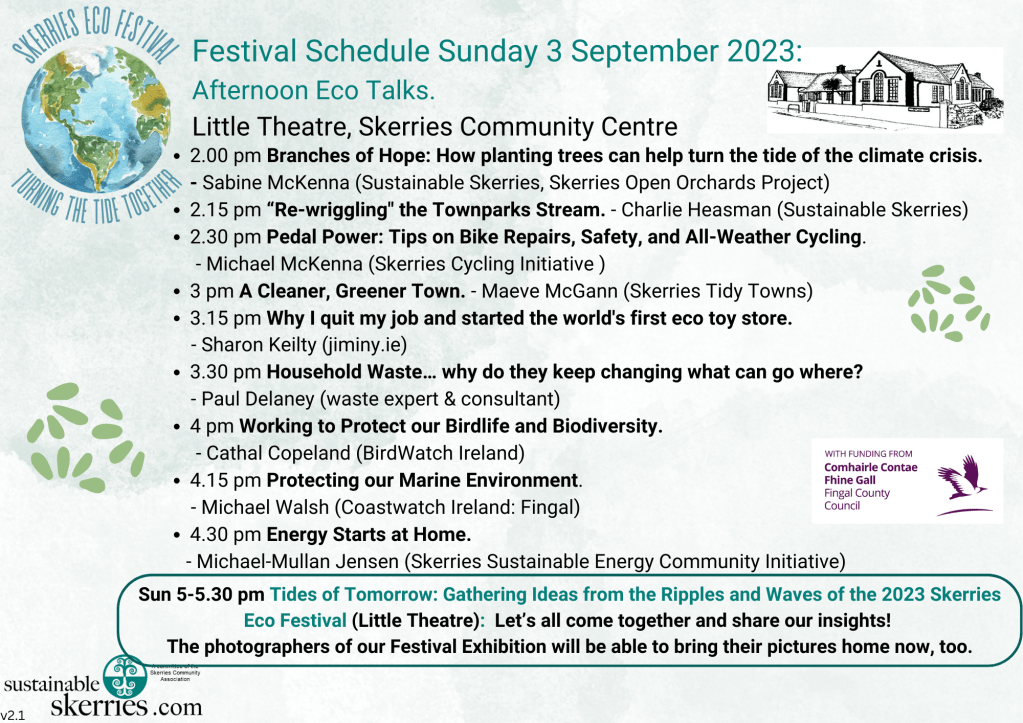
As part of the recent water themed inaugural Skerries Eco Festival 2023 Féidhlim Harty (writer, environmentalist and consultant of FH Wetland Systems) gave a talk on Floods, Droughts, Quality & Biodiversity – Water Management in Skerries in Skerries Mills followed by a tour of the lower stretch of the Mill stream (or the Brook as it is called locally) from Skerries Mills to the sea at the South Strand, with the assistance of local guides.
The slides for the talk can be viewed here.
In his talk Féidhlim provided photos of some examples of polluted waterbodies before showing some examples of measures taken to deal with such issues including pond creation and willow planting.
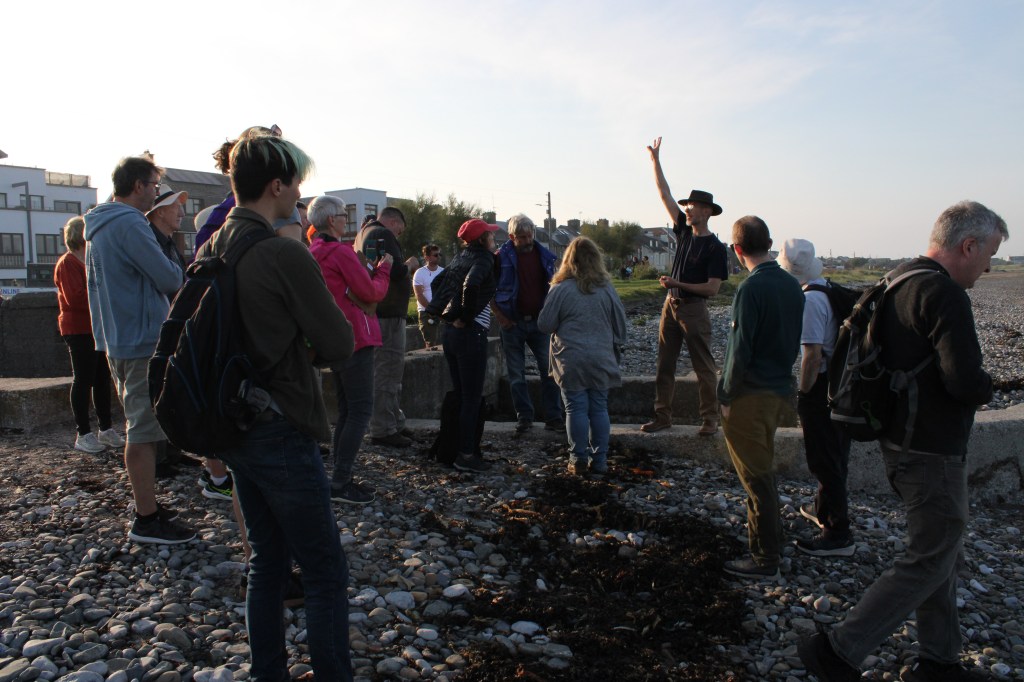
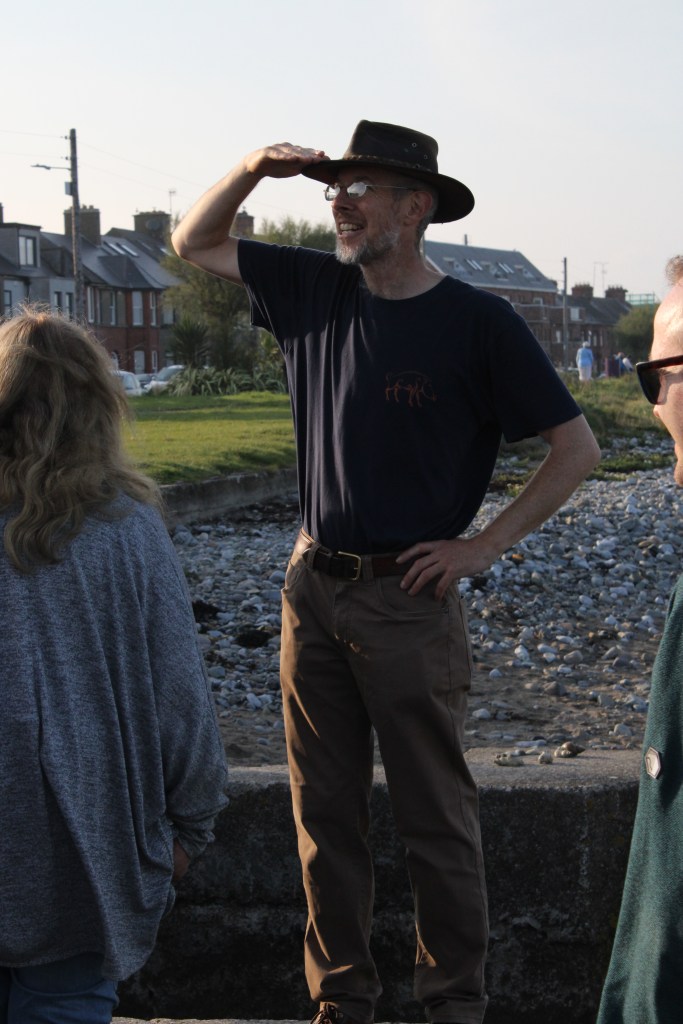
Féidhlim then talked through some of the many possibilities available to reduce water pollution and enhance biodiversity on farmland:
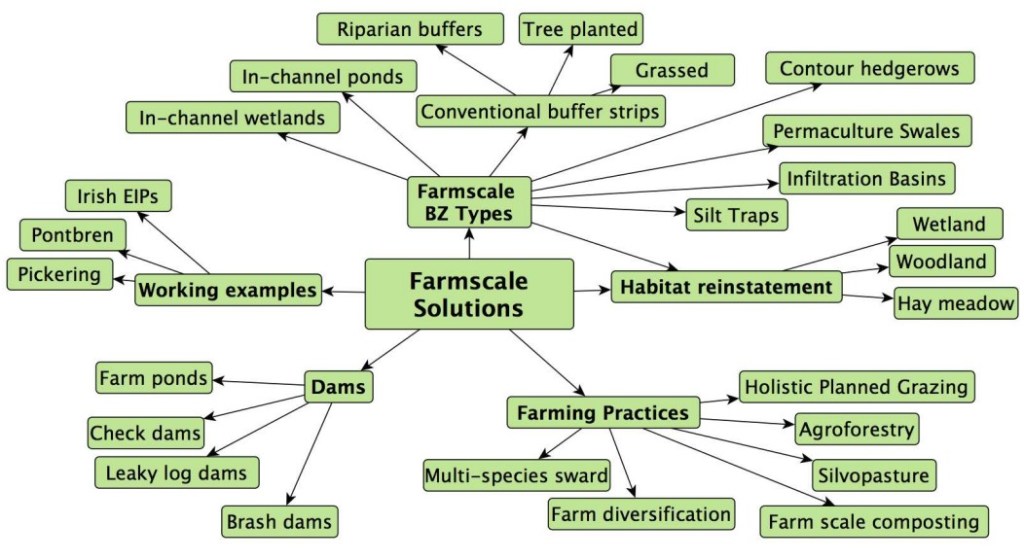
There was a specific focus on drains and how to create these.
The next focus was on what can be done to improve water quality, conserve water and reduce flooding in the domestic and urban context.
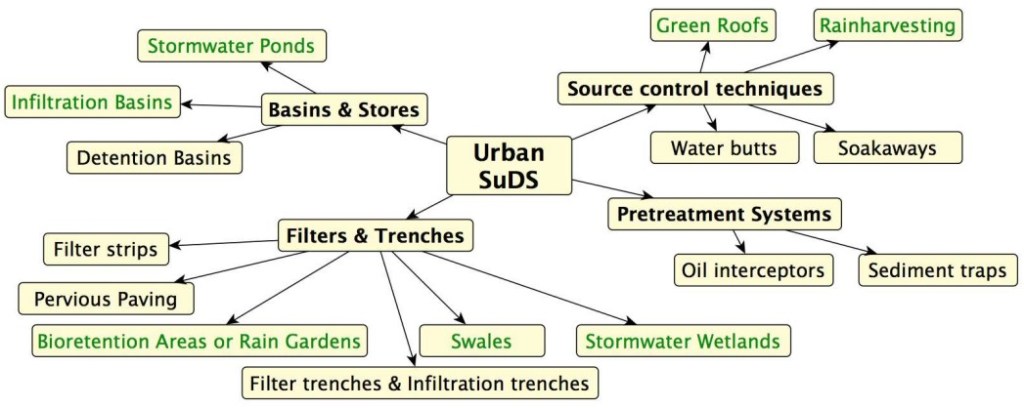
The focus here was on drainage beside roads as well as on the use of water butts and rain gardens in domestic settings.
There was some discussion of water quality in the Mill Stream. The EPA do not monitor the stream but have given it a Poor status based on modelling. However local volunteers have found that nitrates and phosphates levels are well within allowable limits. This work is done using test kits provided by Freshwater Watch.
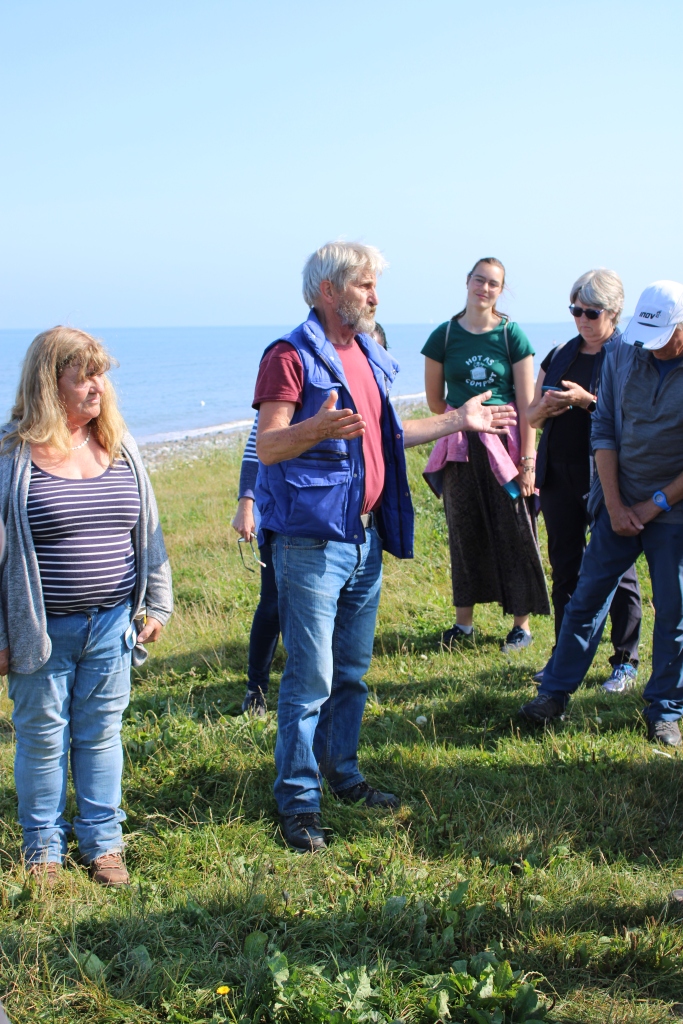
At the conclusion of the talk the group left to tour the lower stretch of the Mill stream between Skerries Mills and the sea. The entire walk was characterized by enthusiastic interest and curiosity about the stream and issues surrounding it. Féidhlim noted that the gravel on the stream bed under the foot bridge looked healthy.
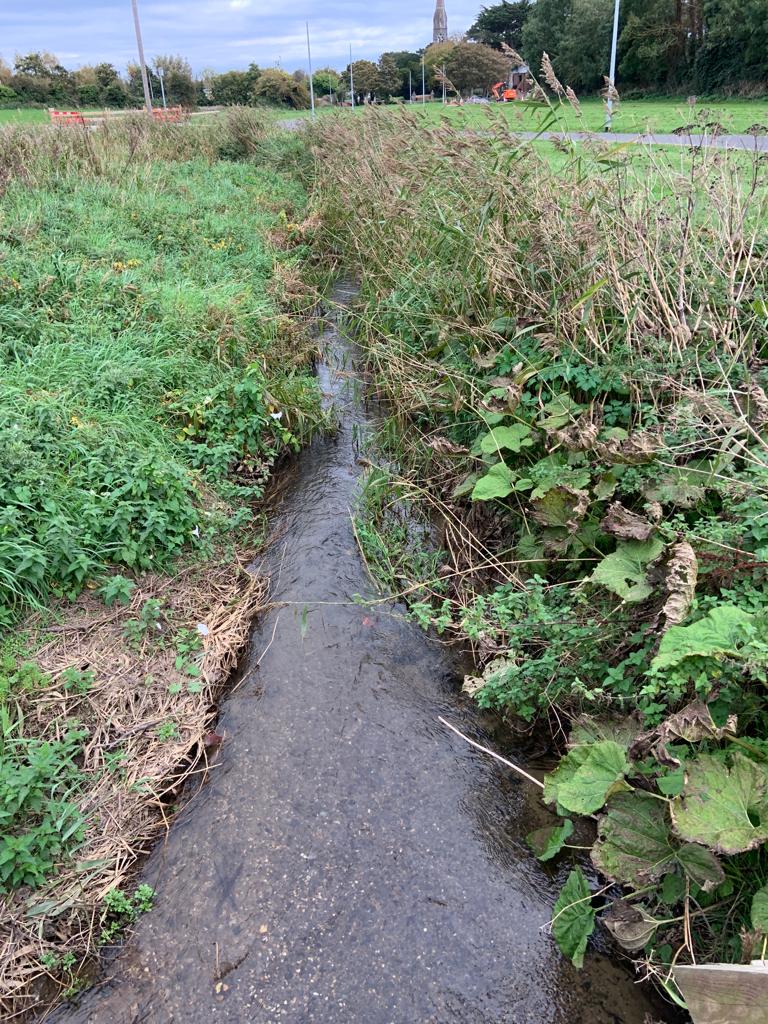
There was some discussion of the annual flailing of the bank vegetation by Fingal County Council. Féidhlim said that clusters of willow planted on the banks in this area would help with water filtration, as well as helping biodiversity and providing visual amenity for people.

There was a lot of discussion of reintroducing a meander in the lower stream area opposite skatepark. Charlie Heasman would be advocating this at a short talk the following day and it is a possibility it will be a recommendation in an ecological study of the town park commissioned by FCC and currently being prepared by Coiscéim Consulting. There has been some flooding at the nearby road area and there was a lot of discussion among attendees on this subject. See recommendation 7 below for Féidhlim’s thoughts on this topic.
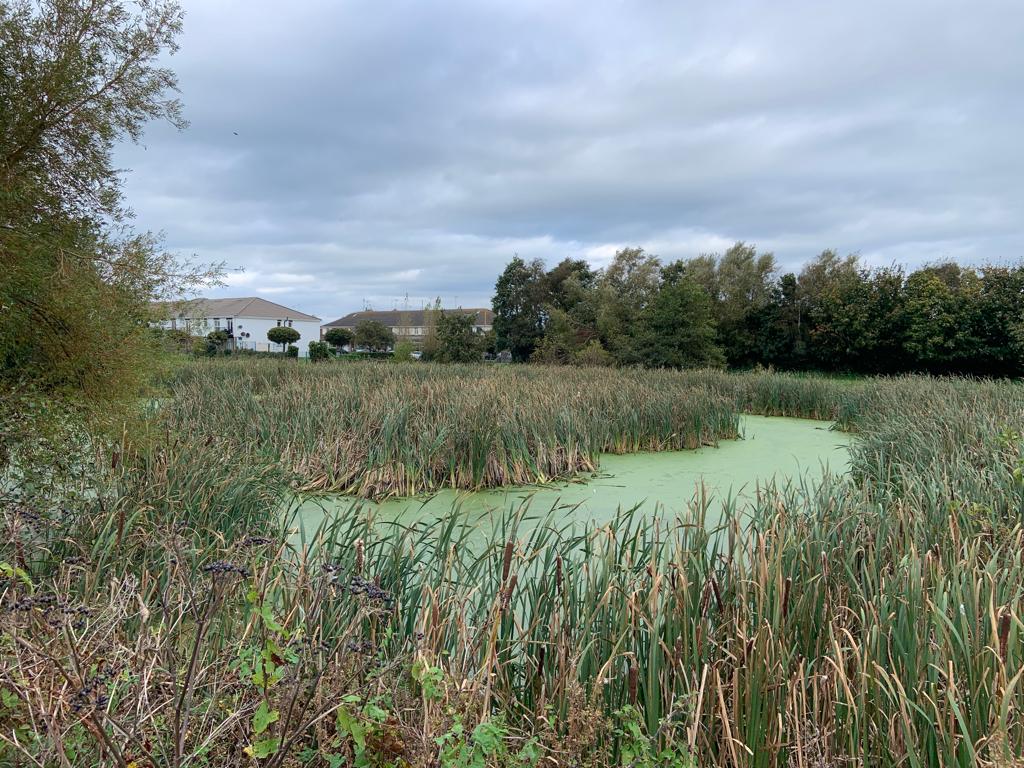
We visited the Kybe pond where the pond was covered in green, but this is duckweed rather than algae. Freshwater Watch water tests indicate good water quality. That said it is not desirable that the entire pond surface should be covered like this as it prevents light reaching the pond bed. The duckweed will die off in winter and would require mechanical removal otherwise.
We then followed the stream to the sea. In the stretch in front of the Maltings planting of common reed (Phragmites australis) and possibly bulrush (Typha latifolia), yellow iris (Iris pseudacorus) and bur-reed (Sparganium erectum) would benefit water quality and biodiversity.
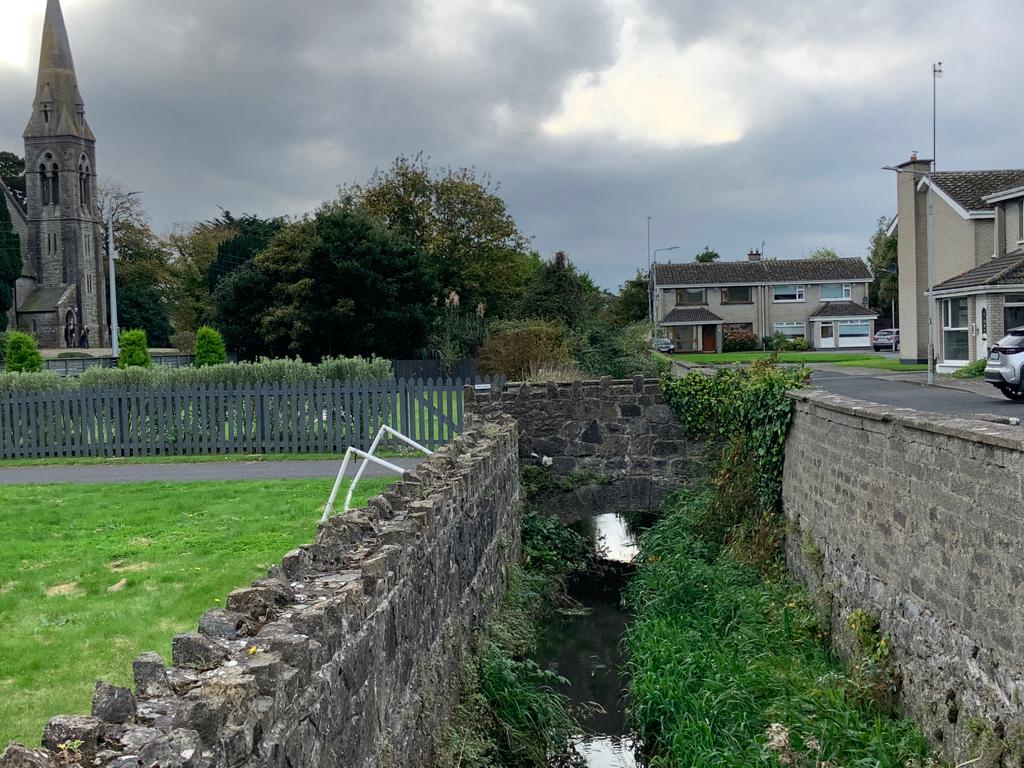
Féidhlim suggested the addition of common reed (Phragmites australis) in the stretch nearest the sea would be beneficial for water quality there.
Féidhlim said that overall while the EU and national policy are moving in the direction of rewarding farmers for measures designed to improve water quality, flood management, biodiversity, carbon storage and sustainability that there is still plenty of scope for communities and activists to try and influence farmers in these directions in the coming years.
Some suggestions for Skerries
Following his visit to Skerries Féidhlim made the following suggestions for how water quality could be improved in Skerries
- Conduct a river safari to identify all piped inputs along the river within Skerries itself and to check these for potential misconnections (black water or grey water inputs into the stormwater drains). Map these and identify solutions for repair and/or filtration.
- Liaise with local farming community to assess availability of low-lying land which could be used for riparian or in-channel buffer zones – either wooded or with marsh filter plants. Also with the farming community is the potential to offer tree planting and/or hedgerow planting. This is particularly useful if planted along the contours of fields so that any runoff water passes through a curtain of vegetation at ground surface and through a curtain of roots below.
- Liaise with FCC to assess availability of low-lying land which could be used for riparian or in-channel buffer zones or stormwater wetlands; particularly upstream of the roundabout which is reported to be a low-lying area.
- Assess the potential for rain planters, stormwater wetlands, green roofs, rainwater harvesting, rain gardens / bioretention areas, stormwater ponds etc for catching stormwater runoff from paved and roof surfaces before it ever gets to the stormwater sewers or the river. This will help minimise storm surge diversion of foul sewage around the sewage treatment system in wet weather (protecting the water quality in the bay) and protect the river directly by filtering direct road runoff to the river.
- Assess the degree of treatment at the sewage treatment system and explore the opportunities for adding in a reed bed or constructed wetland or willow filter to improve the final water quality prior to pumping out into the bay.
- Introduce a habitat management process for local farmers and landowners to provide ponds, in-channel wetlands, hedgerows, woodland pockets etc. for holding and filtering water; also, for promoting farm-scale composting for building soil carbon and drought resilience across the catchment.
- If meandering the river as proposed, consider lowering the land in this area considerably to act as a flood plain as well as meander. This will improve habitat and reduce the potential for flooding of houses between here and the sea by providing storage volume. Also, explore the potential for raising the water level across the new meanders at the same time by using a raised stone riffle area at the downgradient end of the field (near the bridge by the Kybe Pond). This should only be done after assessing the topography of the stream bed back up along the stream and ensuring that existing gravel stream bed areas will not be inundated by standing water due to the works. A flood studies report may also be needed, as might an ecological AA (appropriate assessment) and possibly a NIS (Natura Impact Statement) and liaison with IFI, NPWS and OPW.
- There are many ways to engage the local community too – through regular talks, walks, speaker days, ecology field trips, citizen science events, bio blitz events, beach, and river clean-ups, Coastwatch participation, bat walks, bird walks, insect and plant identification events, young scientist projects, farmer walks and events, local business events, TidyTowns events etc. There is a very strong start already with the Stream Huggers 😊
Local activists, such as the Stream Huggers, Sustainable Skerries, and Skerries Tidy Towns, will be discussing these recommendations to see what is feasible and realistic and what should be prioritised in conjunction with the Local Authority Water Programme (LAWPRO), Fingal County Council and other bodies. A key next step is the expected ecological report from Coiscéim Consulting on the town park and the recommendations it will have for the stream, ponds, and environs.
Dara Mac Domhnaill, October 2023
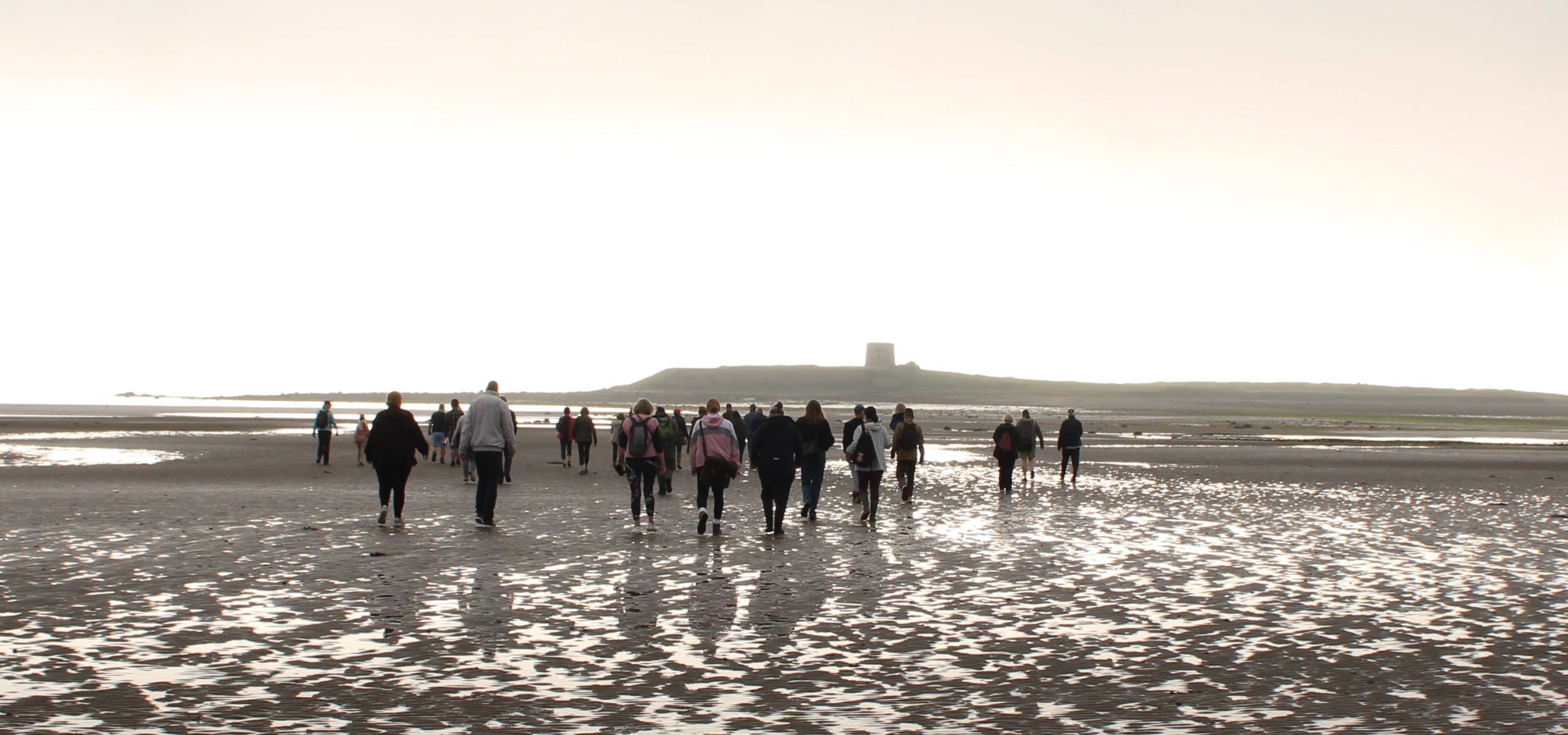
Low Tide Walk & Talk, Southern End of Skerries South Beach by Cathal Copeland (BirdWatch Ireland)
This report by Evelyn Cottell, Sustainable Skerries, continues our series of blog posts about our recent Skerries Eco Festival.
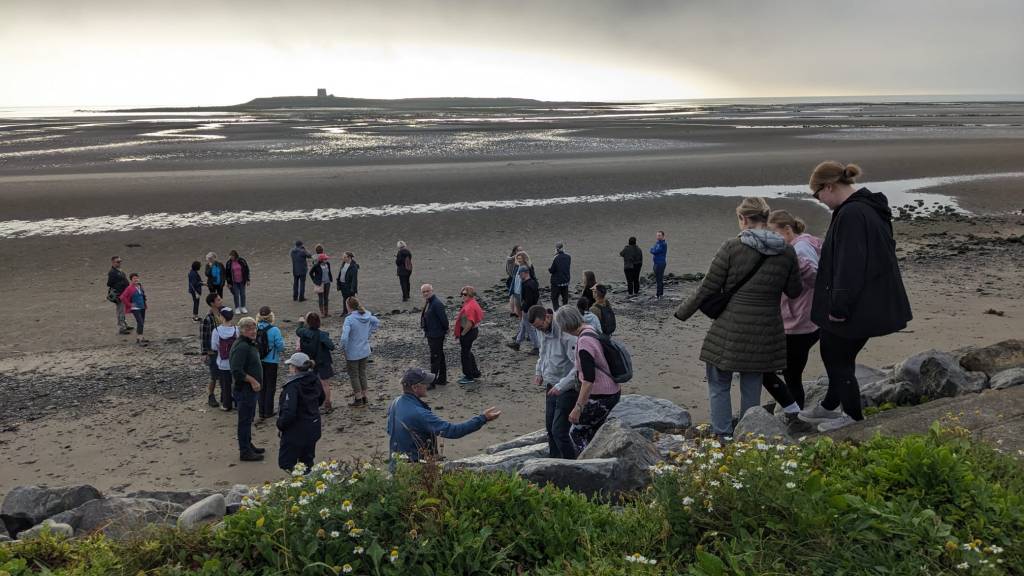
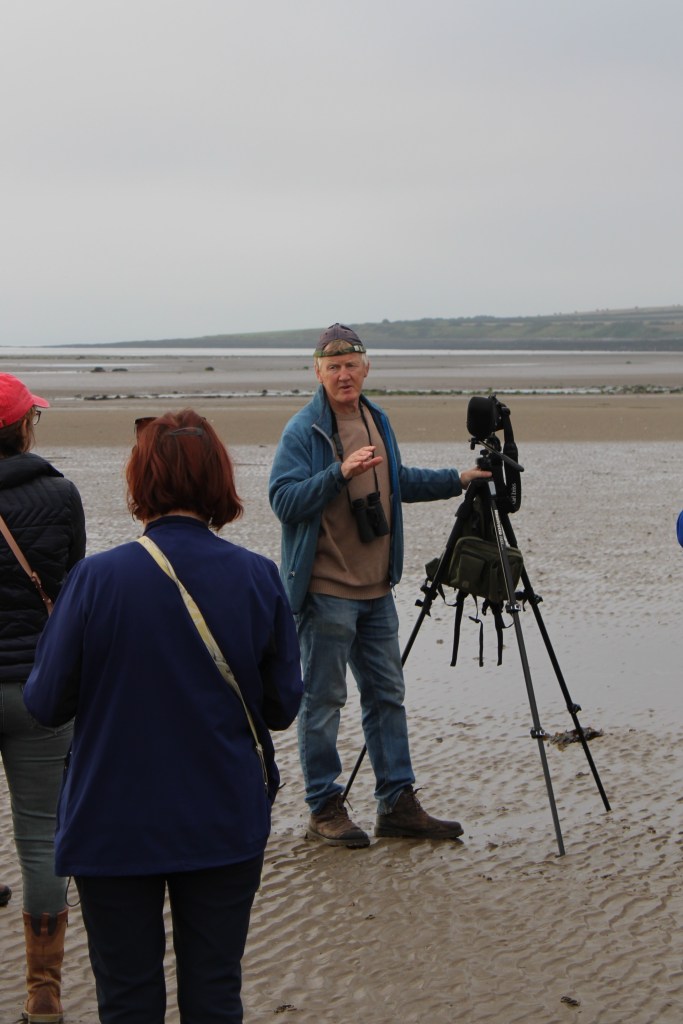
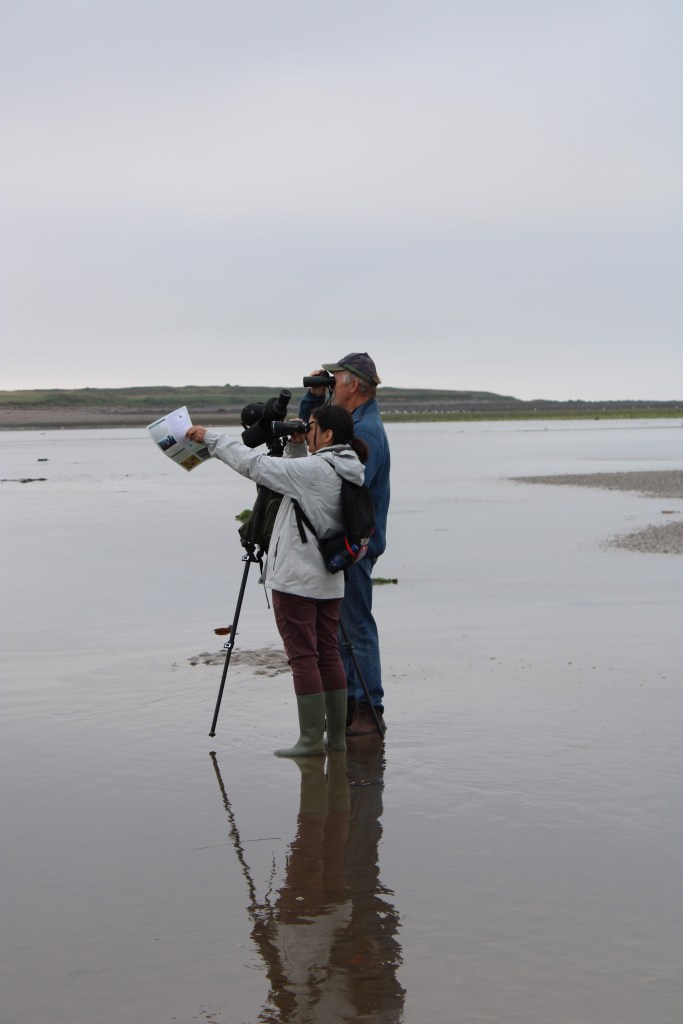
It was an early 8.00am start on 2nd September, for the first of 3 walks and talks, key outdoor events on the Saturday schedule for Skerries Eco Festival. In spite of the early start, a large gathering of 30+ people turned up for a coastal walk and talk, along the south end of Skerries South beach, led by expert BirdWatch Ireland guide Cathal Copeland. Cathal educated us on the sea birds and places of interest along the south beach, in a relaxed and engaging way. We were blessed with optimal conditions- a particularly low tide due to the moon phase, a clear blue sky, a knowledgeable local guide, telescope, binoculars, an enthusiastic bunch of people and a good turn-up of seabirds to match.

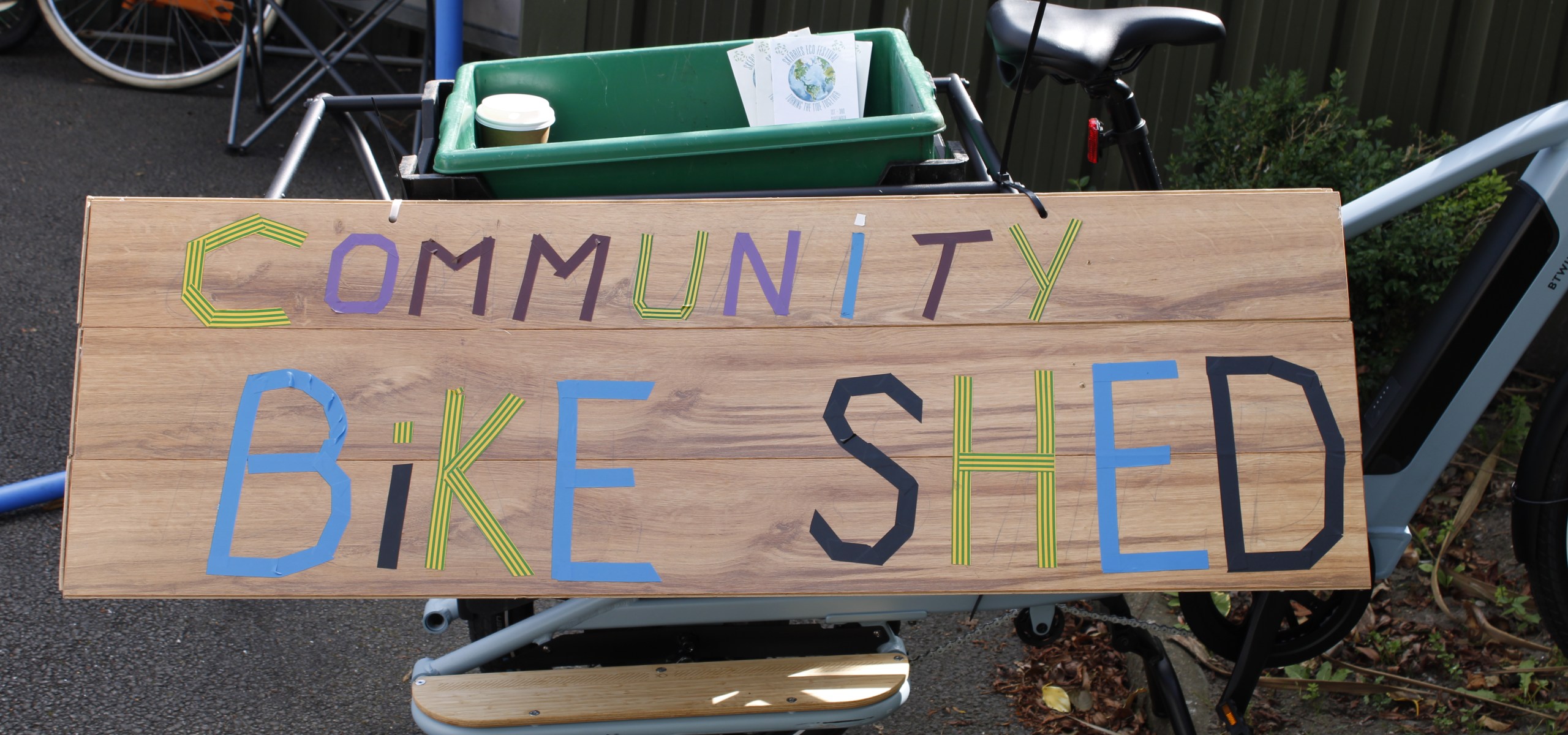
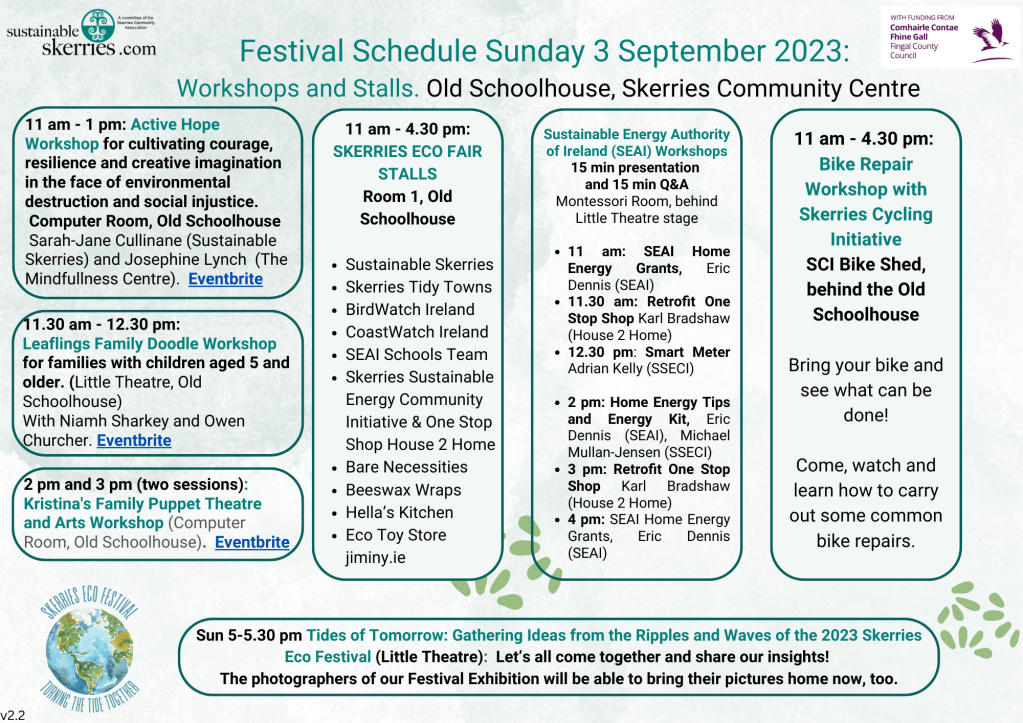
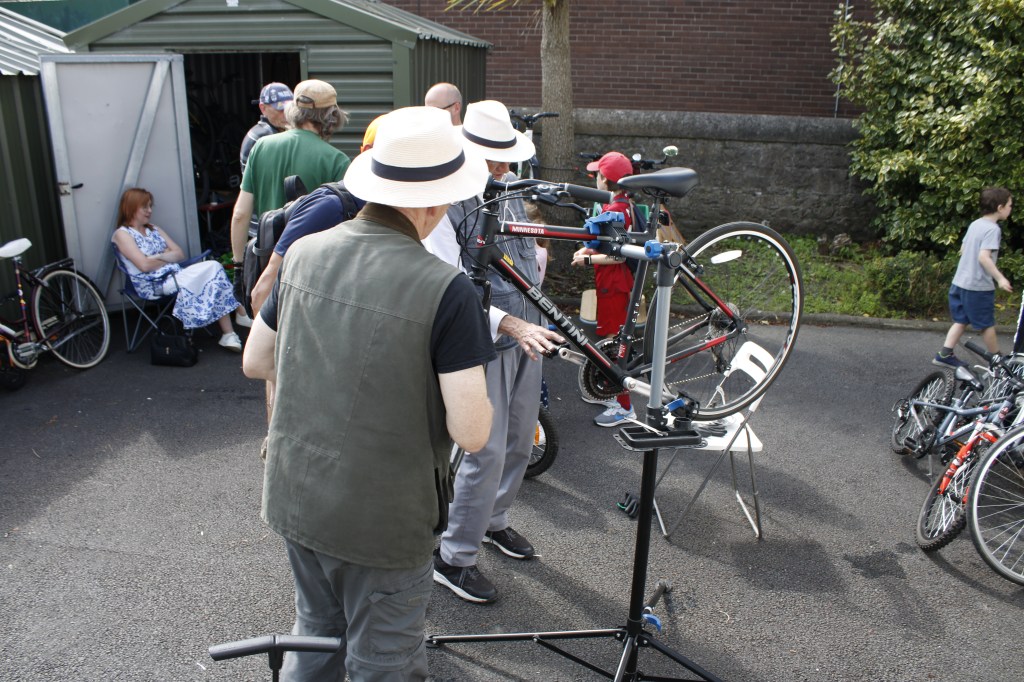
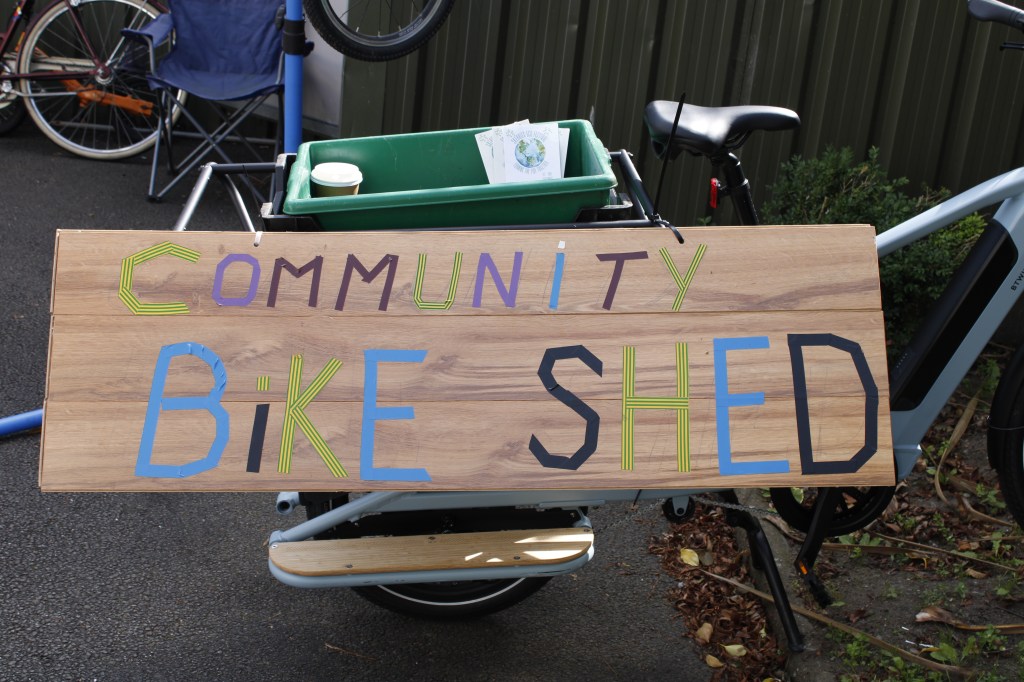
In our latest instalment of blog posts about the recent Skerries Eco Festival, Michael McKenna (Skerries Cycling Initiative) writes about their Skerries Community Bike Workshop Open Session, aka the Skerries Bike Shed.
Skerries Cycling Initiative (SCI) was delighted to be involved in the Eco Festival through their Skerries Community Bike Workshop open session held 11-4 p.m. on 3 September and their presentation: Tips on Bike Repairs, Safety, and All-Weather Cycling in the Little Theatre.
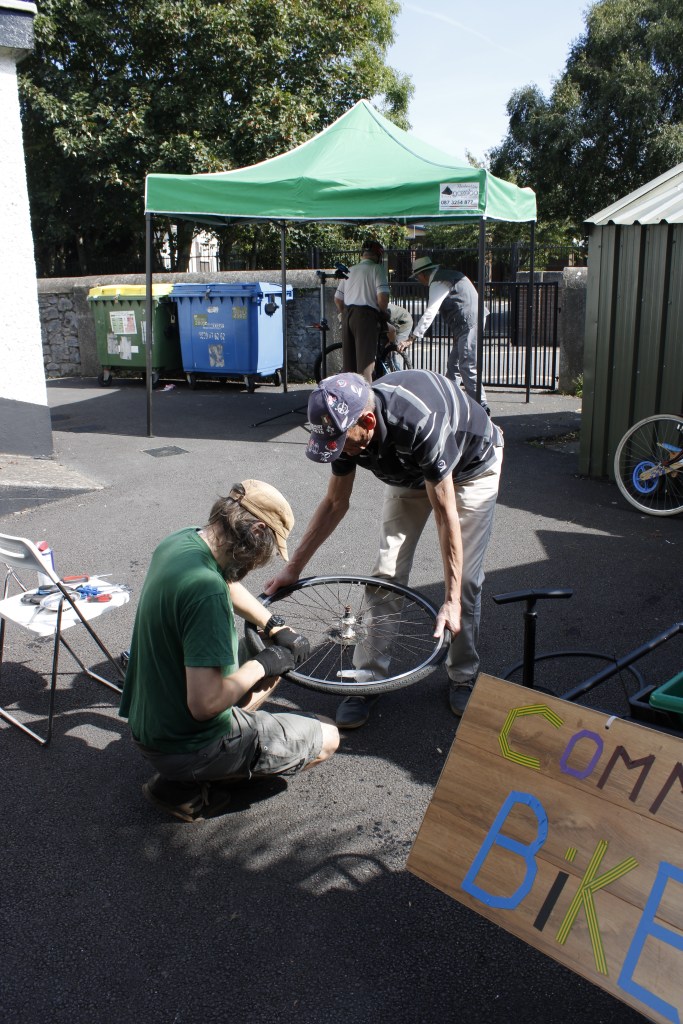
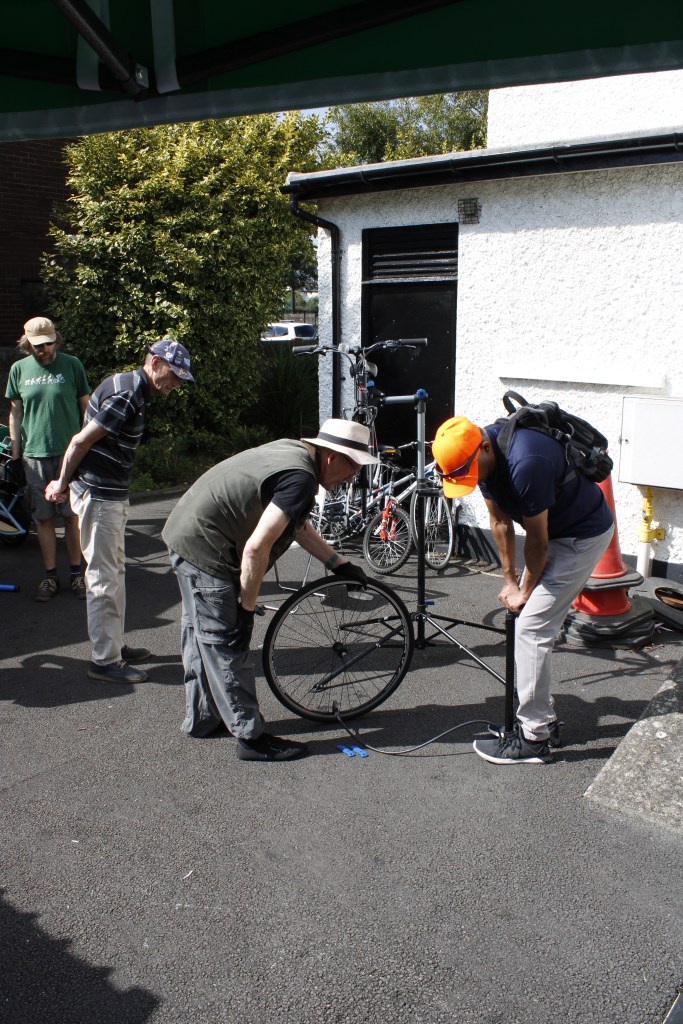
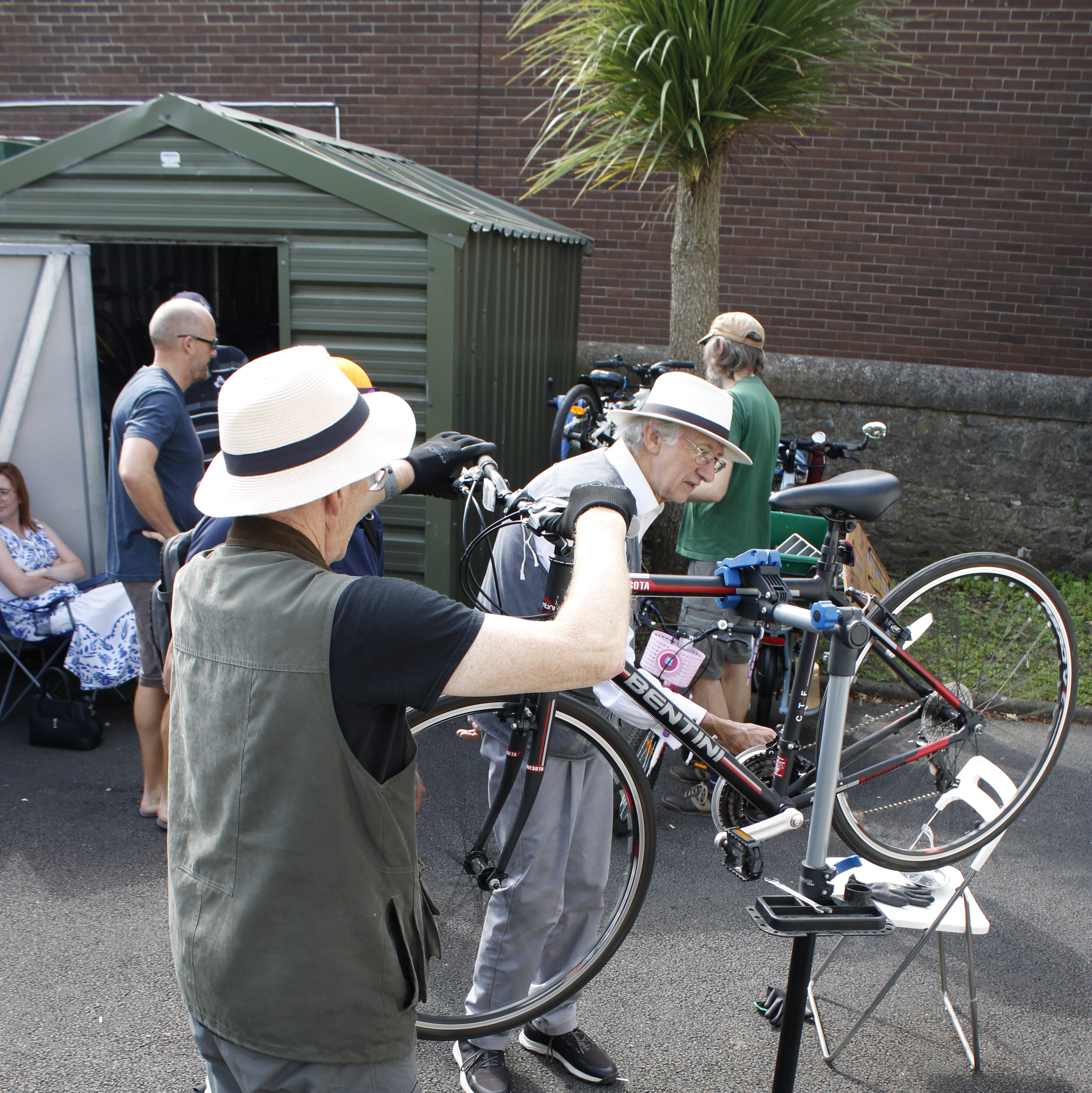
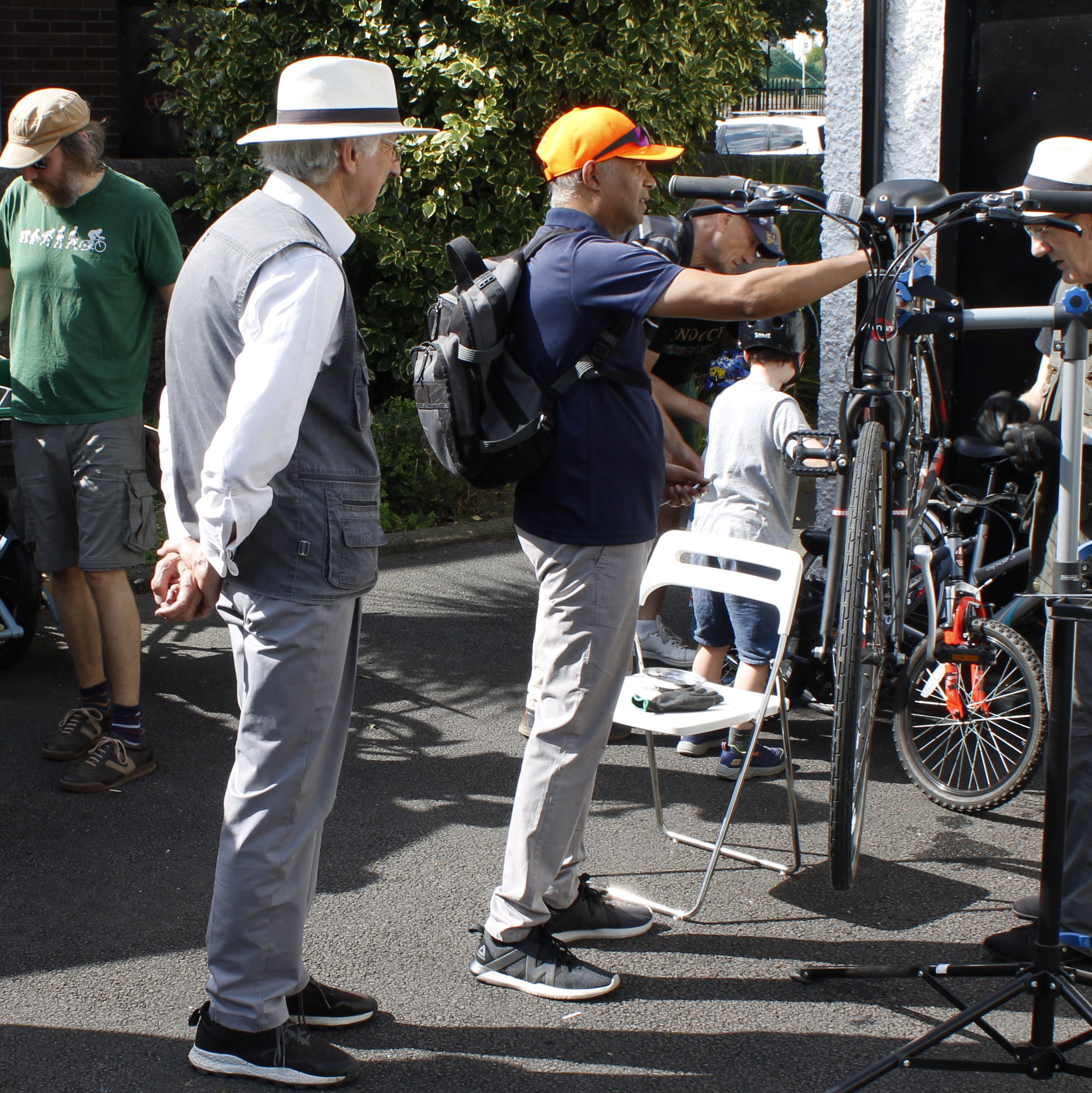
We carried out lots of minor repairs on adult and children’s bikes ranging from raising saddles and handlebars to mending punctures, fixing brakes and tuning gears plus lots of pumping tyres and oiling chains. It was great to pass on a donated bike to a woman whose bike was stolen recently in Skerries. Five people signed up to our WhatsApp group which will notify opening times to members. Email Skerriescycling@gmail.com to get added yourself.
Most importantly, in chatting to people we got lots of positive vibes about the Community Bike Workshop idea which is a space where people can learn how to maintain and carry out basic repairs to bikes. Through repair and re-use we are reducing waste and also promoting a healthy and low carbon way of getting around.
We have a full set of bike tools available to use free of charge, and parts at reasonable or zero cost.
Visitors on Sunday saw how we “Learn by doing”, in a friendly supportive atmosphere.
We want more people involved so that regular sessions all run by volunteers, can happen.
We are non-profit and all donations are used to buy parts/tools.
We would like to thank Jake Gildea for skilfully capturing the action with his photos.
You may be aware of the Draft Fingal Climate Action Plan 2024-2029 – below is a summary of its main points. We encourage everyone to have a look at the Fingal website, especially the other submissions already made, and to make their own submission before the deadline on Fri 3 November, 5 pm.
Summary of the Fingal Climate Action Plan
If the presentation does not display properly, please use the download link to access the PDF.
Thanks to committee member Miriam Sweeney for this overview!
We hope to make a submission in good time before the deadline (3 November 2023) so that others can see what our thinking is on this important plan.
*Update 27 October 2023: Our submission is now up. See it in full here.*
Sustainable Skerries welcomes the plan in principle but suggest better tracking and climate neutrality by 2040!
Comment on ‘Introduction’ to Draft Climate Action Plan:
All actions in the Climate Action Plan need to be linked to specific, measurable, achievable, relevant and time-bound goals.
Sustainable Skerries welcomes the dual vision of becoming climate neutral and climate resilient.
The ideal emphasis of a Climate Action Plan is on mitigation first, adaptation second, and avoiding climate-change-related problems in the first place. However, we recognise the need to include mitigation and adaptation actions in the plan. The AR6 Synthesis Report Climate Change 2023, from the Intergovernmental Panel on Climate Change (‘IPCC’) emphasises the importance of both mitigation and adaptation actions https://www.ipcc.ch/report/ar6/syr/resources/spm-headline-statements. Nonetheless, we would like to highlight the requirement to focus on both mitigation and adaptation equally. Adaptation actions should not detract from the need to continue to urgently focus on mitigation.
Obviously, there is only so much a county council can do, but the influence of setting an example in reducing carbon (and carbon-equivalent) emissions should not be underestimated. For that reason, we feel that being climate neutral by 2050 is too low a target (albeit in keeping with the Low Carbon Development (Amendment) Act 2021) and suggest changing that to 2040 at least. For instance, Waterford is aiming for that Carbon Neutral Waterford – Roadmap 2040 WEB.PDF (waterfordcouncil.ie), and Fingal should join them. We suggest following their example and putting more emphasis on the decarbonising zone.
Fingal could also learn from the experiences of Cork City, selected by the EU as one of 100 European cities leading on climate action and aiming to be carbon neutral by 2030! Zero Carbon Infrastructure – Cork City Council.
All actions in the Climate Action Plan need to be linked to specific, measurable, achievable, relevant and time-bound goals. Multiple actions are currently too vague with no targets specified, e.g., E10, E11, T1, T4 (none of which have targeted numbers or expected impact included). Actions must also be weighted in their impact so that a report on the progress can reflect in a quantifiable manner how much mitigation, or what progress with adaptation, has been made. We note that previous progress reports are insufficient in this regard as they only state whether an action is completed or not (with the majority being ongoing in any case, in which case it is impossible to assess progress without some indication of the impact of work done to date) FCC CCAP 2019-2024 Third Annual Progress Report.pdf (fingal.ie). Additionally, it is meaningless to report that “20% of all actions have progressed” if each action only moves the needle a tiny bit. Indeed, there is no indication across the multitude of actions in each of the six themes as to what actions take priority or are considered most impactful, again emphasising the need to carry out an impact assessment for each action e.g., in terms of emissions or energy efficiency. This should also help with prioritisation and informing where budgets are spent.
We propose that in addition to a “Tracking Measure” being captured in the summary action tables, a column is inserted for “Yearly target range”. We question how a Key Performance indicator can be assessed without a target range being set in advance, or how “Robust oversight and reporting” can be executed without a target-setting exercise in the first instance.
We note that Dublin Airport and the impact of air travel on greenhouse gas emissions are not mentioned at all (data centres at least are referred to) – should Fingal County Council not at least aim to use its influence to reduce the impact of the aviation sector?
Potential additional benefits and opportunities:
p.18 “By providing networks of natural wildlife corridors through the urban environment we will help animal and plant species migrate through the changing landscape.”
“Changing landscape” should be clearly defined here. It is important that the trade-offs in multi-use corridors (e.g., greenways) intended for climate, people and biodiversity are fully acknowledged and factored into site selection and design, as high disturbance levels will not deliver much benefit for biodiversity
Comment on ‘Climate Action Plan Process’:
Need to correct the oversight in omitting the North-West Irish cSPA
It seems that there has been an oversight in omitting the North-West Irish cSPA (site code 004236 North-west Irish Sea SPA | National Parks & Wildlife Service (npws.ie)) from the Appropriate Assessment Screening, this needs to be addressed – see the submission by Naul Community Council
Concern Draft Climate Action Plan is inconsistent with the Habitats Directive | Fingal County Council Online Consultation Portal.
Comment on ‘Baseline Emissions Inventory’:
Clarification of the data centre emissions data needed; Fingal emissions data later than 2018 would be helpful
P.29 of the draft plan states that “Data centres represent 13.1% of the commercial sector’s emissions”. It is not clear if this is 13.1% out of the 31% for the sector (i.e. 4.06% of the total for Fingal) or 13.1% of the total for Fingal. Please can you clarify which applies in the final version of the document. Irrespective of this, the impact is significant. There are currently no actions in Section 5 Energy and Buildings targeting this source of emissions. Actions should be added, such as engaging with the SEAI and large industrial users (including data centres) to discuss e.g., renewable energy or other solutions, attaching emissions-related conditions to planning permission applications etc. Such actions would be consistent with the government principles on data centre development, which include climate-change-related considerations New Statement on the Role of Data Centres in Ireland’s Enterprise Strategy published – DETE.
Additionally, it would be helpful to also include a more recent estimate of Fingal’s greenhouse gas emissions if possible, e.g. for 2022, so the public can understand the trend since 2018 and therefore the extent of the challenge ahead.
Finally, for this section, we acknowledge that this is a draft document, however, it has been made accessible to the public and regrettably, most of the figures on p.28 are not fully legible, as they appear to have been cut and pasted from the original reference material. It is important that all key figures, tables, graphs etc. are fully legible in the final document.
Comment on ‘Responding to Risks-Emergency Response Planning’:
A couple of open questions
This section of the plan is very high-level. Does the Council carry out scenario planning to detail how it would respond to different types of emergencies specific to Fingal? Does it carry out lessons-learned exercises following major incidents and use these to improve future responses?
Comment on ‘Energy and Buildings’:
Need for additional actions regarding SEAI / Industry. Kudos for leading by example with buildings under the control of FCC
We welcome the Council leading by example as evidenced by the large number of actions concerning the buildings it controls. As per the comment under “Baseline Emissions Inventory”, there are currently no actions targeting emissions reductions for large industrial energy users such as data centres. Actions should be added, such as engaging with the SEAI and large industrial users to discuss e.g., renewable energy or other solutions, attaching emissions-related conditions to planning permission applications etc
Comment on ‘Transport’:
Emphasis should be on avoidance first (helping active travel & public transport), move towards electric then – and what about air traffic?
The emphasis should be on reducing traffic first (by improving active and public transport), then on moving towards low-carbon / no-carbon transport.
One barrier to using bikes to get to the train station is the real danger of theft; individual bike boxes are too small for any non-standard bike and expensive to the user. An action could be added to introduce multi-bike parking facilities like the ones in use in Australia About Parkiteer – Parkiteer.
Given the increased likelihood of flooding (section 3 of the plan), actions on infrastructure developments for active travel should be considered in conjunction with actions on flood resilience, as these are interconnected. Actions F12 – F14 on surface water management and action F17 on sustainable drainage systems for new developments are important here. Active travel routes should incorporate “green infrastructure” features, such as trees, see A framework for assessing the quality of green infrastructure in the built environment in the UK – ScienceDirect.
We welcome actions T22 and T23 on shared mobility, specifically, we believe that community car sharing for electric cars should be explicitly mentioned here.
Ireland’s transport emissions continue to increase and there is an over-reliance on the increased use of electric vehicles to address this Transport | Environmental Protection Agency (epa.ie). In that context, it is disappointing that some measures are only suggested for 2026 or even 2028 (e.g., T14, T15, T34, T35.) For T35 on mitigating the impact of the Council’s own business travel, before considering carbon offsets we suggest prioritising a policy of reducing travel as much as possible e.g., meeting remotely rather than travelling (and particularly avoiding flights).
Comment on ‘Flood Resilience’:
Need for cooperation between the OPW and the Fingal Biodiversity Team re F5: Flood Alleviation Schemes especially Mill Stream Skerries
“F5: Progress Flood Alleviation schemes in conjunction with the OPW – including Mill Stream Skerries, Bissett Strand and The Green Malahide Village, Portmarnock Bridge,”
Ongoing ecological studies of the Mill stream area, Skerries, point to the potential for natural flood risk management, incorporating existing wetlands, in this small catchment. It is important that OPW engage with the Fingal Biodiversity Team to deliver such an ecologically sensitive scheme. An Ecological report on the Skerries Millstream area is due shortly from the Fingal Biodiversity team. We would ask that this engagement is carried out as soon as possible, and not deferred until 2029+ as documented. This is particularly urgent considering the recent flooding in this area.
Comment on ‘Nature-Based Solutions’:
Some detailed comments regarding specific measures.
p.74 – the important role of tree planting and ecosystem restoration in sequestering carbon over the long-term, given the appropriate species and climate conditions, should also be emphasised here, see Summary for Policymakers — Special Report on Climate Change and Land (ipcc.ch).
“N2: Map and survey all significant/historic stands of woodland within the county e.g. in excess of 5ha, and review the effectiveness of the protection offered under the Green Infrastructure Network Zoning of woodlands in the County Development Plan”
Given the lack of woodland in Fingal, and its fragmented nature, limiting this study to woodlands of more than 5ha would likely miss important small woods that have the potential to be restored and expanded.
“N6: Explore funding models for carbon offsetting to fund wetland and woodland development”
It would also be prudent, as part of this study, to explore funding/legal arrangements for biodiversity offsets, to facilitate the achievement of biodiversity net gain for more developments.
“N7 – Commission a study to report on the ecosystem services/nature-based solutions provided by Fingal’s trees with reference to their economic/climate change adaptation benefits”
As the ecosystem services (benefits to humans) of trees in both urban and rural environments are well researched, it is suggested that this study focuses on identifying areas in Fingal where tree planting/natural regeneration may be best targeted to provide optimal ecosystem services.
“N9 – Initiate a programme of targeted Strategic Annual Tree Planting including identifying and mapping priority locations, to include sites suitable for woodland creation. Reviewed in an annual works programme, presenting what is planned for the coming year. Taking advantage of government funding programmes such as the New Woodland Creation Scheme on Public Lands”
Identifying locations suitable to encourage the natural regeneration of woodlands should be included in the mapping study. Areas particularly suitable for woodland creation on private lands e.g., adjacent to potential seed sources, along river corridors or in areas with former woodland cover, could also be identified, and an information campaign implemented to inform the public of relevant private government funding schemes such as the new Native Tree Area Scheme, for which no licence is required.
“N10 Prepare a list of suitable tree species recommended for differing situations/functions and make available to developers and other stakeholders following the Guiding Principle of ‘right tree in the right place’”
The guiding principle also includes ‘the right management’ and therefore suitable management regimes for different situations/functions need to be specified as part of this exercise, particularly where the aim is to create a woodland ecosystem. Advice for developers/stakeholders on planting approaches that best avoid tree vandalism would also be helpful.
Actions N11-N15: Preservation and Conservation
The council are to be commended on Actions N11 to N14, particularly regarding the planned implementation of restoration projects. More specific and ambitious targets for Action N15 should be set.
Actions N17 – N18: Agricultural Sector
These actions appear to be straightforward and should be accelerated sooner than the current timeframe of 2028.
Comment on ‘Circular Economy and Resource Management’:
Fingal leading by example is good – food waste prevention should be added to waste segregation; Bring Bank network needs to be extended asap
It is positive to see the Council intending to lead by example through Green Public Procurement actions to reduce its own waste, and land use management.
The food waste actions (R11 and R12) focus on waste segregation, we encourage the Council to add actions on food waste prevention, such as encouraging local businesses to partner with FoodCloud FoodCloud: Food waste hurts our planet and/or use food waste prevention apps (see recent news article https://www.independent.ie/life/family/i-used-an-app-to-prevent-food-waste-and-saved-49-on-my-shopping-bill-in-four-days/a165190747.html#:~:text=The%20Too%20Good%20To%20Go,of%20food%20waste%20in%202015 ).
R18 – expanding the Bring Bank network
We are happy to see this action included. We propose the following additional actions to help empower people to affect change in this area: additional civic amenity sites, the provision/expansion of community repair and recycle spaces in our towns and villages, and the provision/expansion of deposit and return scheme facilities.
R17 – extending opening hours in Coolmine in line with the Estuary Recycle Centre
It would be helpful to also extend the opening hours of both centres to include Sundays. For many people, the weekends are the best time to visit a recycling centre and limiting the opening hours to Saturday only is restrictive. As above, we also believe that additional Civic Amenity Sites are necessary given Fingal’s size and population.
Comment on ‘Community Engagement’:
Education and awareness are necessary but not sufficient – infrastructure and facilities need improvement too
Sustainable Skerries welcomes the Council’s new inclusion and recognition of the importance of community engagement and supports all actions included here (whilst noting that some of them could be more specific and require explicit targets – see comments under the Introduction and Implementation sections). We also welcome the appointment of a Fingal Community Climate Action officer, to guide and support communities in developing projects and initiatives and the opportunity to avail of funding through Strand 1 of the “Building low carbon communities” Community Climate Action Fund.
We note that the actions here focus on education and awareness. These are necessary but not sufficient for action, people also need to have the facilities/infrastructure to be empowered to affect change. Citizen empowerment is a key theme in Ireland’s Climate Action Plan 2023
https://www.gov.ie/en/publication/7bd8c-climate-action-plan-2023/. More empowerment actions should be included in the plan. For example, we have proposed additional actions under the “Circular Economy and Resource Management” theme, such as the provision/expansion of community repair and recycling spaces, to enable behavioural change.
Comment on ‘Decarbonising Zone’:
Let us learn in real time from the pilot!
Sustainable Skerries looks forward to learning from this pilot.
We request that regular updates on progress and learnings be made publicly available.
Comment on ‘Implementing and Reporting’:
Funding / resourcing, reporting & tracking and embedding the environmental principles in all of the Council’s work is a must!
Firstly, all actions must be appropriately funded and resourced. It is not clear from p.123 of the draft plan whether this is the case, although the mentioned expansion of the Council’s core Climate Action team and references to government and European funding opportunities are positive. We urge the Council to ensure that all necessary funding is obtained, ring-fenced, sufficient staff are in place and highest impact actions are prioritised, to support and deliver on the plan.
Secondly, we believe that transparent tracking and monitoring of progress against the agreed actions is critical. We welcome the reporting outlined on p.124 of the draft plan and the inclusion of tracking measures in the tables of actions in Section 5. However, the measurement of actions alone is insufficient. As per the comments under the Introduction, multiple actions are currently too vague with no targets or expected impact specified. For such actions, targets need to be set and the expected impact assessed. e.g., E30 how many/what proportion of SMEs availing of SEAI funding would be considered a good outcome, what will this achieve in terms of emission reductions? T1 How many additional metres of high-quality walkways is the Council targeting, with what expected reduction in short car journeys? T13 How many traffic calming measures is the Council targeting with what expected impact? etc. Specifying targets or targeted ranges for the tracking measures would enable “red/amber/green” traffic light-type status reporting to be developed for each action to indicate whether an ongoing action is on track vs its target or requires remedial action (e.g., green to indicate on-track, amber at-risk, red significant issues). As previously stated, actions must also be weighted in their impact so that progress reporting can reflect in a quantifiable manner how much mitigation, or what progress with adaptation, has been made. Reporting the % of actions progressed is not meaningful without an assessment of their impact vs target. We propose that in addition to a “Tracking Measure” being captured in the summary action tables, a column is inserted for “Yearly target range”. We question how a Key Performance indicator can be assessed without a target range being set in advance, or how “Robust oversight and reporting” can be executed without a target-setting exercise in the first instance.
Thirdly, we strongly support the environmental principles in Table 7.1 of the plan. We believe that such principles should be embedded into all the Council’s work, not just in the context of the actions in the draft Climate Action Plan. Otherwise, there is a risk that work undertaken outside of the context of this plan could undermine climate action.
Strategic Environmental Assessment Report:
Supporting the environmental principles and the incorporation of the recommendations of this report
As previously stated, we strongly support the environmental principles in Table 7.1 of the plan and the incorporation of the recommendations from this report.
Appropriate Assessment- Natura Impact Report:
Need for rectifying oversight in omitting the North-West Irish cSPA
It seems that there has been an oversight in omitting the North-West Irish cSPA (site code 004236 North-west Irish Sea SPA | National Parks & Wildlife Service (npws.ie)) from the Appropriate Assessment Screening, this needs to be addressed – see the submission by Naul Community Council
Concern Draft Climate Action Plan is inconsistent with the Habitats Directive | Fingal County Council Online Consultation Portal.
Other comments on Fingal County Council Draft Climate Action Plan: Improvements regarding the Executive Summary suggested
The Executive Summary should set out the plan’s Vision, Mission, Goals and Targets in that order. Goals can be broad statements, whereas targets are more specific e.g., the 17 Sustainable Development Goals are high-level statements, with 169 specific targets associated with them. We believe that of the four “targets” on p.6, the first two are targets, whereas the last two are goals. These should be separated. Additional specific targets could be added, such as “Supporting a 51% (or higher) reduction in Fingal’s overall greenhouse gas emissions by 2030 relative to a 2018 baseline”, and “Reduce the costs of extreme weather events for Fingal by x% over 2024 – 2029 relative to a 2023 baseline” (or similar). It is important that targets refer to the baseline year where applicable, e.g., “51% reduction in the Council’s greenhouse gas emissions by 2030 relative to a 2018 baseline”.

Helen Scullion, Sustainable Skerries & Skerries Community Association Board of Directors, shares her impressions of the Opening Night (1 September 2023) with us.
The first event of the 2023 Skerries Eco Festival was packed with expert speakers, uplifting music, and stunning images of water in and around Skerries.
We were delighted that the Mayor of Fingal, Councillor Adrian Henchy, and local TD, Minister of State Joe O’Brien, were both in attendance for the opening night, along with many others.
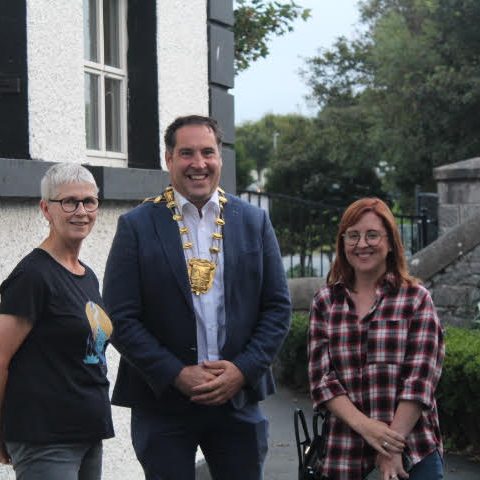
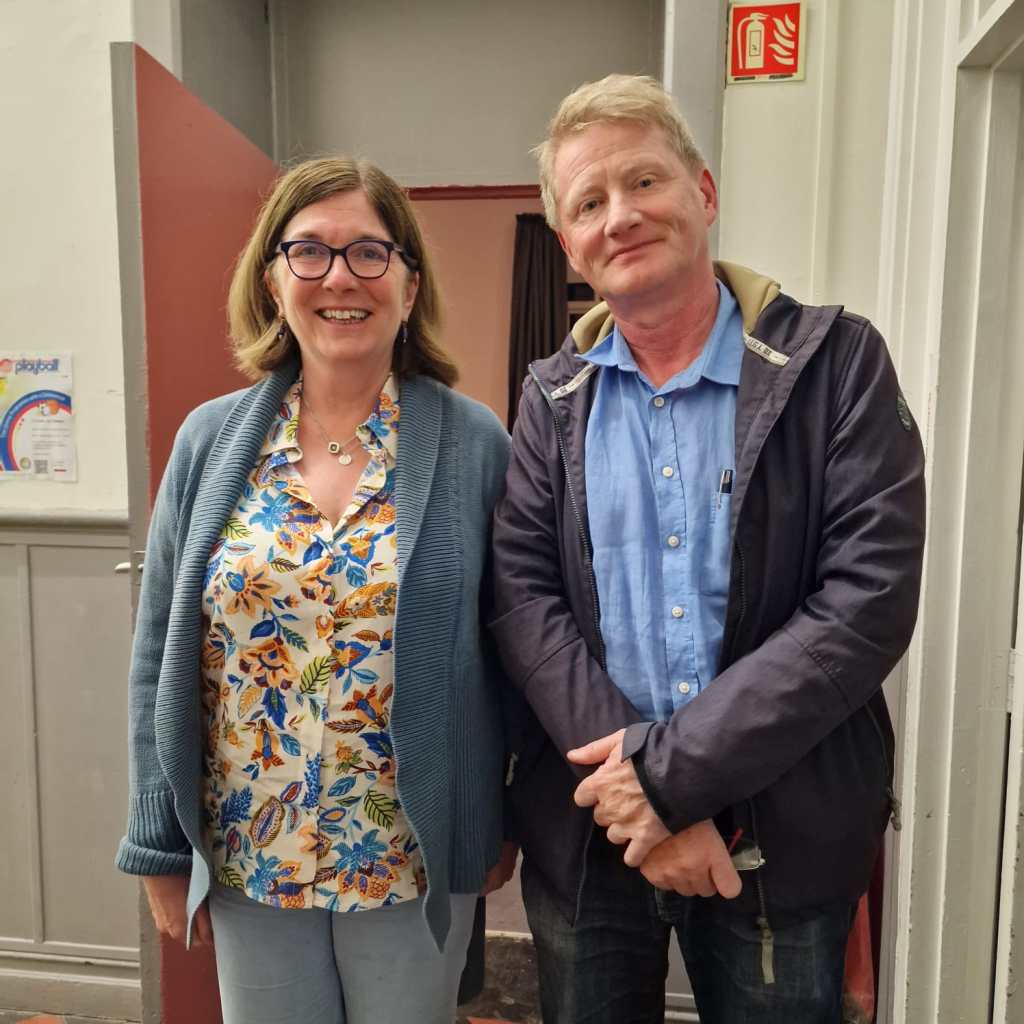
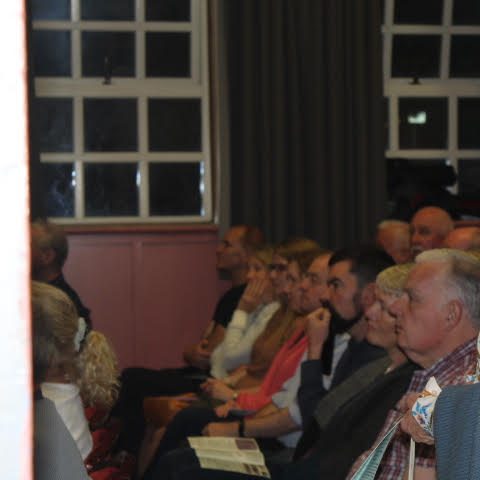

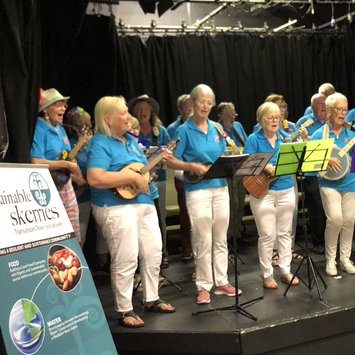

The evening got off to a harmonious start, with a wonderful selection of water-themed songs from the very talented Skerries Ukulele Strummers. From Bad Moon Rising to The Wellerman, they set an upbeat tone.
John Gibbons: Climate & The Everything Emergency
The first speaker, John Gibbons of climatechange.ie & thinkorswim.ie, gave a riveting and often alarming talk about the seriousness and urgency of climate change. More than once, there were audible gasps in the room at the scale of the emergency.
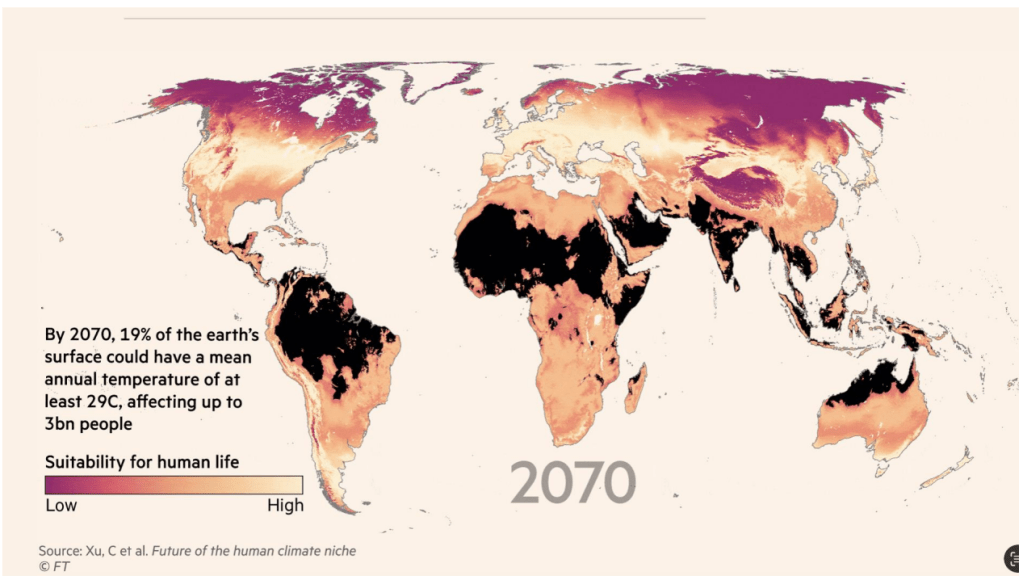
One image really hit home for me; it shows that 19% of the planet could be uninhabitable for humans by 2070, if things continue the way they are. Within my children’s lifetimes, 3 billion people could be displaced. A crisis of that size would have a huge impact worldwide.

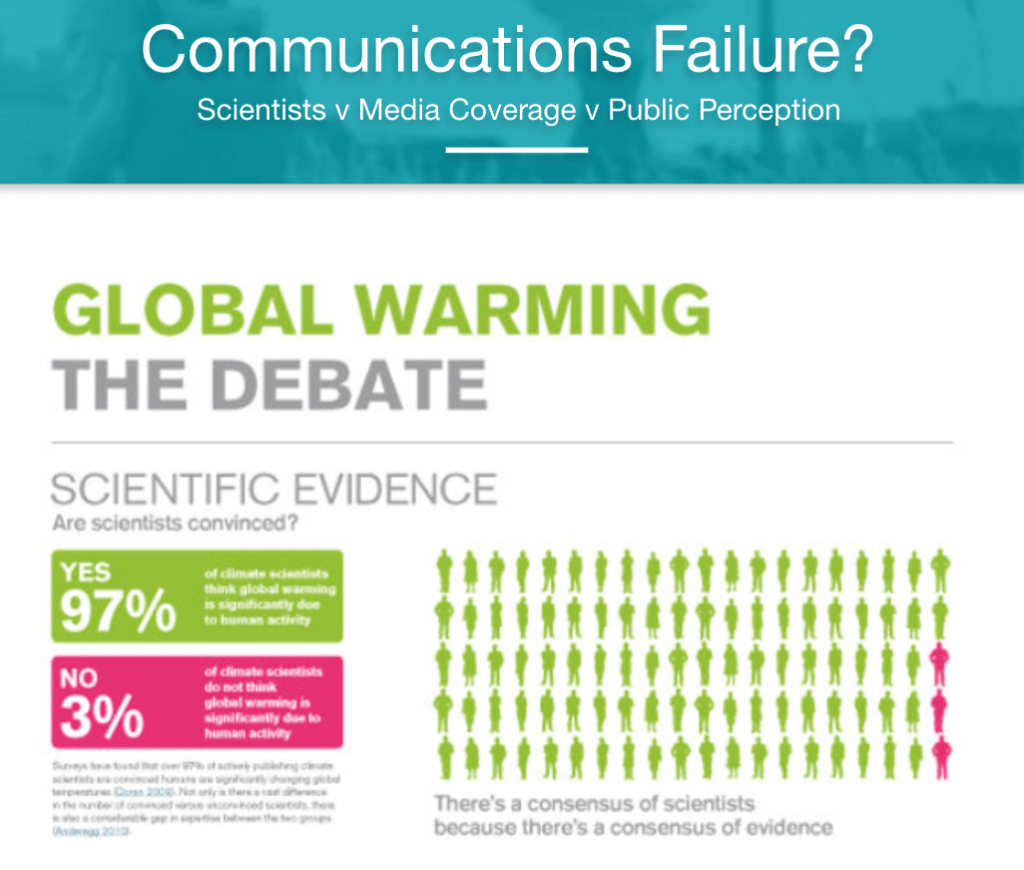
Another fact which has stayed with me, is the chasm between how scientists view climate change and how that is presented in the media, and the impact this has on public perception. Perhaps this isn’t surprising given how the media is owned and funded, but it presents a huge challenge for those trying to raise awareness and seeking action.

Speaking to people over the course of the Festival, there was agreement that we should try to ensure John’s message is spread as widely as possible. There was so much more than I have space to mention here, all of it riveting. I urge everyone to take a look *here* and to share it far and wide.
Hans Visser, Fingal Biodiversity Officer: Restoring Fingal’s Rivers, Wetlands and Marine Environment
Next up was Hans Visser, Fingal County Council Biodiversity Officer. He spoke about some of the challenges we face here in Fingal, and some of the many projects already underway to restore Fingal’s waterways, wetlands and marine environment.
Hans highlighted the importance of coastal ecosystems for climate change:

He explained that 2 of the biggest challenges in Skerries are the surrounding agriculture and the fishing locally. Clearly these are both complex issues to address, the need for food and local jobs must be balanced against their environmental impacts. It’s also clear though, that the potential benefits of improving water quality, and of restoration of ecosystems are massive.

Again, Hans made many more important points than I can summarise. See the full deck *here*.
Skerries Ukulele Strummers
Both talks were compelling, but they also made for very tough listening at times, so it was fantastic to hear from the Skerries Ukulele Strummers again. They finished with “What the world needs now is love”, which felt very apt.
Questions…
The first question put to the experts after their talks was “what can we do now?”. The answer on the night was to engage with politicians from all parties and make it clear to them that tackling climate change is an urgent and important issue to us. The size of the response required clearly means that structural change is needed. However, there are also actions which individuals, organisations and communities can take, to help at local level. Throughout the Festival we learned more about a number of these. We’ll share some of them in the coming weeks and months.
Skerries Eco Festival Photo Challenge
We closed the evening with the unveiling, by Skerries News’ David Diebold, of the water-themed photos he selected for our Eco Festival exhibition. The reasons for his choices were fascinating, and the variety and quality of the images submitted by Skerries photographers was very impressive. You can see more on these **here**. It was a beautiful reminder, if one were needed, of how lucky we are in Skerries to be beside the seaside, and how important it is for us to preserve and protect our shoreline for future generations.
DAA: Despair – Accept – Act
John had explained that the 3 stages of grief are, “Despair, Accept, Act”.
I left the Little Theatre on Friday night feeling inspired to learn more about what we in Skerries can do to help combat climate change, and to improve the quality of, and biodiversity in, our streams, rivers and shoreline. I was excited for the rest of the festival, and determined to do my bit to spread the word and figure out how we act.
What the world needs now is love. And action.

In another instance of the series of blogposts about our 2023 Skerries Eco Festival, Eithne O’Connell writes about the folk singing session hosted by Dónal Kearney and Sara Dennedy of the Skerries Folk Club.
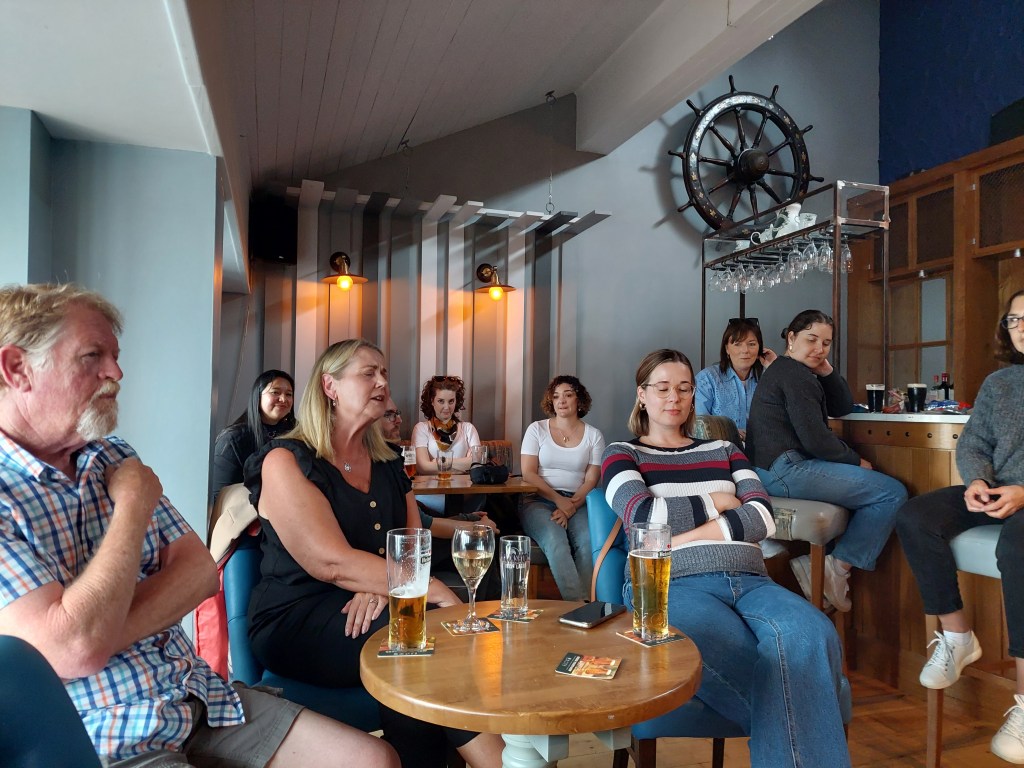
On Saturday, 2 September 2023, as part of the Skerries Ecofestival, the Skerries Folk Club held a special singing session upstairs in Joe May’s pub at the harbour. The event ran from 4pm to 6pm and was hosted by two of the Club’s founders, Dónal Kearney and his wife, Sara Dennedy. In keeping with the designated special theme of the Ecofestival, which was ‘Water’, the session was entitled ‘Songs of the Sea and the Sirens’.

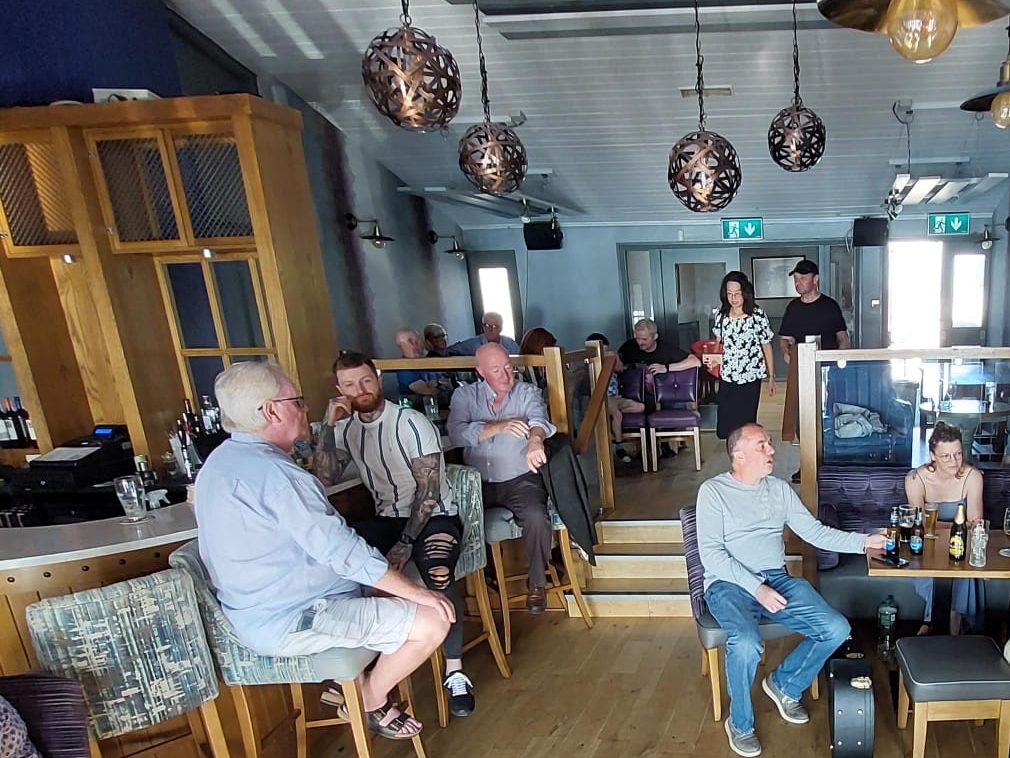

The Skerries Folk Club hosts a regular singing session at the same time and in the same venue on the last Sunday of each month so this extra session attracted some familiar voices as well as some newcomers. About 40-50 attended and visitors included people from the Dominican Republic, Poland and Lithuania, now living in Ireland. There were sea shanties and accounts of shipwrecks and drownings, references to ferries and seaweed, old ballads and new songs from Ireland, England and Scotland, some obscure and others very well known, at least to people ‘of a certain age’.
Anne McGough from Red Island, a Folk Club regular and fine singer, treated us to ‘The Grey Funnel Line’. Bob Laird, a great supporter, with his wife Anne, of eco initiatives in Skerries popped in for the first hour to reprise the rousing ‘Holy Ground’ before hurrying away to another festival event. The ballad was made famous internationally by Tommy Makem and the Clancy Brothers as well as the Dubliners in the 1960s and the chorus as always ‘made the rafters roar’. Later, Green Fingal County Council Councillor, Karen Power’s young daughter Olivia lifted our hearts with a beautiful version of ‘You are my sunshine’.
One of the session organisers and a member of Skerries Sustainable Energy Community Initiative (SSECI), Eithne O’Connell, went out on a comic limb with a ditty she had penned herself for the occasion just an hour earlier. Delivered to the tune of ‘Will you come to the bower?’, it made some serious environmental points with simple rhyming couplets.
As always, some of the real musical highlights were provided by the Folk Club organisers. Dónal sang about maritime links between Newry and Scotland alternating between Scottish Gaidhlig and English while Sara treated us to ‘Willie Taylor’. Versions of the English song about a young woman taking to the sea in the guise of a young sailor date back to the early 1700s. It’s a song full of adventure, betrayal and danger with a remarkably contemporary feminist twist and got more or less everyone present joining in for the chorus.
The Findhorn Eco Community in Scotland maintains, ‘If it’s not fun, it’s not sustainable’ and those in attendance at the singing session had plenty of watery themes to consider that afternoon while they certainly also had fun.
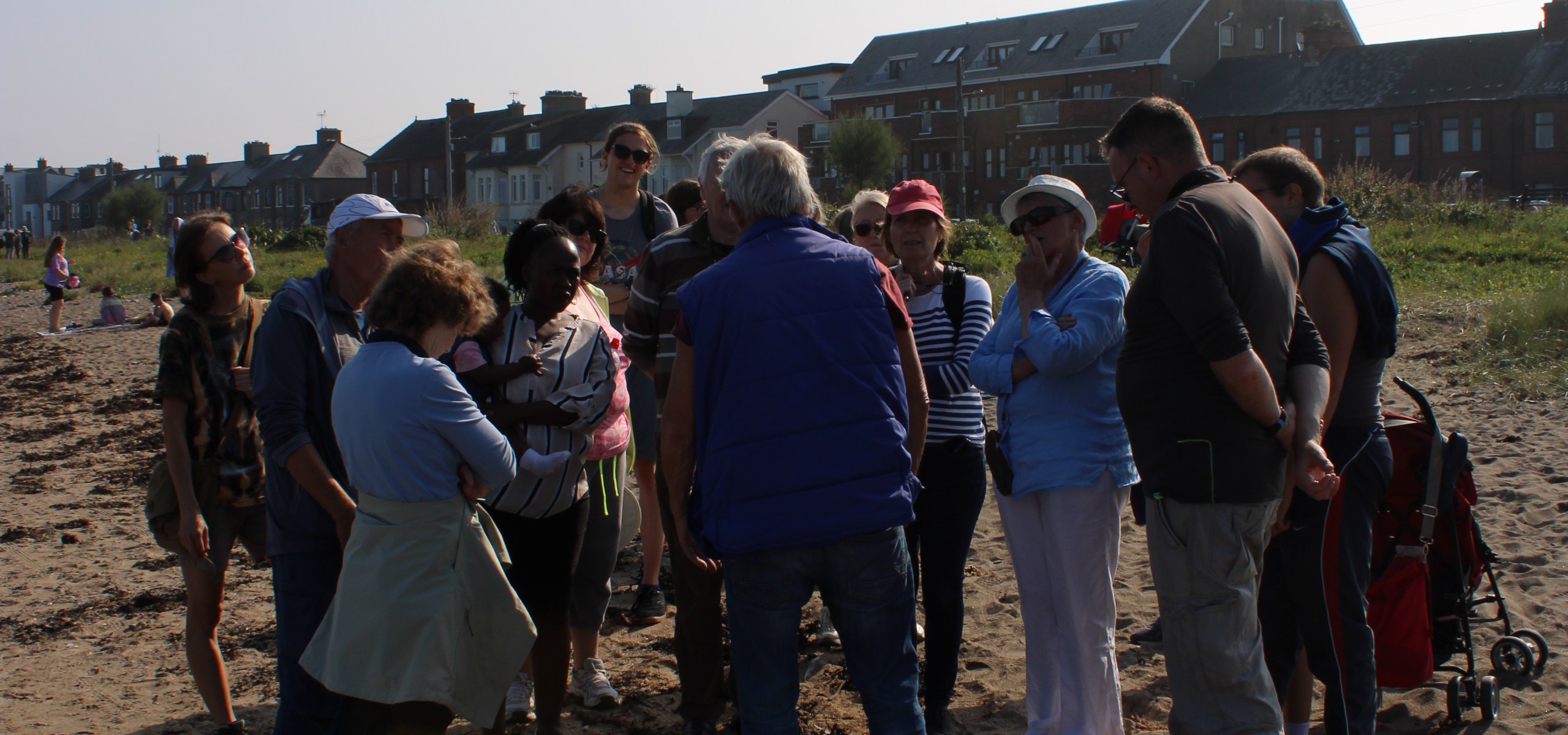
In the first of a series of blogposts about our 2023 Skerries Eco Festival, Leo Carroll writes about the Biodiversity Walk with Marion und Charlie Heasman.
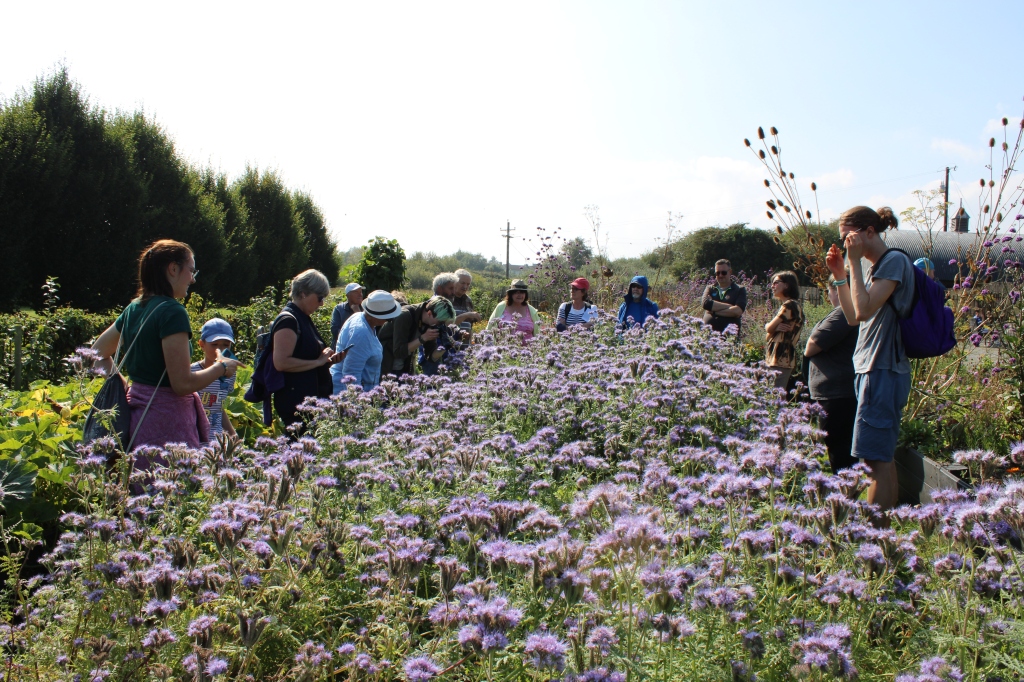
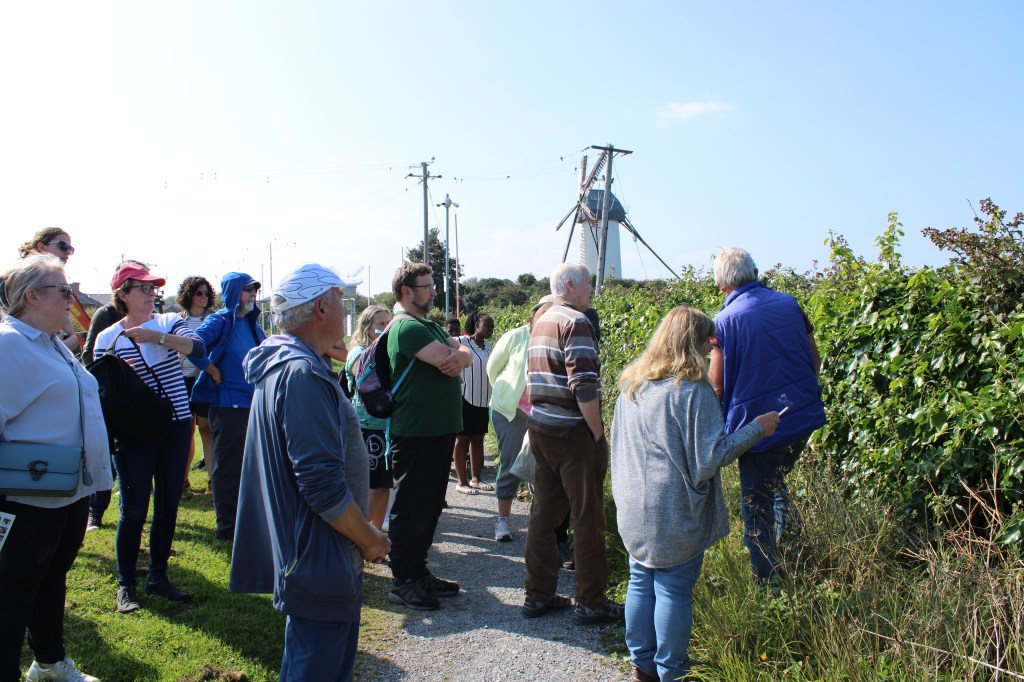
The Saturday Biodiversity Walk with Marion and Charlie Heasman began that afternoon, following the hustle and bustle of the farmer’s market. We started congregating next to the windmill flower beds bursting with colour and pollinators of all varieties. The purple phacelia blooms in particular seemed to be a fan favourite of the bees, with Charlie and Marion noting that every species of bumblebee currently found in Skerries had been spotted on the flowers; including some more elusive species such as the ever beloved large carder bee.
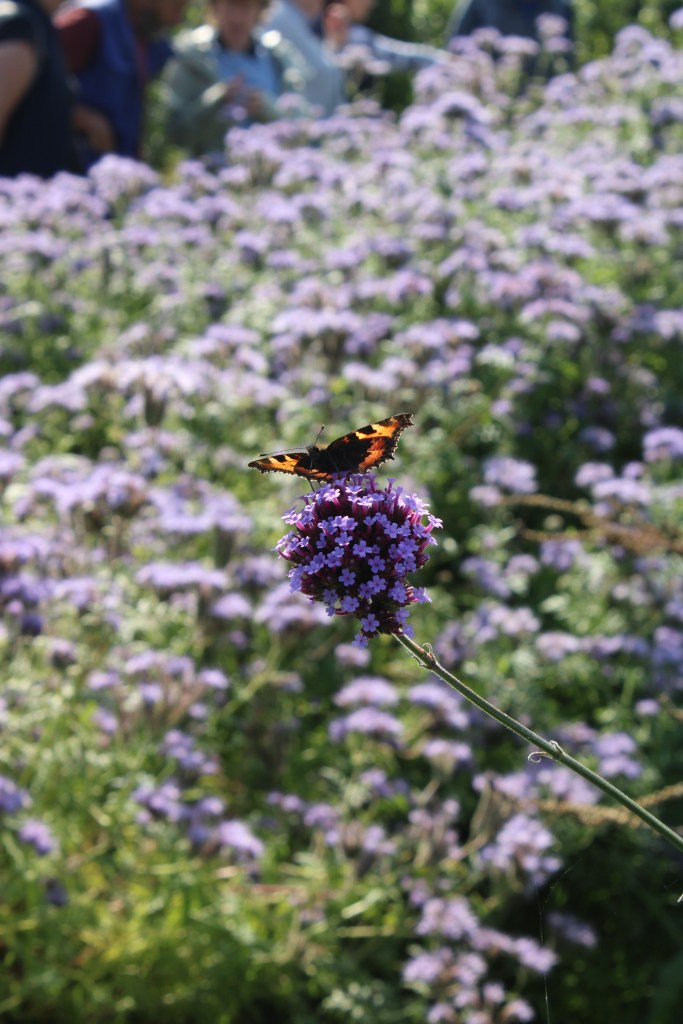
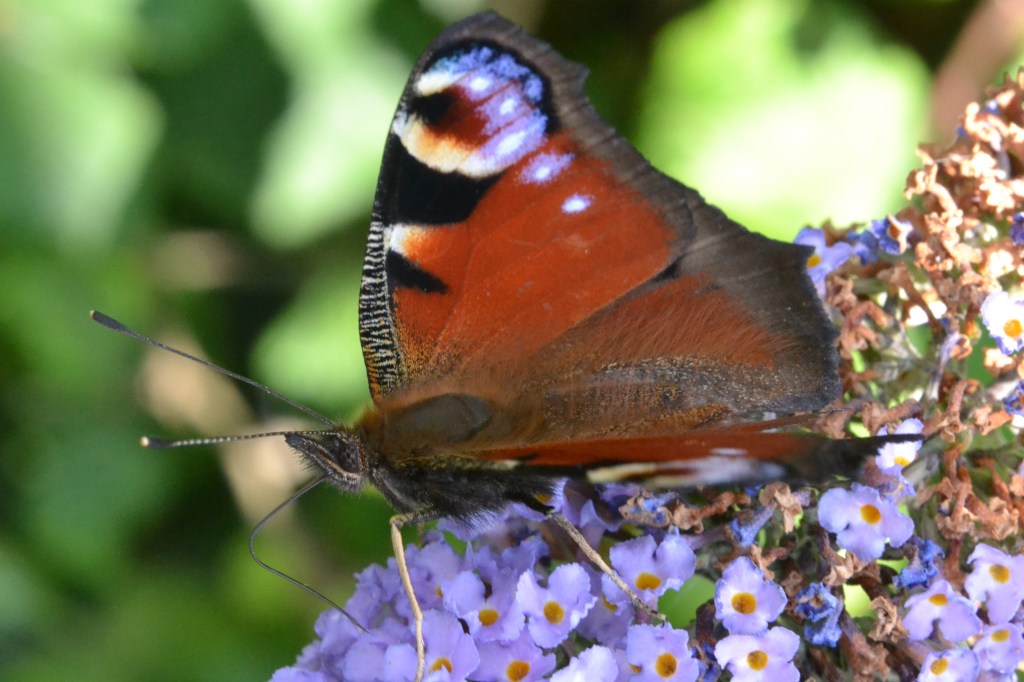
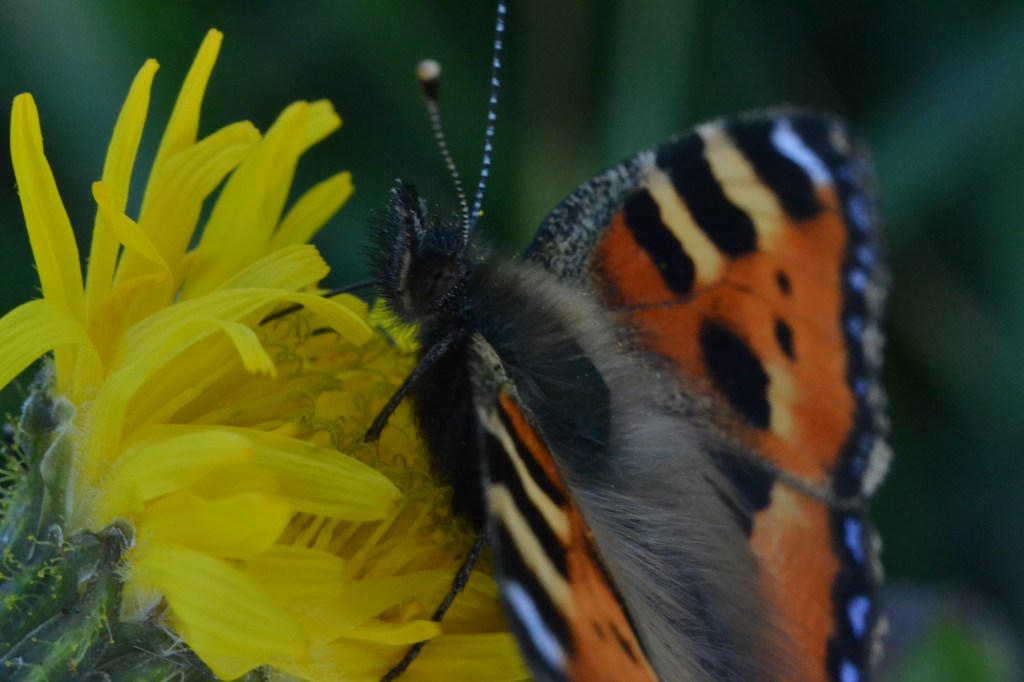
We made our way down to the coast, the bright sunshine and clear skies providing the perfect setting to admire the wildlife around us. After reaching the main promenade we split into small groups to walk along the dunes and learned about the fascinating plants and animals in the area, especially that of marine birds like black headed gulls and the iconic roseate terns of Rockabill Island. We learned about the flying motions of some species as well as the vast variety of plant life scattered about. Although there were a few unwanted visitors in the form of invasive species, there was plenty of life to be found, with grasshoppers and large tortoiseshell butterflies flitting between the vivid greens of marram grass and vibrant yellows of wildflowers such as birdsfoot trefoil.


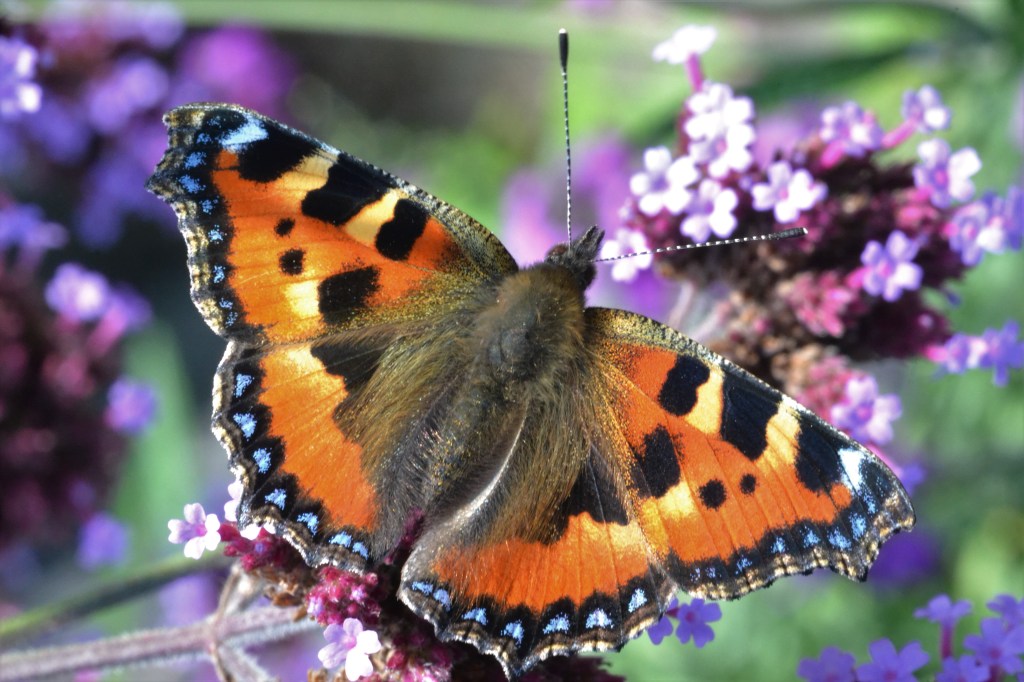
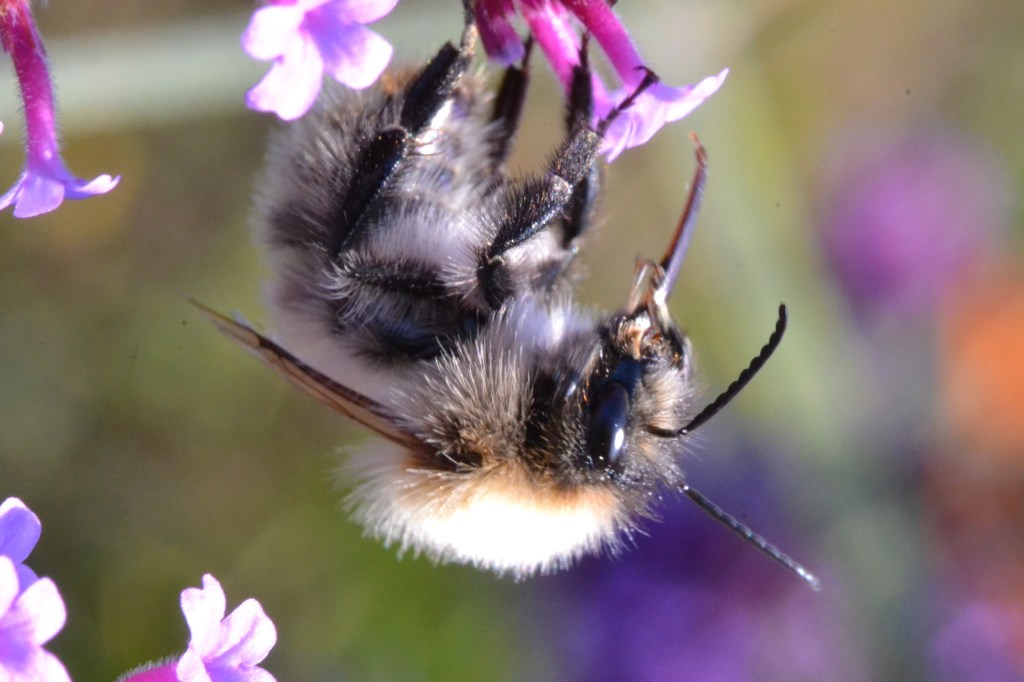
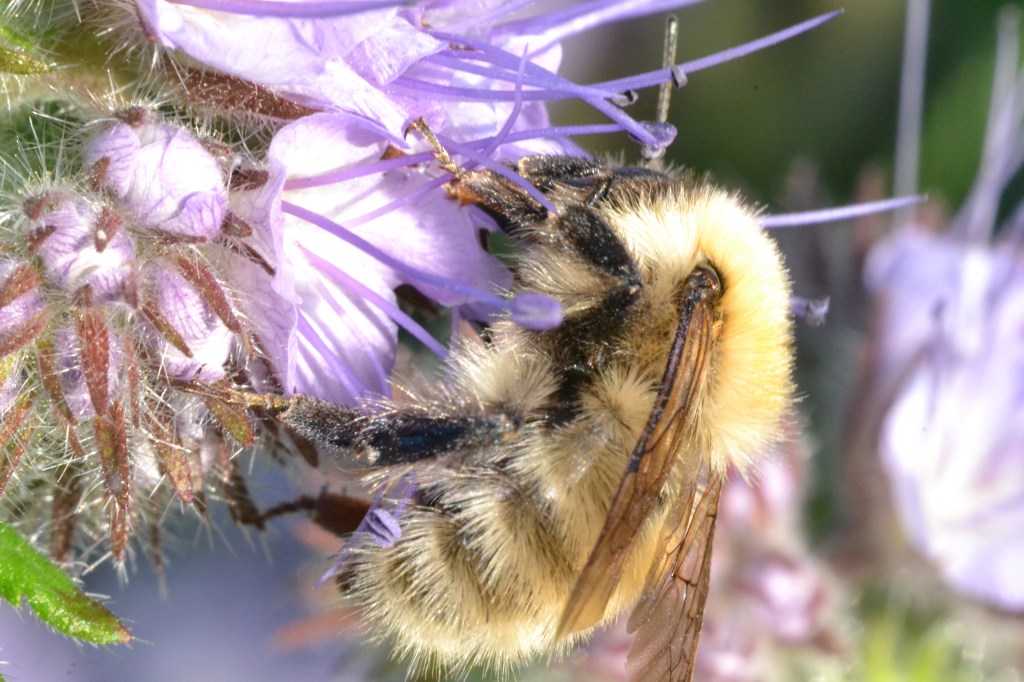
We eventually gathered together again near the base of the dunes to have a discussion about the biodiversity along the Skerries coast and decisions we could make to reduce our impact on the beach, with issues such as razor clam farming being brought up.
We took our time on the walk back to admire the duck pond while discussing the handling of relief water in Skerries and its surrounding area. The water’s surface rippled as though there was a light rain overhead, a closer inspection revealing hundreds of diving beetles gathering small bubbles of air before diving back down to their aquatic abodes. Overall the walk was a wonderful experience and provided insights into Skerries’ biodiversity that I’ll take with me every time I go for a stroll around town.

Our call for images with a water theme was met by a wonderful collection of entries – see all of them in this video – and then our exhibition curator, David Diebold of Skerries News, had the hard job of selecting ten to make up the Skerries Eco Festival Water Picture Exhibition. During the opening night, he shared his thoughts on each of the selected ten images – and he agreed to share them with you here now!
If you were at the festival, by the way, please send us your feedback now!
David Diebold’s Comments on the images he selected
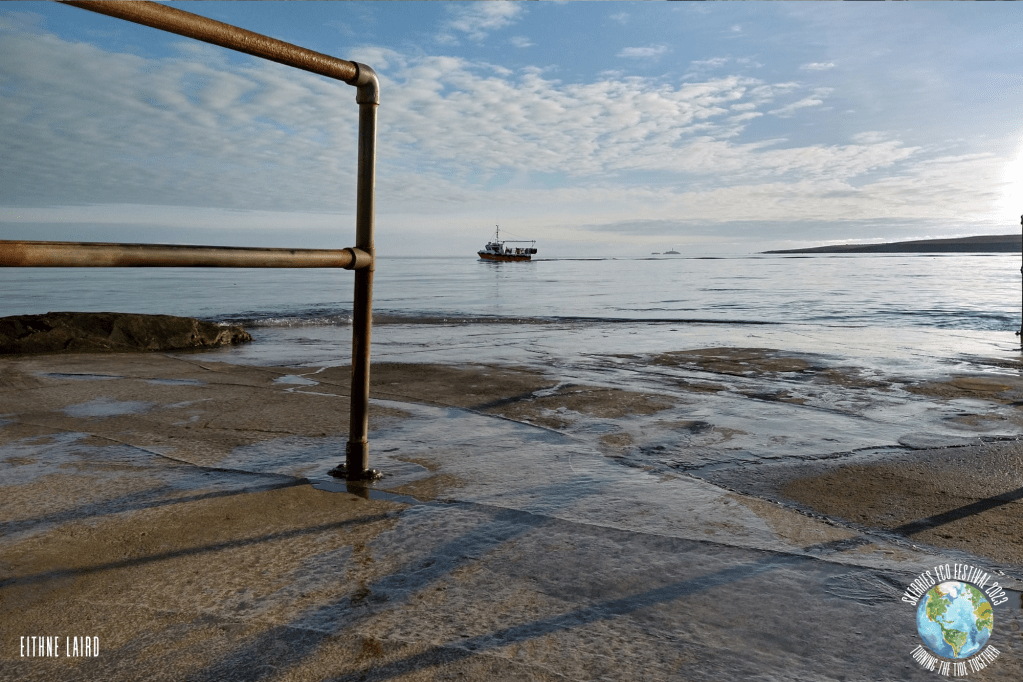
EITHNE LAIRD (railings)
A man-made structure that blends seamlessly into the natural environment, the sea beyond and the seemingly infinite horizon. And something finite, fleeting — shadows of railings stamping their silhouette into the concrete. A single boat representing our reliance on the sea in so many ways. The infinite and the finite. I can’t think of a better way symbolize humankind’s complex, often dysfunctional relationship with water and the natural world.
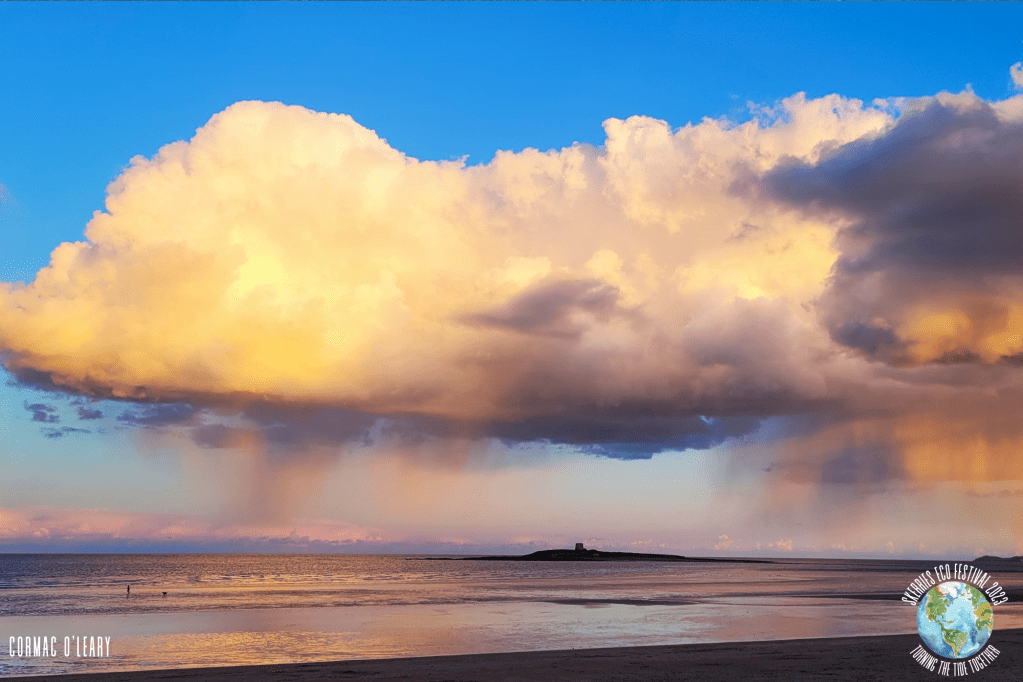
CORMAC O’LEARY (big clouds)
The ominous beauty apparent in this image is so perfectly apt in trying to wrap our heads around the sheer power of nature. Interestingly, the entire cycle of water is almost represented here – sea to vapour to rain and back to sea.
Ultimately, it’s just a bloody beautiful photograph.
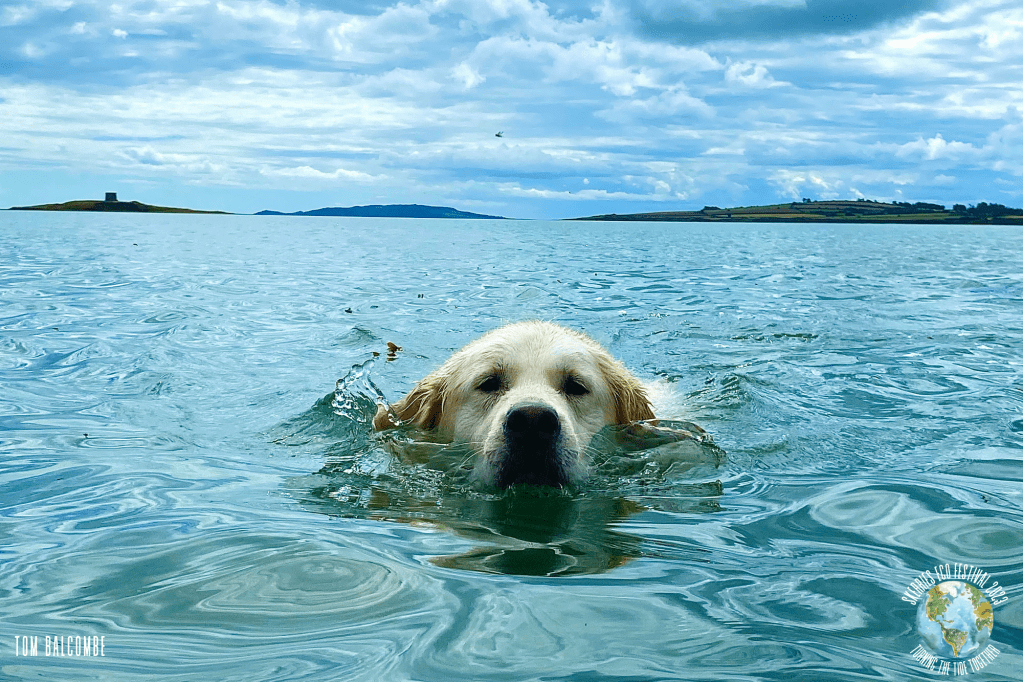
TOM BALCOMBE (happy dog)
It feels like we’re in deep with this dog when we look at this photo, and it could easily be interpreted as representing the rising waters of impending doom – in fact, I think this dog is in his happy place.
What’s beautiful about this photo, in which water is everywhere, is that I was able to zoom right in and appreciate every fibre on that dog’s head and drops of water frozen mid splash, all in crystal clarity. Outstanding.
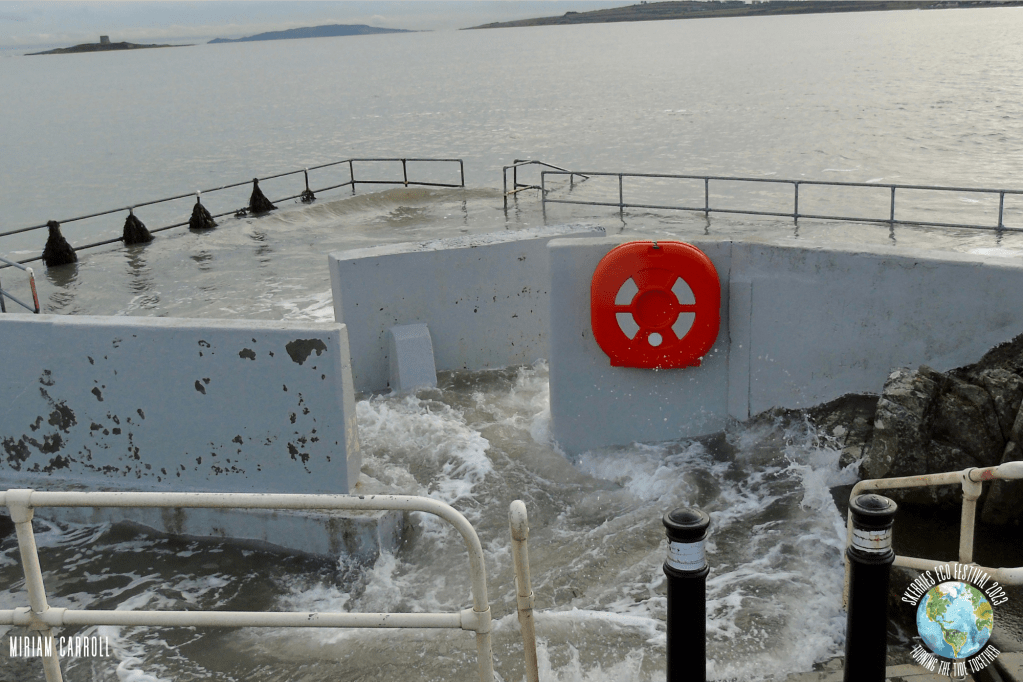
MIRIAM CARROLL (springers)
Rushing waters, action, urgency – nothing speaks to the potential for imminent environmental catastrophe quite like the tide consuming a man-made structure. What’s interesting is how that movement contrasts so nicely with the calm sea beyond, as though it’s all spilling over the edge of a bowl, and there’s the life buoy standing out so stark in the middle of it all.
Look how the horizon dips on one side like the whole image is a sort of sinking ship. It’s a familiar place to most of us, yet sort of scary in this context. Nice work.
RICHARD MARSH (rainbow)
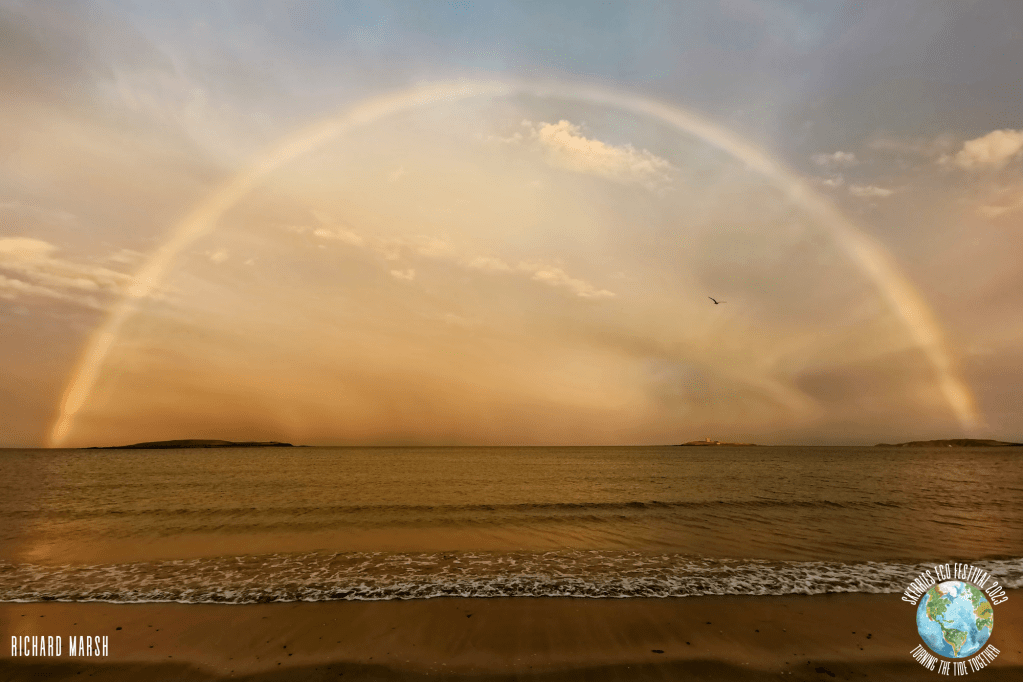
One of the best rainbow shots I’ve seen – and I’ve seen a lot, second only to photos of sunrises and sunsets when it comes to Skerries – yet this image is phenomenal.
Sand sea, islands, horizon, mist, clouds and sky, layer upon layer of sumptuous detail and colour, all tied together by this perfect ark that in any language says hope, change, renewal, themes that chime so well with what this festival and what the Sustainable Skerries group espouses. A fine photo.
JULIE BLUNDEN (blue sand)
The blue of this image is so rich and deep, like a cold blue light in the dawn of a new day at low tide, green seaweed on the rocks emerging from the wave-textured sand.
For the colour contrast alone this exhibition needed this image, but the way it is structured and how it brings our eyes from bottom to top and into the skies beyond the island is ingenious if it was intentional, or it was a very lucky, beautiful accident. Well done.

ERNESTINE WOELGER (Ladies’ Mantle)
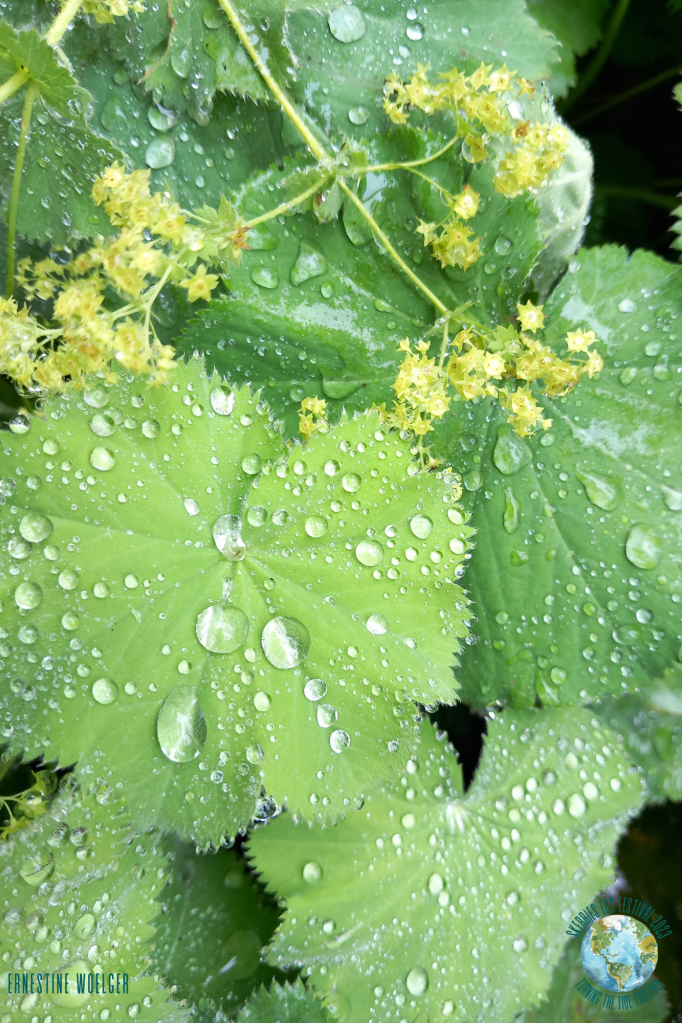
I didn’t want seawater to predominate this exhibition, when fresh water is so vital to the living environment on land.
I thought this image, again a strong addition to the palate of the overall ten, perfectly encapsulated how precious fresh clear water is, whether this is rain or dew, and also the simple beauty that is the very fragility of the life that water sustains.
MARY COURTNEY (clothes pegs)
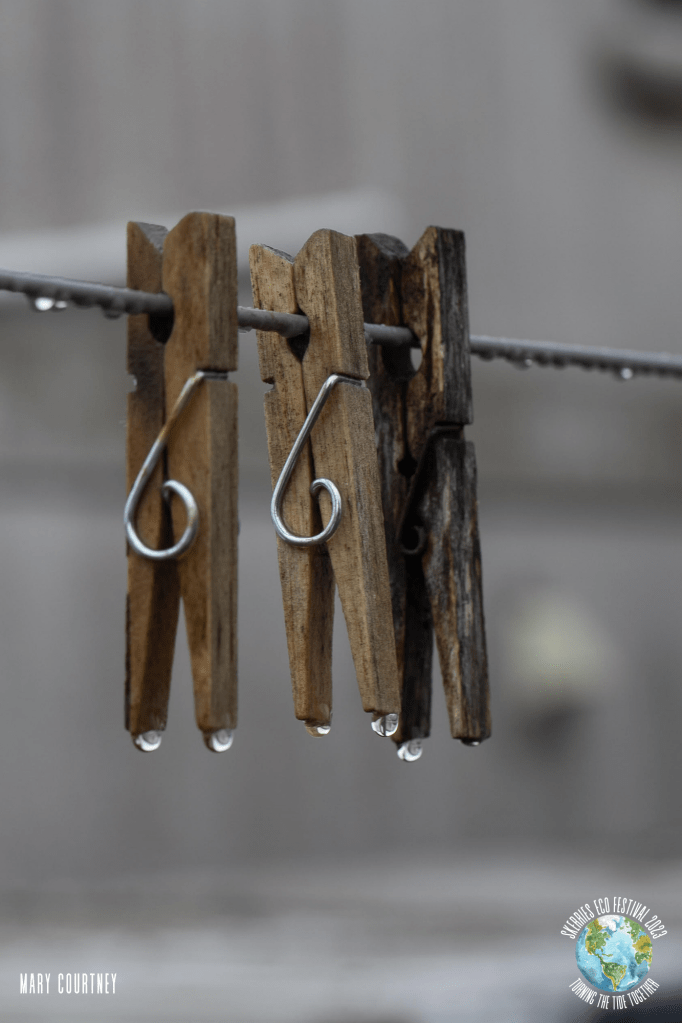
Not a great day for drying. But I loved the simplicity of this shot, and how the photographer saw something interesting, even beautiful in its own way in these three old fashioned wooden clothes pegs – hanging on, which I think would be a good title, amid the drips of rain.
It’s an image that almost holds its breath waiting for one of those drips to drop.
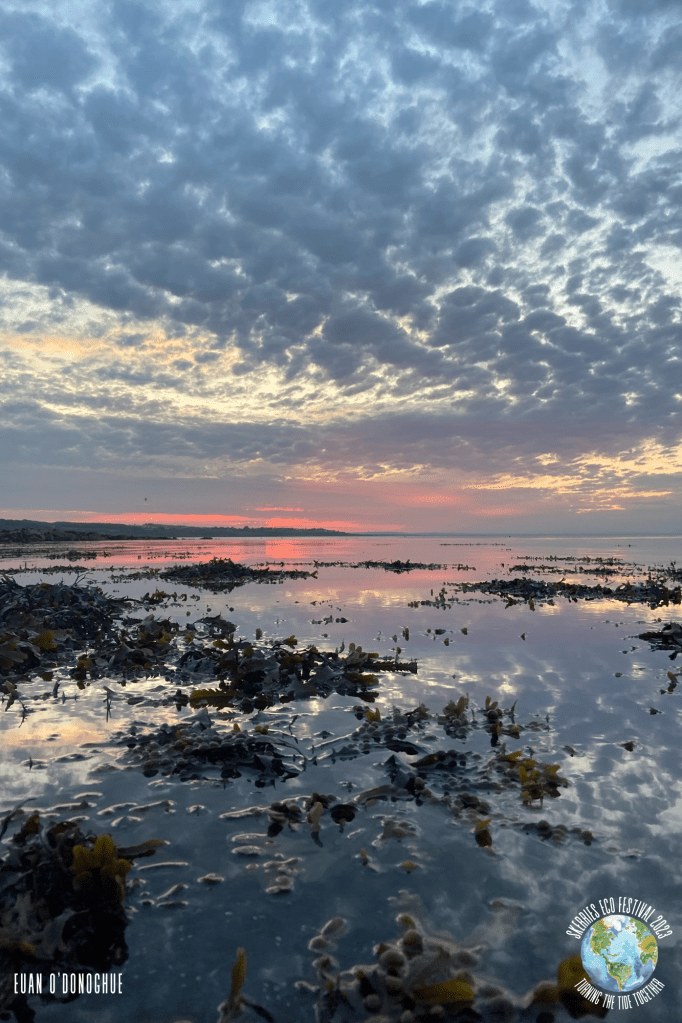
EUAN O’DONOGHUE (reflection)
A moment of reflection, literally. I’d be a fan of John Ford’s statement, so perfectly characterized by David Lynch in Spielberg’s Fabelmans, horizon at the top, interesting, horizon at the bottom, interesting, horizon in the middle, boring. But I’d certainly disagree with that sentiment here.
The perfect split between sky above and sea below has the eye trading off and comparing beauty with beauty. The calm silence in this image of seaweed floating on the surface. Frozen clouds. The blood red meridian.
Another photo that seems to hold its breath.
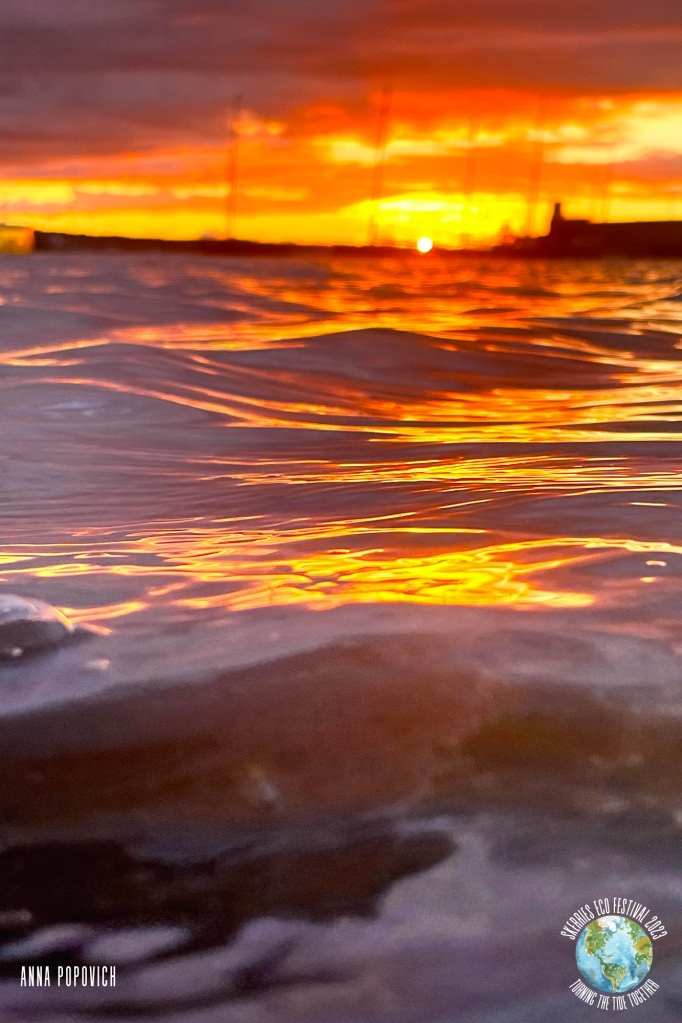
ANNA POPOVICH (sunset)
Like I say, sunset photos are no rare thing around these parts, but this one is truly something special, reflected in a sea that feels like we’re up to our necks in once again.
Simultaneously beautiful and terrifying. Rather like nature itself.

The Skerries Eco Night: Water (Sat 7.30 pm, Skerries Mills) is taking place as part of the 2023 Skerries Eco Festival. It will give individuals and members of groups & associations the opportunity to first learn more about water and environmental issues as they relate to us here in Skerries, and then to explore together what we can, and should, do with that knowledge.
If the first two Eco Nights are anything to go by, you’d be well advised to secure your space soon on our Eventbrite page!
Two presentations will set the context:
We are delighted to have won Karin Dubsky of Coastwatch Ireland. The well-known environmentalist will talk about “Coastal Biodiversity and the Importance of Enhancing and Protecting It” – those who have heard her before know what a treat is in store for us.
Féidhlim Harty, environmental consultant, writer, and director of FH Wetland Systems, will then talk about his observations on water management and Skerries, “Between Floods and Droughts” – in our changing climate, both occurring more than they used to. (Féidhlim also leads a talk & walk about water in Skerries in the afternoon, highly recommended.)
After a quick break for refreshments, everybody will then have the opportunity to explore in detail what we in Skerries can do for coastal biodiversity, and to mitigate the current changes we’re experiencing.
As with the previous two Skerries Eco Nights, we are hoping for interested individuals as well as representatives of neighbourhood groups, clubs, organisations, associations and businesses to come together in the congenial surroundings of Skerries Mills.
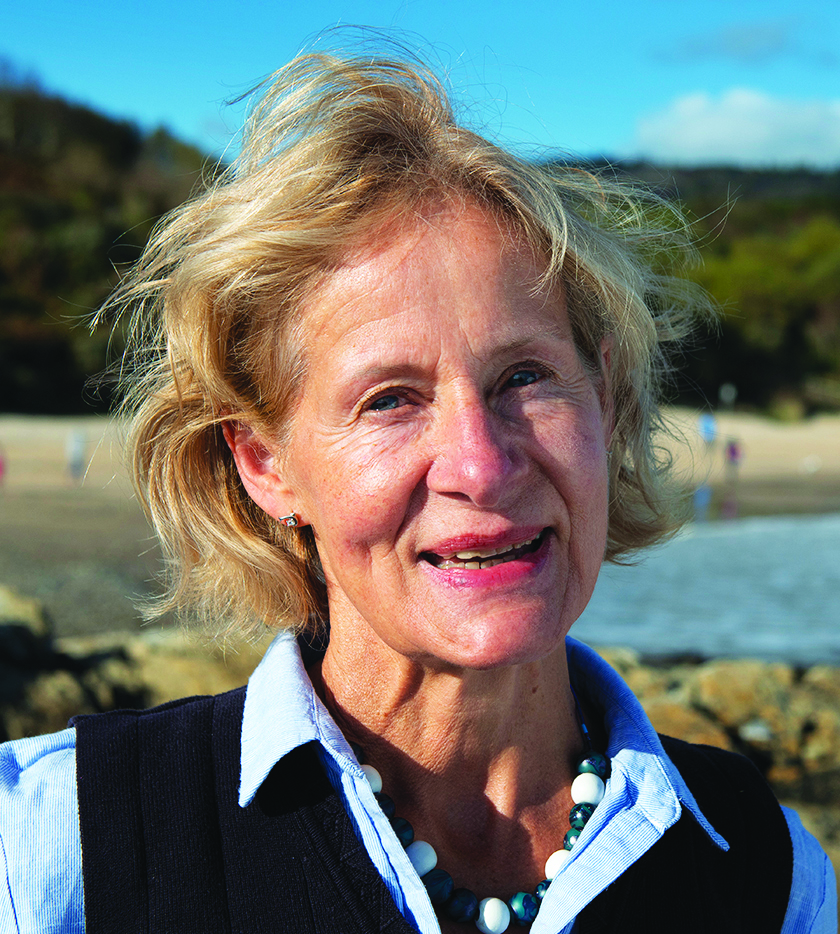
Karin Dubsky is a German-Irish marine ecologist working in Trinity College Dublin, notable as an environmental activist, the coordinator and co-founder of Coastwatch Europe, an environmental NGO and a member of the European Environmental Bureau.
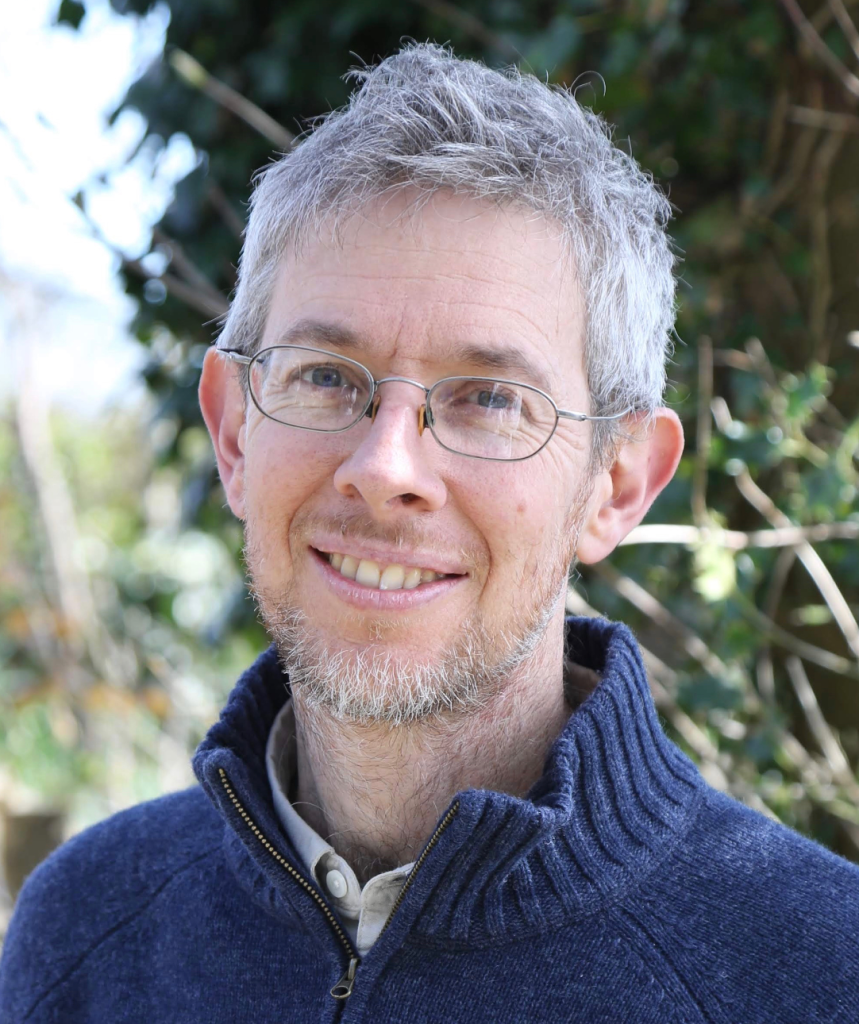
Féidhlim Harty is an environmental consultant and writer. His company, FH Wetland Systems, established in 1996, offers designs and guidance on waterway repair and rewilding, eco-friendly wastewater treatment training and education, and holistic landuse management for catchment protection and regeneration.

When the sirens called, you did not want to hear it.
If their song caught your ear, it lured you to your doom. There was no way to avoid catastrophe once you heard those intoxicating strains. The sirens’ melodies rang out so beautifully as to drive the listener insane. Invariably, seafaring men were their target.
Unfortunately, sirens put an end to many the sailing voyage. We know the culprits thanks to those surviving boats that returned to shore unscathed. Local crews would witness their friends and relatives perish from a safe distance (out of earshot). Forever more, certain rocky shorelines were doomed and sailors took a wide berth.
These spots would trigger alarm bells and boats were warned not to approach in local stories, folklore and songs. These lessons were learned the hard way in port towns and fishing villages over many cruel centuries, after countless tragic deaths at sea.
To this day, our relationship with the sea remains complex. If we listen, we may still hear alarm bells ringing, but these are not due to supernatural melodies or mythic creatures. Rather, it is a cry for help.
The seas are suffering.
On our planet, water supports all life forms. Every human society needs clean water to survive. With an unprecedented global population of 8 billion people, we need more clean water than ever before.
However, the impact of the climate crisis on our water sources today is concerning. As droughts become increasingly frequent across the world, the process of water conservation becomes more urgent. With extreme rainfall and storms leading to more frequent and devastating floods, we face increasingly difficult questions about our relationship with water. The amount of plastic in our seas is a well-documented crisis and affects the complex and delicate ecosystems that nurture our oceans and our coastlines – including coastal towns like Skerries.Inspired by the global climate action movement and icons like Greta Thunberg, local volunteers will host the inaugural Skerries Eco Festival on 1st – 3rd September 2023. This will involve environmental workshops, live music and family fun and together we will celebrate the fact that “Water is Life”. The intention of the festival is to bring together the local community, as voters, citizens, consumers “to give ourselves the space to see what is happening, to explore together where we could go.”
One of the groups getting involved in the festival is Skerries Folk Club, founded in 2022 by musicians Sarah May Rogers, Sara Dennedy and Dónal Kearney. They usually meet upstairs for a free singing session in Joe May’s on the last Sunday of the month, but they’re hosting a special session for the Eco Festival at 4pm-6pm, upstairs in Joe May’s, on Saturday 2nd September. Singers and listeners of all ages are welcome – please come prepared with a water-themed song!
Traditional Irish folk songs boast a wealth of sea lore about emigrant boats, war ships, fishing wreckages, and the various creatures that inhabit our coast lines; the maighdéan mara (mermaid), the selkie (half-seal, half-human), and the sirens of Greek mythology.
There is much to learn if we listen to the old songs. There is a reason folk songs survive for generations – they have something important to pass on. As we listen carefully to the songs of the sea during Skerries Eco Festival, there is no doubt we will hear the wisdom within.
You are invited to listen with us.
—
Skerries Folk Club will host “Songs of the Sea and the Sirens” at 4pm-6pm on Saturday 2nd September 2023. For more information about Skerries Eco Festival, visit sustainableskerries.com/skerriesecofestival
Guestpost written by Dónal Kearney, Director of Ecojustice Ireland – ecojusticeireland.org