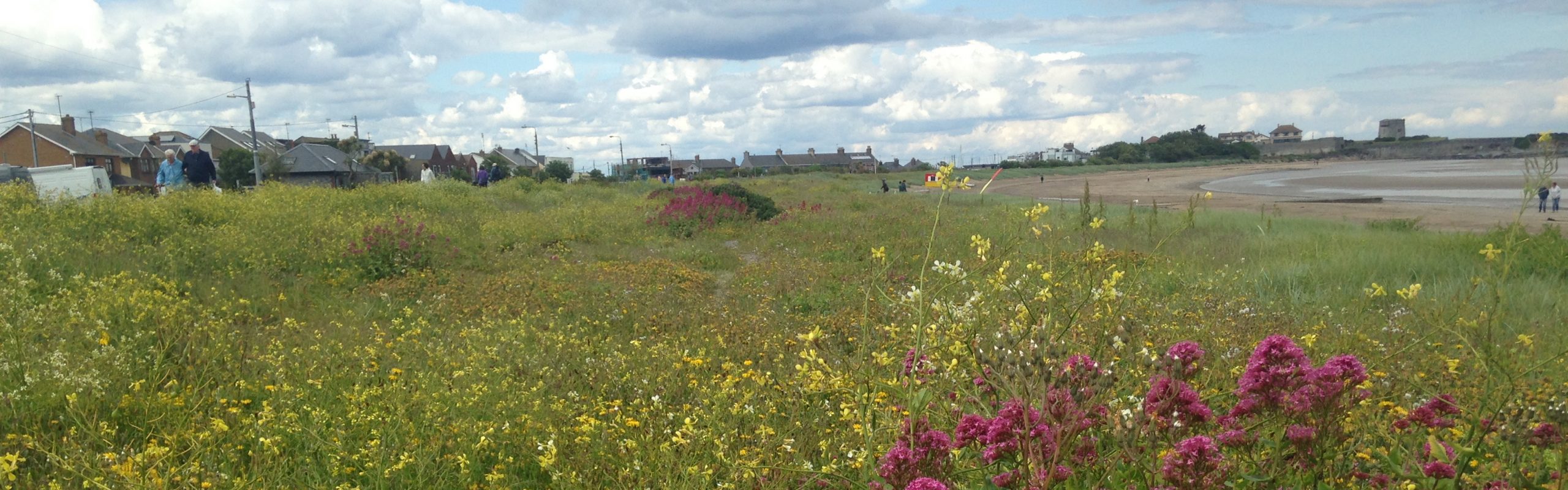
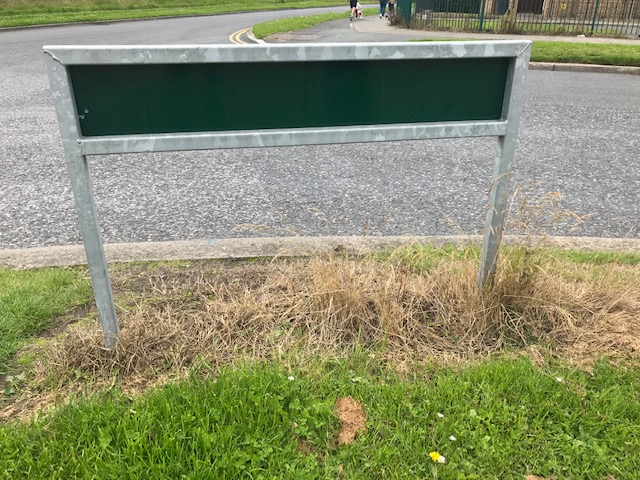
Just over a year ago I wrote a post here entitled “Time to Rethink Our Approach to Grass Verges”. You may care to read it either for the first time or to refresh your memory if you read it last year.
In case you feel you have no time to do so: I bemoaned the fact that we are so obsessed with neatness and grass mown-to-within-an-inch-of-its-life and wondered if we could not take a more enlightened approach that allowed nature a chance. Cut higher; cut less often; allow flowers to grow and please, please stop spraying weedkiller everywhere.
The post included this photograph, with the observation that the poppies were probably doomed because Fingal CC would soon come along and spray them.
I was wrong; they didn’t.
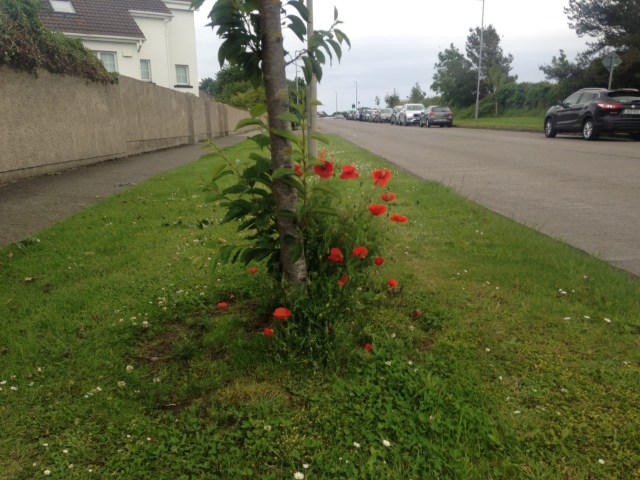
Not last year anyway.
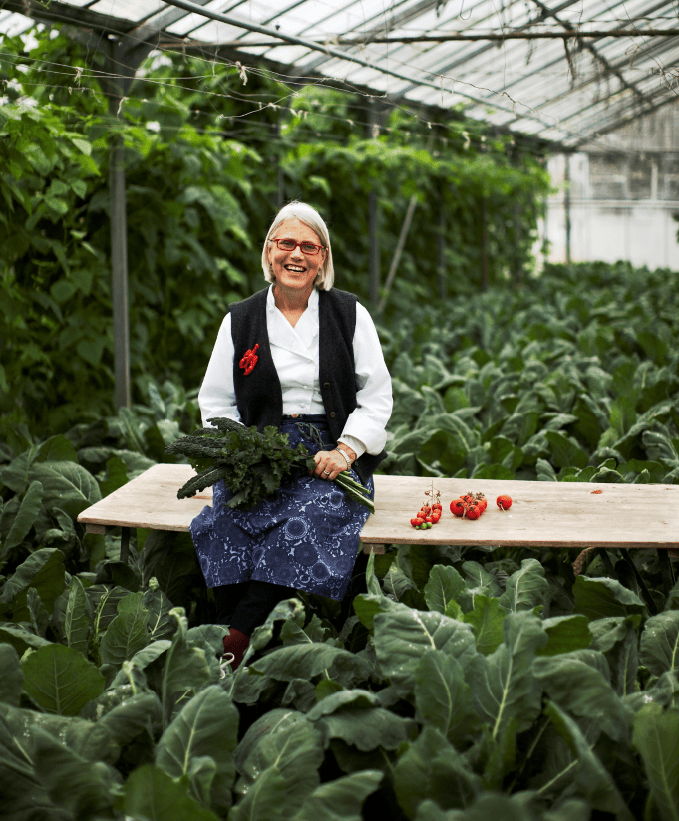
Recently, Darina Allen was in town! Well, she was here virtually on Wed 24 June 2020 and talked to over fifty Skerries residents in a web event organised by us here at Sustainable Skerries. She gave an inspiring and energising talk about our food, our environment, and our health and was joined by our own Karen Power, local Green councillor, self-confessed foodie and member of the Barnageeragh Residents’ Association – you might know her from the No Drive Through campaign and her regular parenting column in Skerries News.
Both Darina and Karen said we need to respect our food, for our own health’s sake, for the environment’s sake, and for our community’s sake.
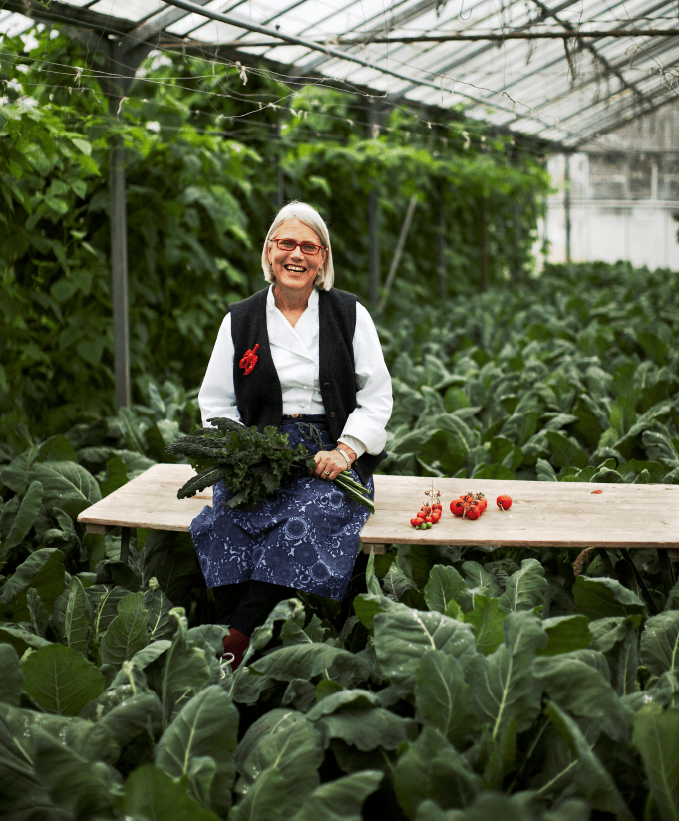
Darina, a trained and renowned chef who founded the Ballymaloe Cookery School in 1982, became a household name through her “Simply Delicious” TV series and her many cookery books. The latest, One Pot Feeds All, not only won her yet another World Gourmand Cookbook Award this year – it also became the go-to book for many of us who were searching for recipes for nourishing food for our families during lockdown.
Read MoreIt would be fair to say that most of us these days acknowledge that bees are in trouble; most of us also realise that if bees are in trouble we will soon be in trouble ourselves. Serious trouble.
Our response varies: some of us actively try and help out, others hope and trust that someone else will do so, others again believe that they can’t make a difference, and there are those that neither know or care.
I would like to see far more people in the former category and less in the last, which is why I write this stuff.
But why are bees in decline? For that matter why are all pollinators and associated insects in decline? Some say that the causes are complicated and hard to understand; I say that is complete nonsense; we only have to open our eyes and ears and see the obvious.
Try these explanations for size:
Insecticides
Herbicides
Habitat loss
Starvation
Let’s take them one at a time, starting with insecticides.
We can’t really drive around the countryside and see what is going on in this regard but we do know that far too many are being used far too indiscriminately with disastrous consequences. Spraying against a fruit moth to produce perfect unblemished peaches is a great short term solution for French fruit farmers and the fussily demanding buying public because it kills fruit moths. Surprise, surprise, it also kills everything else. The EU tries to get the worst of the sprays banned; the big chemical companies such as Bayer fight back to protect their very considerable short term profits. And they have the money to do so.
Meanwhile French farmers, eager to keep producing an expensive high end product, nip across the border to Spain where restrictions are more lax and import the same banned chemicals on their own behalf.
Irish farmers don’t grow peaches, so no problem there, but you’d probably rather not know what or how many sprays go onto our tomatoes and strawberries.
So that’s insecticides out of the way, surely herbicides aren’t a problem here?
Unfortunately they are. Weedkiller might be intended to kill weeds but at the end of the day it’s very toxic stuff. If grassland is sprayed and bees happen to be foraging on flowers there at the time they will ingest it and die. Beekeepers have been known to lose whole hives this way. Even where good neighbour arrangements exist and a beekeeper is warned to either move his hives or keep them shut up for the day this is of no use to wild populations of bees which are going to die either way.
Habitat loss and starvation are pretty much the same thing. Here’s a photo taken at the back of Skerries a couple of weeks ago.
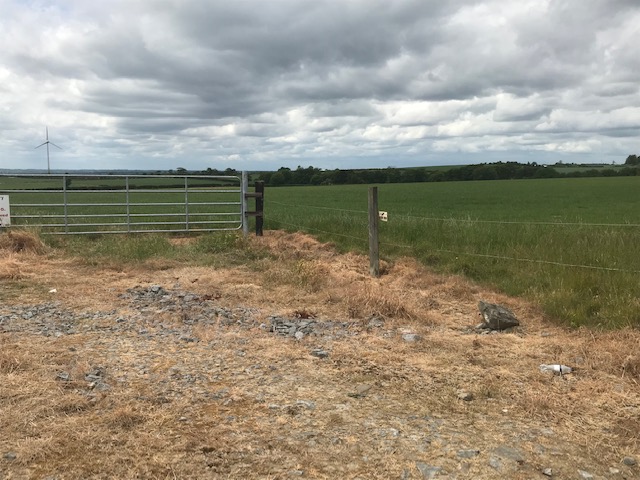
It shows acres and acres of monoculture with not a flower in sight. Worse, the entrance to the field has been spayed to kill all wildlife.
Why?!!
It’s as if someone has said “there’s 50 acres of countryside that nature’s not getting, and she’s not getting this bit either”.
Ironically, not quite visible in the photo is a notice proclaiming this to be a game sanctuary!!
Whoever did this is not alone, here’s another example a few miles away:

I cannot for the life of me understand the mindset of someone who does this. What’s the point? Fortunately not all farmers do this of course, but there are far too many who do.
With all this going on in the countryside it is not so much surprising that bees are in decline; it is almost surprising that there are any left at all.
It is now being realised that much of modern agricultural practice is not sustainable in the long term. It seems to have served us well enough up to now by putting cheap food on the table (too cheap in a way, worldwide we throw 40% of it away) but things have to change. Someone (can’t remember who) speaking on the subject recently said “agriculture is a big ship, and big ships take a long time to turn”.
Until that ship is turned bees have one last refuge in which to survive: your front or back garden.
Compare and contrast the pictures above with these, both from Skerries:
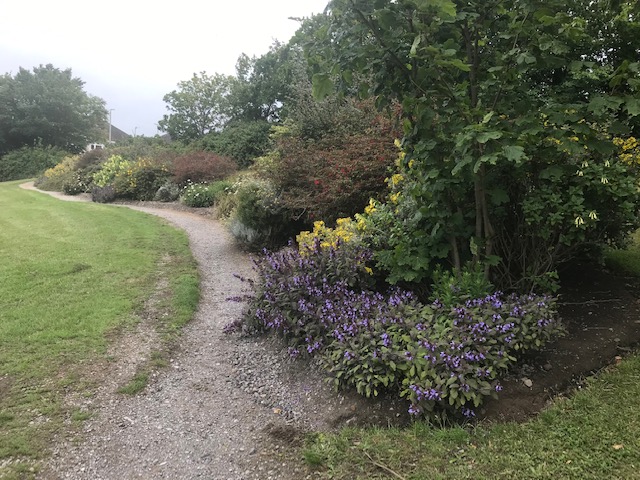
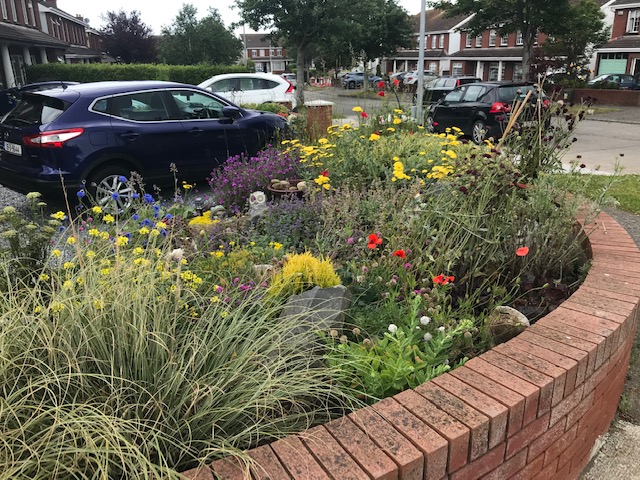
Both are alive with bees.
I have no idea who tends the garden in the top pic, but do know that the owner responsible for the garden below selected pollinator friendly plants and wouldn’t dream of using sprays.
I don’t see the necessity of using herbicides at all in our gardens. hoeing, mulching or digging is all that’s needed in the beds, and if you have problems with weeds growing between paving stones a quick application of malt vinegar does the job.
——————————
Bees, in my experience, are very largely misunderstood. Which is a pity.
Bees can sting, so everyone assumes they will. Unless threatened they will not. A dog can bite, a cat scratch, and a Dublin bus flatten you to a pulp but no-one runs around in a panic shouting and waving their arms about whenever they see one. Bumblebees are by far the most docile of the four.
Are bumblebee stings more painful than honeybee’s? I don’t know. Despite all the messing about observing, peering at and brushing past bees that we do, my wife and I have yet to be stung. (Our friend Eugene was recently stung twice by Bombus muscorum when he accidentally disturbed their nest. He said it was no worse than being stung by a stinging nettle. I’ll take his word for it).
We have 21 different species of bumblebee in Ireland. It was 20 until a couple of years ago when the European Tree Bee, having some time previously crossed the English Channel, managed to traverse the Irish Sea and arrive on our East Coast. The first sighting was in Dublin, the second in Belfast. Makes you wonder if they took the ferry.
Some species are doing considerably better than others; some are in serious trouble. So couldn’t we afford to lose a few?
The answer is no. Different species have evolved to fit different environmental niches. Eugene’s B. muscorum, or Large Carder Bee feeds predominately on vetches, Kidney Vetch in particular. The bee needs the vetch and the vetch needs the bee. It is also worth noting that of the seven bumblebee species we have so far identified in Skerries this is the rarest, being currently classified as near threatened conservation status. In fact Skerries appears to be something of a stronghold for them. Well worth protecting.
For those who haven’t seen it before, here’s a pic. South Strand this time last year.
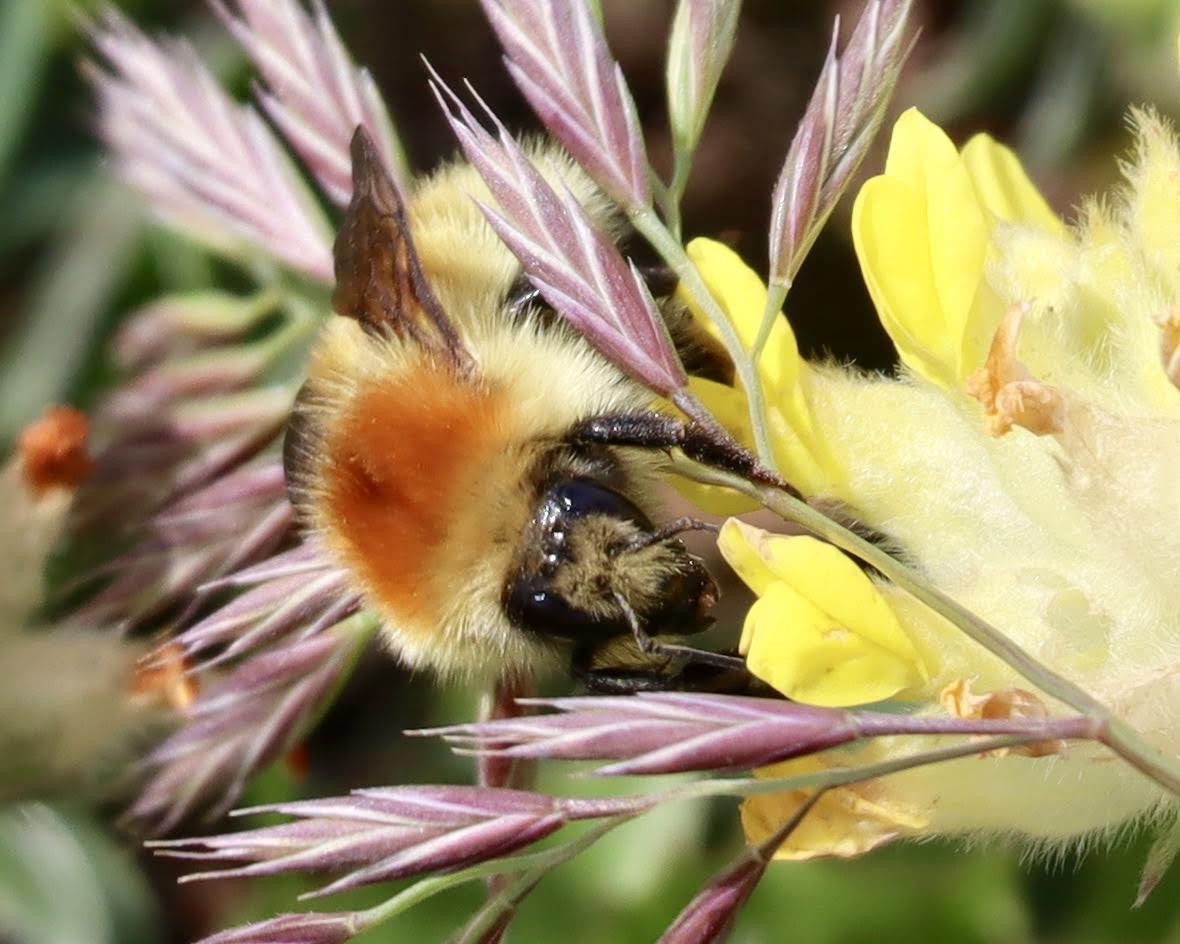
The Garden Bumblebee, Bombus hortorum, is also found here although it is not as common as might be expected.
This bee is a specialist feeder that has developed an enormously long tongue which can reach deep into flowers other bees cannot reach. In fact it can be nearly half as long as her head and body combined. When not in use she rolls it up and stores it in her purpose-built elongated head.
Selskar Road, earlier this year.
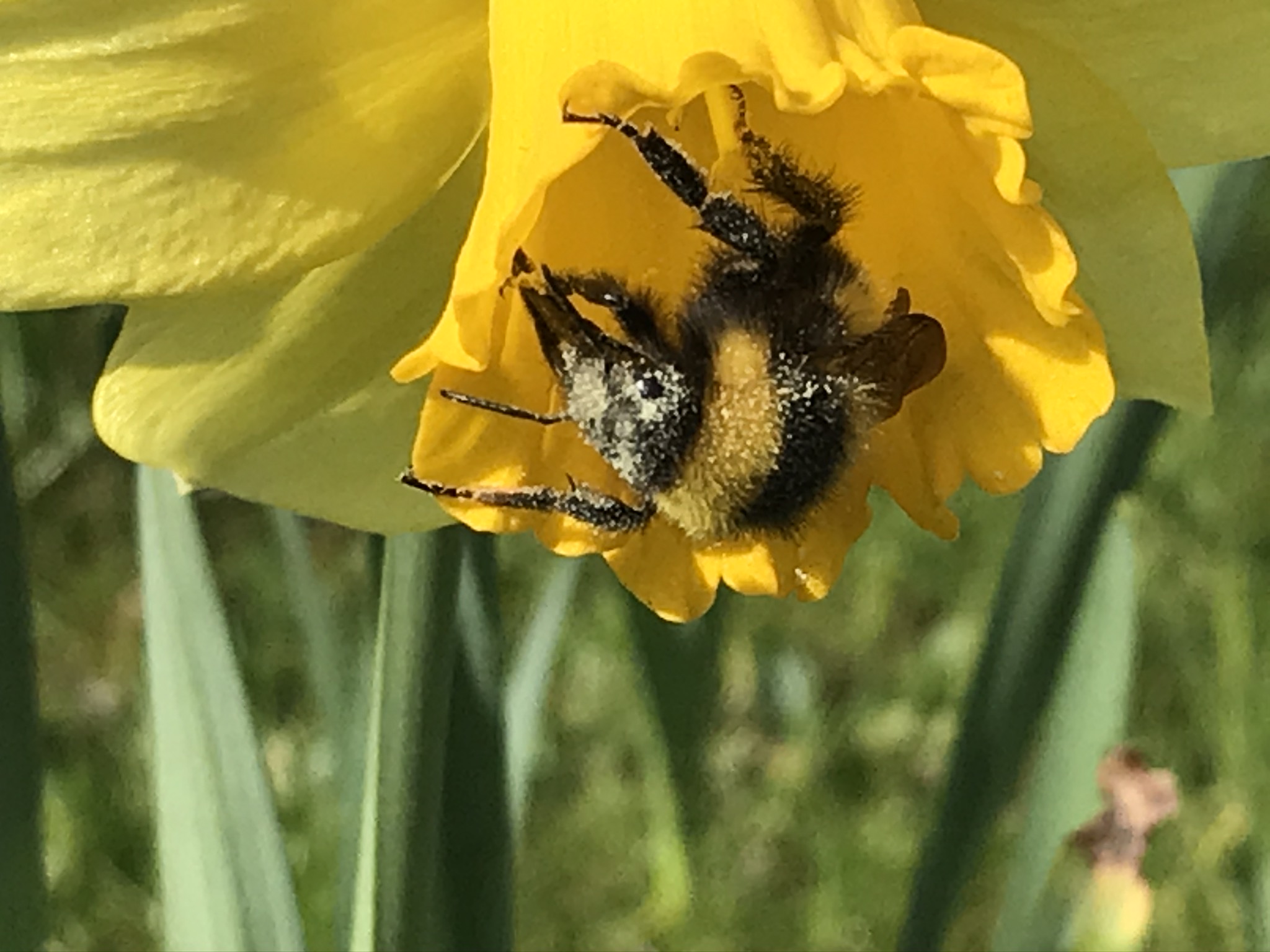
This, believe it or not, is a bumblebee related picture, but what’s going on here? Both strawberries from the same plant by the way.
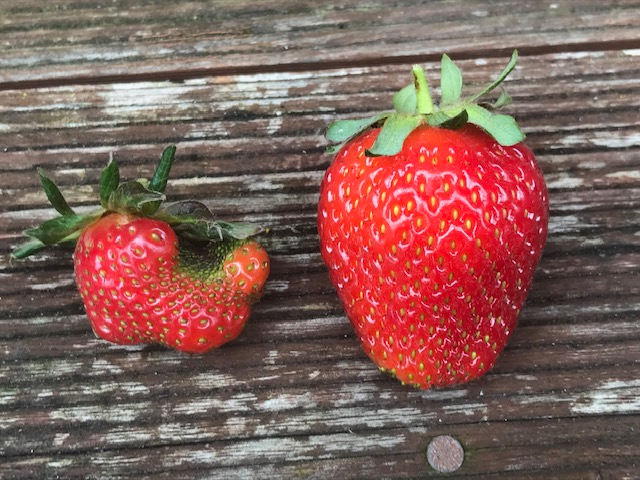
The answer is that bumblebees are the best ever pollinators of strawberries, far better than honeybees or anything else.
The strawberry is actually a compound fruit: all those pips represent individual fruitlets. If they are not all pollinated fairly evenly the result is the specimen on the left; if the job’s done properly we get the one on the right.
Bumblebees have developed a technique called ‘buzz pollination’: they hover over the flower vibrating their wings at exactly the right frequency to blow up a cloud of pollen. Some of it coats the bee’s fur from where she can comb it out and store it in her pollen baskets, which suits the bee; the rest evenly pollinates the flower, which suits the strawberry plant. It also suits us.
So if you want perfect strawberries get yourself a bumblebee.
I hope in this post that I have not given the impression that all farmers are irresponsible destroyers of the environment; that was not my intention. There are good and bad in all walks of life and there are a lot of conscientious and responsible farmers out there.
The problem is that in many cases they have been and still are encouraged to, indeed driven to, work the land in an ultimately unsustainable fashion. This as a result of both consumer demand (us) and Governmental policy (EU farm subsidy system), not to mention pressure from agrichemical companies intent on profit maximisation.
I do not retract or mitigate my contempt for those who wantonly spray round gateways or anywhere else that is not crops.
I DO hope that I might have convinced a few people that bumblebees are not nasty little stinging insects to be avoided and feared, Get to know them folks, you’ll be surprised.
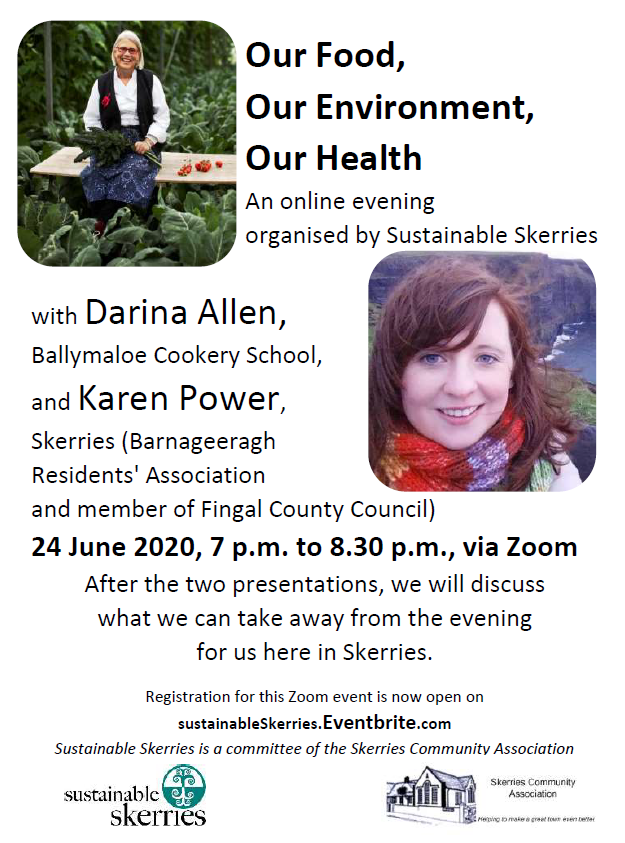
An online evening with Darina Allen and Karen Power: 24 June 2020, 7 p.m. via Zoom.
There is so much talk about food, nutrition, agriculture, the environment, our climate, our health… we are all aware that we ought to do something. As individuals, as those buying food, as those preparing it for others, as those growing it. As parts of our community and as citizens.
But what actually can make a real difference? What are the things we ourselves can do?
Our two speakers will address these questions from different angles, and then all will have the opportunity to add and react to their inputs.
We are delighted to have Darina Allen, well-known chef, author, and presenter of television programs, for the overall perspective, and Karen Power, Skerries resident and Green Party Councillor, for a focus on what we in Skerries can do. See below for more about our two speakers!
And go to SkerriesFoodEvent.Eventbrite.ie to reserve your space.
Through this event, we of Sustainable Skerries hope to ignite the debate around our local food web, the environment, and our health.
We have to limit the number of participants to 90, so reserve your (free) space as soon as possible!
This event is free. If you like, you can make a donation to Sustainable Skerries, which we will then pass on to Darina Allen for her chosen charity, the East Cork Slow Food Educational Project which raises money to educate children from nine local primary schools on sowing seeds, keeping chickens and teaches them how to cook using fresh seasonal produce.
Read MoreAnyone walking down the Selskar Road might notice a front garden that’s both vibrant with colour and buzzing with bees. The garden belongs to Cathal Copeland and Sustainable Skerries talked to him to find out why and how he made it.
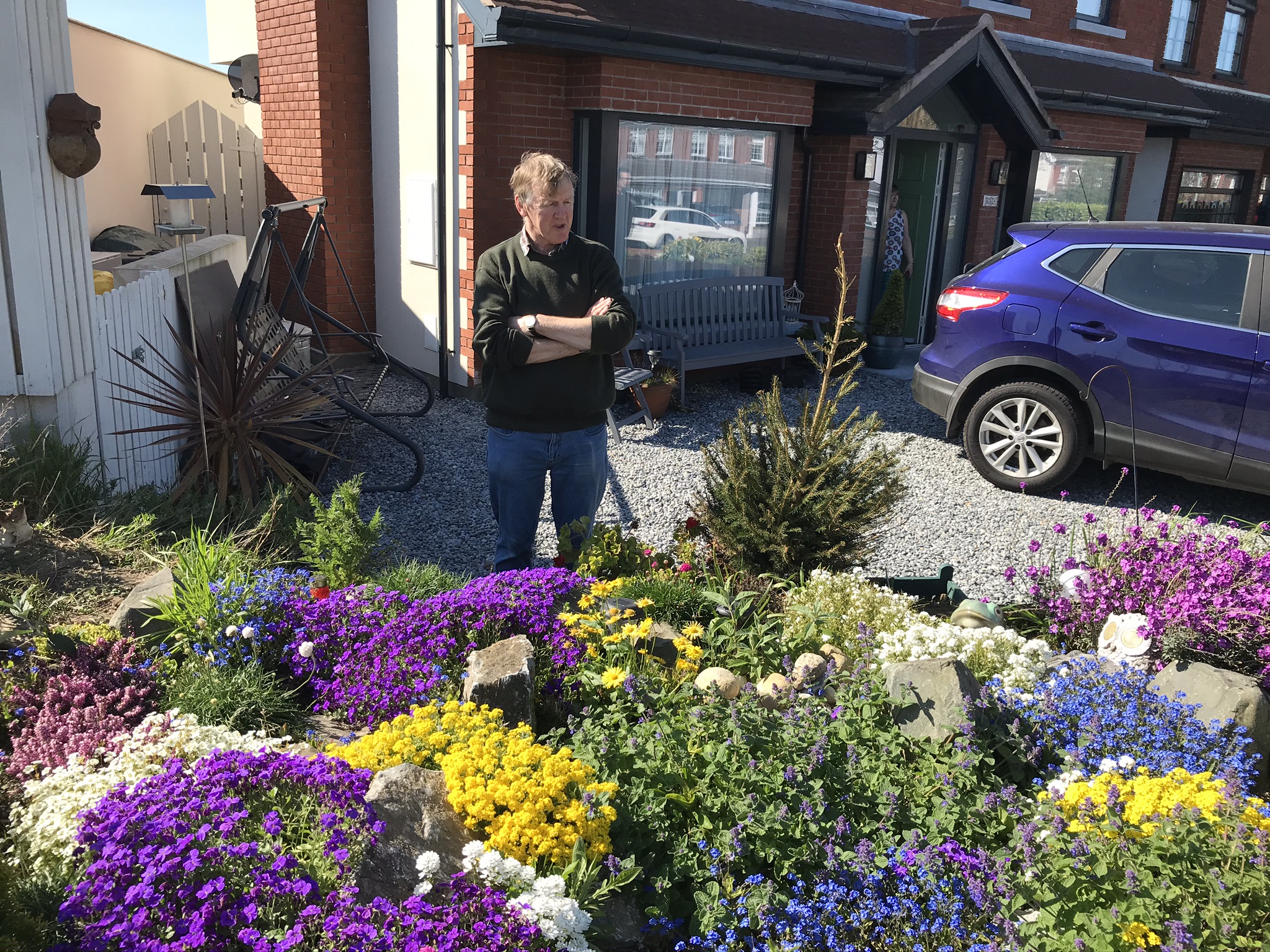
Cathal in his garden. Birdbox top left
Sustainable Skerries: First of all, tell us a bit about yourself.
Cathal: I was a teacher in Blackrock College and was their Green Schools Coordinator. I’m semi retired now and do three days a week. I think it’s really important to teach kids about biodiversity and in fact they love it when you do. Once you get them interested in that all the other Green tenets follow on. For my part I’ve always been into ecology, particularly birds, but of course all things, birds, insects, plants are inextricably interlinked anyway. If you help one you help the other.
SS: And the house? I believe you had it built yourself. Tell us about that.
C: That’s right; we had it built a couple of years ago. The problem was that it necessitated taking down some trees. We tried to avoid it but it couldn’t be done. I felt bad about that and decided to put something back, so to speak. Thus the garden. It doesn’t just attract bees; we get birds as well, so I feel better about that.
(As we talked a pair of nesting blue tits were flitting in and out of the birdbox on the garden fence).
SS: When you built your beds did you add to or amend the soil in any way?
C: No. Most of the fill came from the site, plus I had to buy some bags of topsoil. But no compost or other enrichment.
SS: You describe yourself as an amateur gardener, did you feel the need to consult a professional in any way?
C: No, not really, despite this being the first time I’d built a garden from scratch. Anything I’d done before was what you might call heritage gardening: where I’d simply carried on an existing garden that someone else had started. I did have a friend help me with shrub selection for the back, but I pretty much knew what I wanted for the rockery out front.
SS: So how did you know which were the best pollinator plants?
C: To be honest I simply went to the garden centre, looked at the labels and bought the ones that said “pollinator friendly” on them.
SS: And wildflower seeds? Did you try any?
C: I certainly did, and I was gobsmacked by how they grew. About this high and smothered in flowers. [He holds out a hand and indicates a metre]. My problem this year will be finding space for a repeat sowing. The perennials have filled out and there’s not much room. I prefer to garden as naturally as possible and let nature take its course but I’m afraid that in this case I’ll have to interfere.
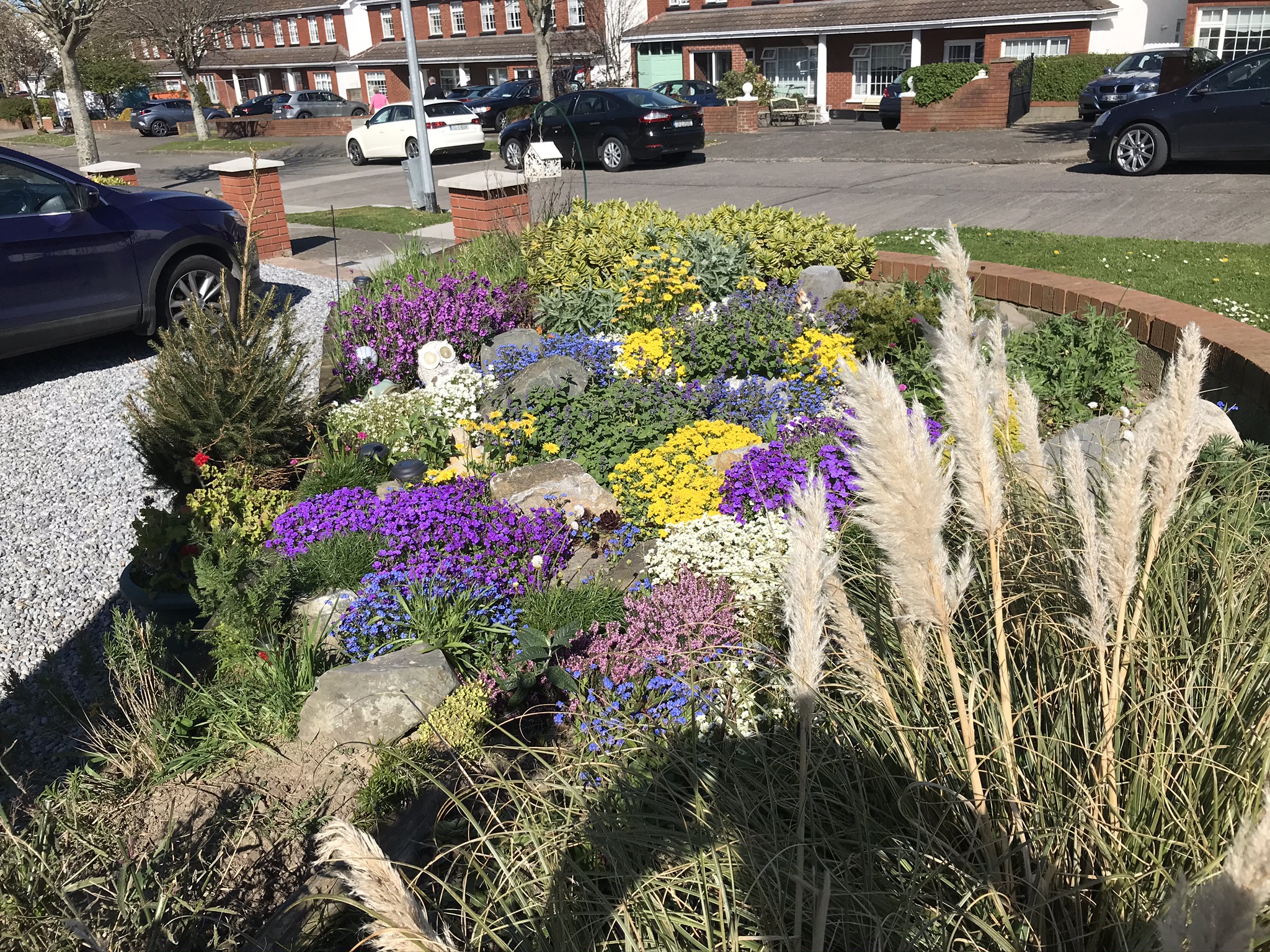
Garden today
SS: So how old is the garden exactly?
C: We finished laying it out in February last year and planted it soon after, so I guess you could say 12 months.
SS: We walk by here fairly often and have noticed it has retained colour all through the winter. Was this deliberate?
C: Yes. I tried to go for a spread of plants that would extend as early into the Spring and as late into Winter as possible. This not only pleases me, it benefits the insects and thus the birds.
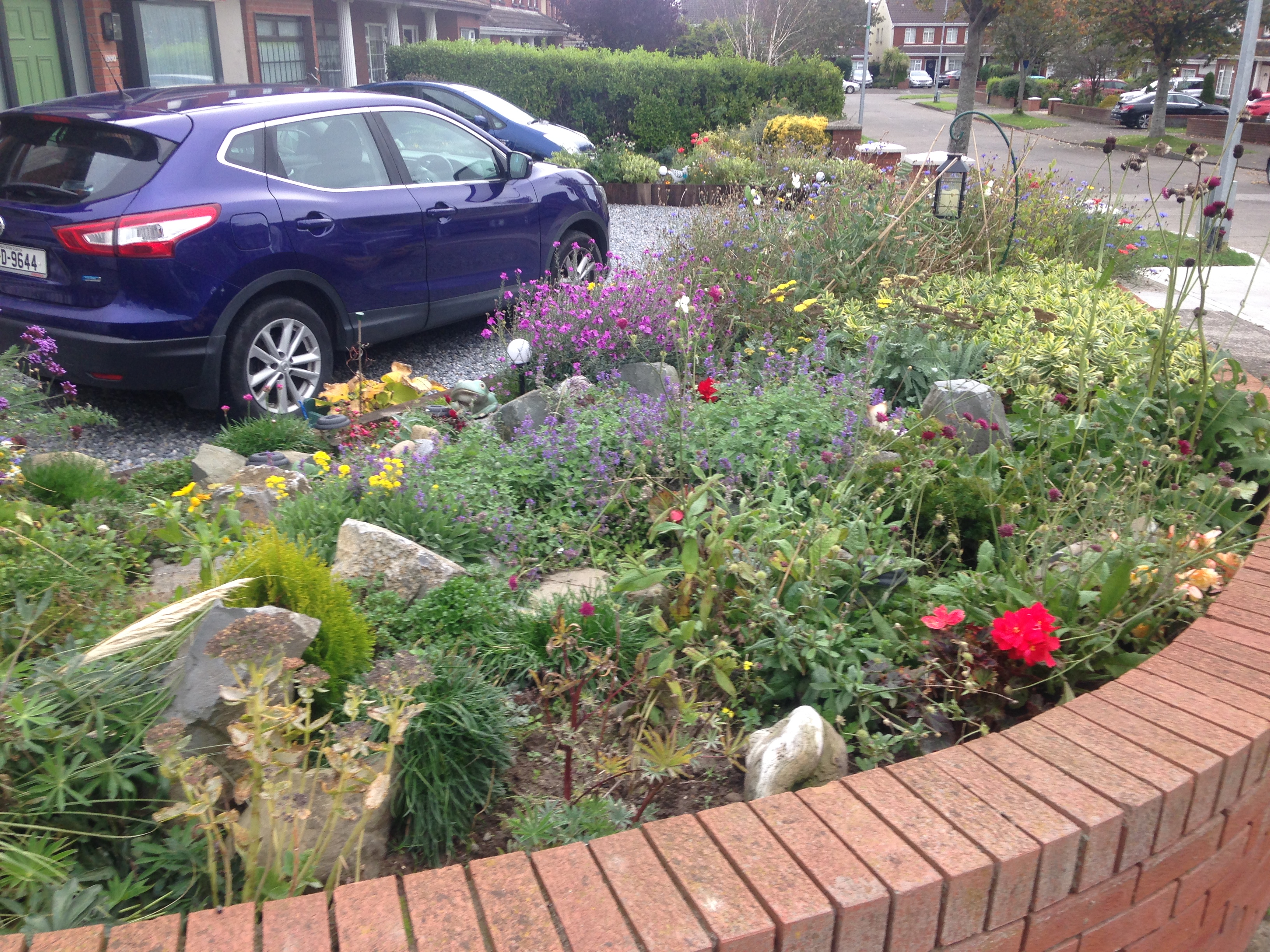
October last year
SS: Thank you.
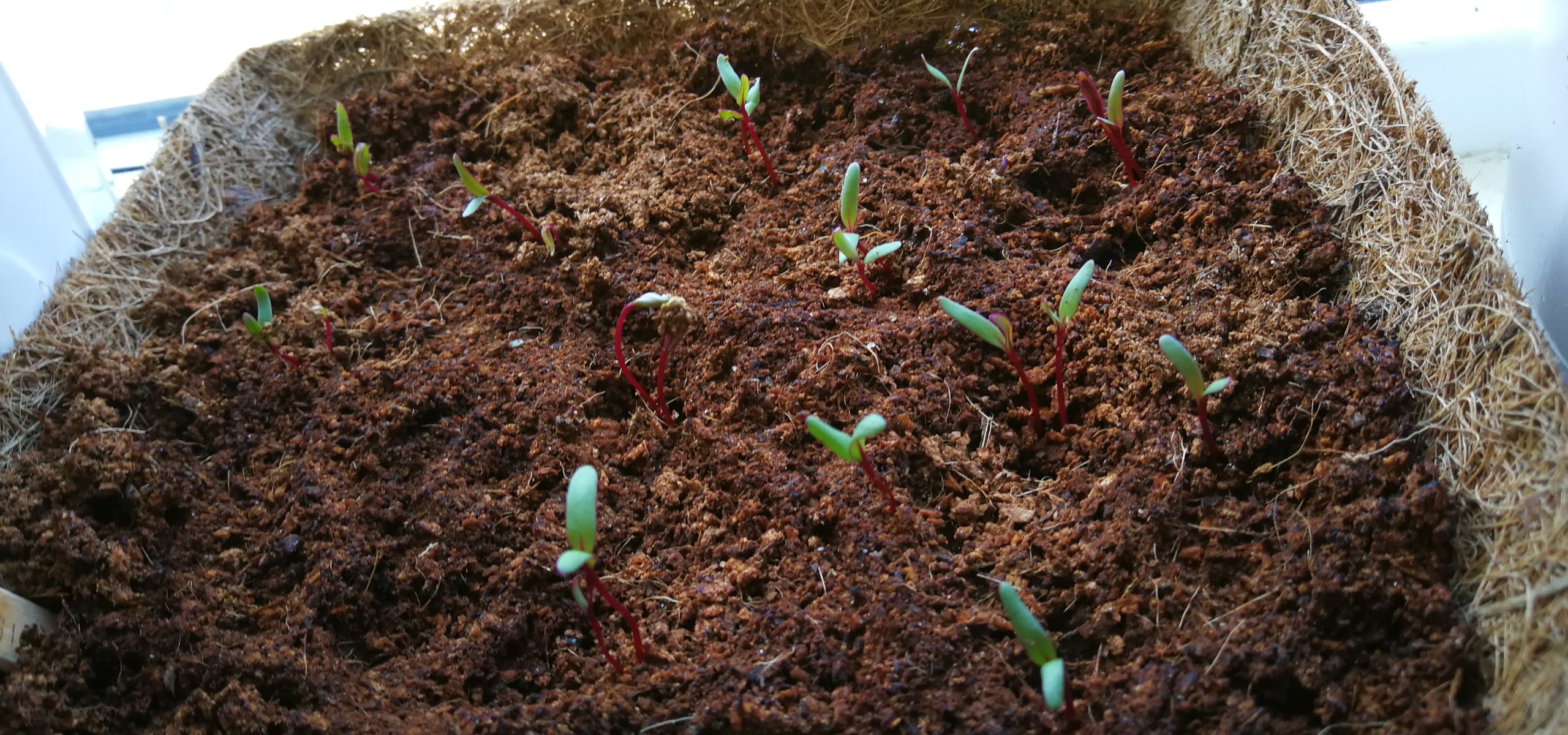
Whether you’re a child or an adult, have lots of experience or none at all, are living in a house with a huge back garden or just have a balcony and some window sills – right now is a super time to start growing something.
Obviously, you need some soil and some seeds or seedlings and possibly also some pots and maybe gardening tools.
You’ll find that many people have had exactly that idea in these lock-down times. It might take a bit of work to source seeds – but it’s not impossible, and there is, of course, always the possibility to benefit from a friendly fellow gardener. See also our recent blog post on plant sharing! Or join our Facebook group for Skerries Food Gardening.
Here are a few websites that today (10 April 2020) do have at least some seeds available for order:
- The Organic Centre – while many seeds are sold out, others are available! (Today, out of 187 vegetable seeds, 22 were available. Some really nice ones! I’m ordering the radishes…)
- The Irish Seed Savers Store is hoping to reopen their online ordering system on 14 April.
- The people of the non-profit organisation Grow It Yourself are doing their best to catch up with order volumes. Practically all of their super Growboxes (great for complete beginners) are currently sold out, but they do still have Grow Your Own Herbs. They do have a good selection of books (Grow Cook Eat is one useful book; it goes with the TV series. For everyone, including children AND adults, GIY’s Know-itAllmanac is a great and fun intro to food gardening.)
GIY still do have some seed starter packs, and also a few individual seeds.
Joanna and Klaus Laitenberger’s Green Vegetable Seeds is normally a favourite, but they have closed their online shop for now. Do check, they are hoping it will only be down for “a short period”! And let us know by email to sustainableskerriesnewsletter@gmail.com when you see it’s open again, so we can update this post. Thank you!
Where to find tips for new food gardeners
Of course you can google “how to grow radishes” (or tomatoes or Jerusalem artichokes), but the results may not always be best suited for conditions here in Ireland.
So here are a two Irish online places that we found particularly helpful.
- Grow It Yourself has lots of super-easy-to-follow texts and videos for complete beginners. Start with their month-by-month info in the grower’s calendar, consult their veg directory or watch how to do what you need to do in their list of video tutorials.
- Klaus Laitenberger of Green Vegetable Seeds sends out very useful monthly email newsletters. You can see the archive on the Green Vegetable Seeds General Garden Info page – a handy source for information on what to do in April (or May or June etc.).
There is also a video channel that I particularly like. RED Gardens Project (RED stands for Research Education and Development) consists of 6 family scale gardens each one 100m2 (1000sqf) and following a different methodology, or approach to growing vegetable. It’s based in Cloughjordan, Co. Tipperary (yes, the eco village!), and Bruce Darrell publishes regular, highly data-driven videos comparing different (organic) ways of growing your food.
So in the end… it’s all about the beginning!
The biggest reason that any of my own gardening projects have failed in the past is that… I had great plans, but didn’t get around to actually putting those seeds in the soil! This year, what with being at home a bit more and all that, I’ve finally managed to start some tomatoes and beetroot on the kitchen windowsill. I stuck a few potatoes into the ground. And I have more new seeds that I will make use of over the weekend. What a great way to spend Easter, planting on my tomatoes and sowing some radishes!
Join us in the Skerries Food Growing Group, subscribe to our Sustainable Skerries Newsletter and let us know how you are getting on with your planting!
PS: Want to do that little bit extra for climate action? Make your garden regenerative! https://kisstheground.com/5-ways-to-make-your-garden-regenerative/
PPS: Remember the pollinators! Read Charlie’s recent blog post here on our website.
PPPS: And these tips by Ernestine about plant sharing are also well worth a read.

One of the great things about having an established garden is that I can pass on cuttings and seedlings or bits of plants that needed to be divided to friends neighbours and even passers-by. Chats and walks in the garden ensued, and visitors would walk away with bags brimful of bits and pieces.
In these times of spacial distance this is no longer possible. However, more people are finding an interest in gardening, at a time when gardening centres are closed and many online gardening sites are unable to keep up with the demand.
One way of overcoming this unfortunate set of circumstances is by sharing plants. Simply leave surplus plants in your porch (in a bucket of water) and tell friends via social media what they can collect.
Some points to consider for the donor:
- If possible, pass on bare rooted plants, for immediate planting.
- If plants come with soil attached, try to remove the roots of weeds that may be lurking.
- Do not pass on plants that are diseased.
- Be willing to pass on some gardening knowledge to the recipients.
For the recipient:
- Bring your own container
- Take only what you need, there may be others interested also.
- Check your new plants for weeds and signs of disease.
That way we can share plants which may otherwise have been composted or placed in the brown bin.
Apart from everybody’s personal social network connections like Whats App, Twitter, Facebook etc there are dedicated sites and Facebook groups, such as Free Skerries Stuff and Skerries Connected… and our very own Skerries Food Gardening, set up by Sustainable Skerries!
Give it a try. Gardening is a gift that keeps on giving.
Let us know how you get on. 🌱
Ernestine Woelger
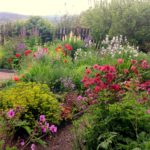
We live in strange times and all must make sacrifices of some kind or another but here in Ireland the covid outbreak has had an unexpected consequence: an upsurge of interest in gardening.
I found this out the hard way recently when going online to stock up on Irish wildflower seeds; every single site was sold out. Should have done my panic buying earlier!
Perhaps we should see this as a good thing; a small silver lining of hope and positivity as people plan and plant for the future. And if we are indeed to plant for the future, now is an excellent time to plant pollinator friendly flowers.
There are two different ways of going about this. Mention ‘pollinator friendly’ to most people and they will automatically assume wild seed mixes and undisturbed areas of the garden. More and more people are going this way, which is great news, but possibly not to everybody’s taste. Some might prefer more traditional cultivated plants and that’s okay, we’re all different after all.
Let’s deal with both in turn, starting with the wildflower approach.
The first thing to realise is that when dealing with wildflowers we’re immediately confronted with a gardener’s paradox. Most of us have spent years trying to improve soil fertility, whether to grow abundant vegetables or vibrant blooms. We’ve added peat, collected seaweed, mulched in compost and manure, some have used chemical fertilizers; anything to inject more nutrients and get things really going.
But guess what? Wildflowers prefer poor soil!
That’s a broad generalisation of course, and different species will have different optimum preferences, but it’s a good rule of thumb none the less. It’s also something of a lie. It’s not so much that they can’t grow on rich soil so much as they are out-competed by stronger plants, especially grasses; they quite simply get swamped.
If sowing wildflower seeds, the best thing to do is dig out as many of the perennial weeds and grass roots as reasonably possible, make sure there is as much bare earth as you can, scatter your seeds and stand well back. Repeat next spring.
Establishing a permanent wildflower meadow actually requires more work and takes years to achieve, up to ten believe it or not. Another paradox.
Christine and Mike Mullan Jensen wish to see a vibrant show of wildflowers this summer and are in an excellent position to do so. They moved into a newly built house a couple of years ago and their front garden was pretty much a barren wasteland of builder’s rubble which grew a few weeds and not much else.
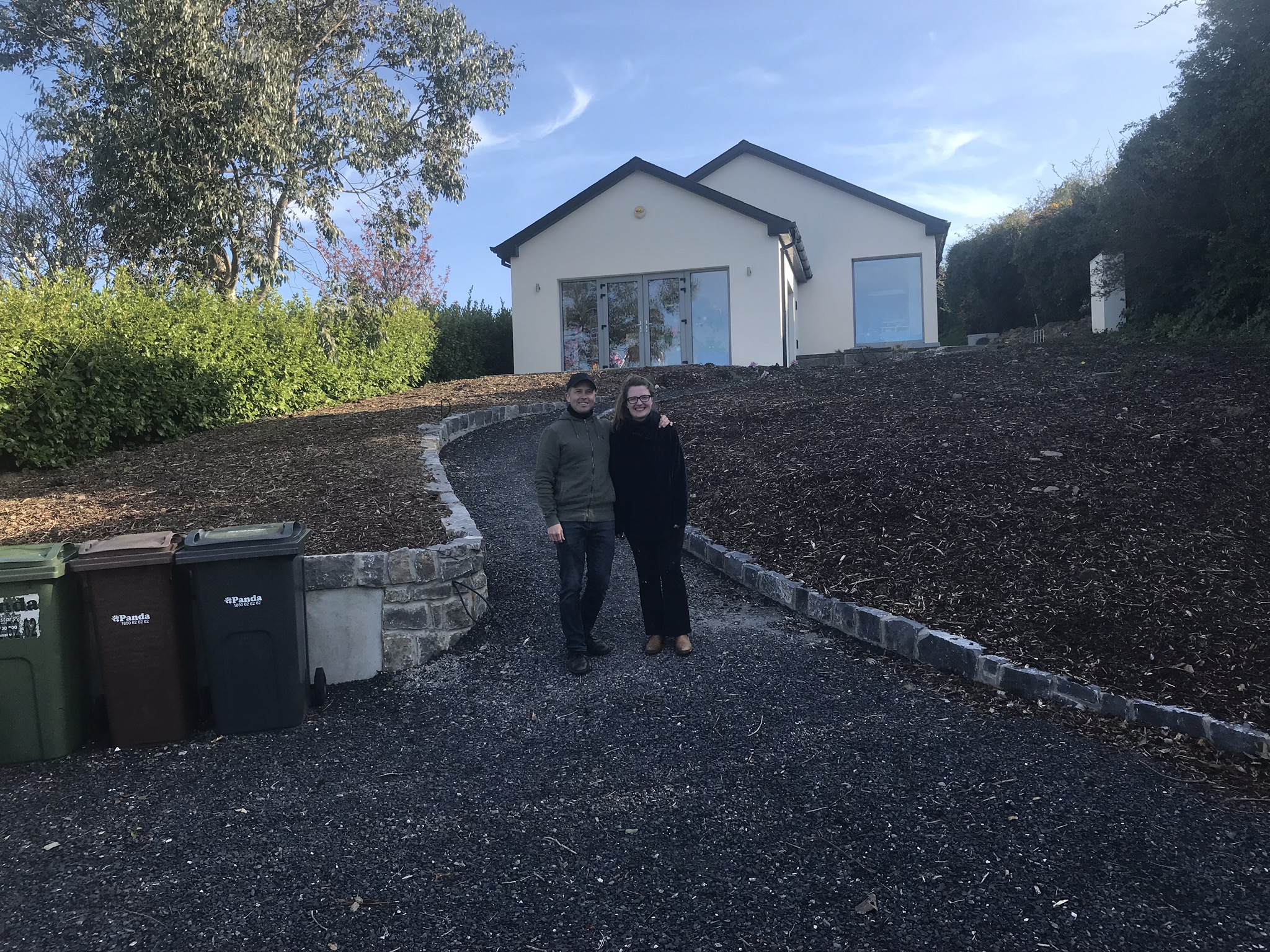
Long story short: the weeds are now gone, the area landscaped, and the bare earth about to be seeded. Watch this space!
On to the traditional cultivated style of garden:
Just because flowers have been selectively bred to enhance their beauty and showiness does not always mean that they are of no use to pollinators. They often are, but not always. The trick is to pick the right ones.
This is not always easy to do. Look at a daffodil, it looks like it should be full of nectar and pollen but in fact it’s pretty useless. By contrast, a grape hyacinth appears insignificant but is in fact far better. Has anyone noticed that Fingal have now started mixing them in with their roadside plantings of daffodils by the way?
There are guidelines. Anything double petalled can be written off. This includes such as roses and dahlias, both excellent in their open-faced single form and no use at all as doubles. The stamens have been selectively bred out to be replaced by petals, bees find them impossible to negotiate.
Some cultivars of sunflower should be avoided. Ludicrous as it sounds, these have been bred to have little or no pollen. Reason? As cut flowers they don’t drop inconvenient yellow powder on the living-room table.
Honestly! The things we humans come up with.
‘Proper’ sunflowers are excellent by the way.
Lovers of hanging baskets might be dismayed to hear that petunias are useless.
Plants such as pansies and double begonias offer little benefit to bees due to their shape and little-to-no production of pollen or nectar,
Here’s a copy and paste list of some of the better ones:
- Asters
- Clover
- Dahlias
- Foxglove
- Geraniums
- Marigolds
- Poppies
- Roses
- Snowdrops
- Sunflowers
- Bluebells
- Honeysuckle
Crocus – all types provide rich sources of pollen
Cheiranthus and Erysimum – wallflowers for pollen and nectar
Galanthus – snowdrops are valuable because they flower so early
Muscari – grape hyacinth are good for pollen
Annual and Perennial Flowers
Aubretia – long flowering season
Centauria (cornflower)
Echium
All native geraniums [NB NOT pelargonium]
Helianthus (Sunflower)
Impatiens
Kniphofia (red-hot pokers)
Lilium -excellent for pollen
Lavatera (mallow)
Limanthes douglasii (poached egg plant)
Lithodora
Nepeta (cat nip)
Papaver (poppies) excellent for pollen
Phacelia tanacetifolia
Romneya coulteri (californian poppy)
Solidago (Golden Rod)
Herbs are good for bees
Boragio and related herbs like comfrey
Lavandula (lavender)
Mentha (mint)
Origanum (marjoram, oregano)
Rosemarinus (rosemary)
Thymus (thyme)
Late Summer – Autumn Plants for Bees
Asters, especially multiple heads like Michaelmas daisies
Calluna (ling heather)
Erica (bell heather)
Gaillardia
Hydrangea (choose lace-cap varieties)
Hypericum (rose of sharon)
Lamium (dead nettles)
Nemophila (shoo-fly plant)
Sedum (ice plant)
Stranvaesia
One final word:
It’s worth remembering that bees and other pollinators desperately need pollen and nectar both in early Spring and late Summer/Autumn. In Spring because they’ve just come out of hibernation and urgently need food; in late Summer to build up reserves to survive the Winter. Planting both early and late flowering varieties gets the pollen and nectar to them when they need it most.
—————————————–
And another final word:
We have a limited supply of wildflower seed to give away. First come, first served.
Also, we have set up a WhatsApp group for anyone interested in the above. Intended for those who wish to exchange ideas, information, experience etc.
If you wish to be added to the group email charleseheasman@gmail.com
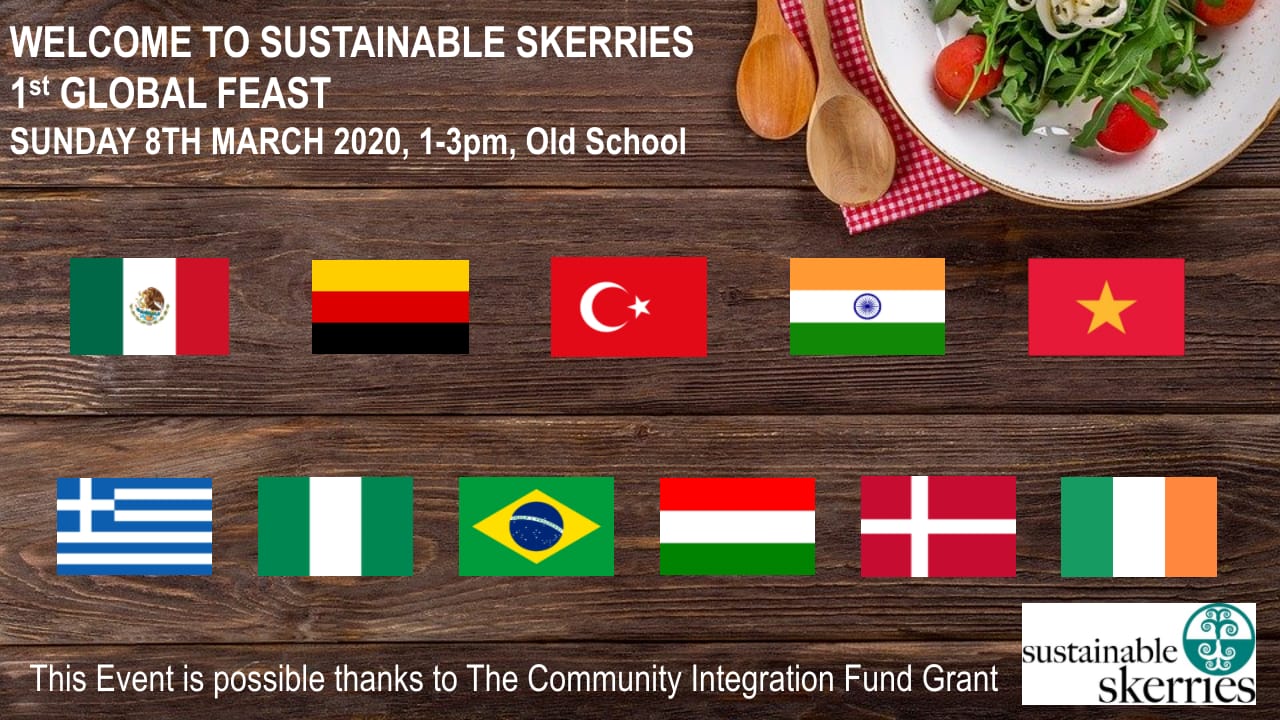
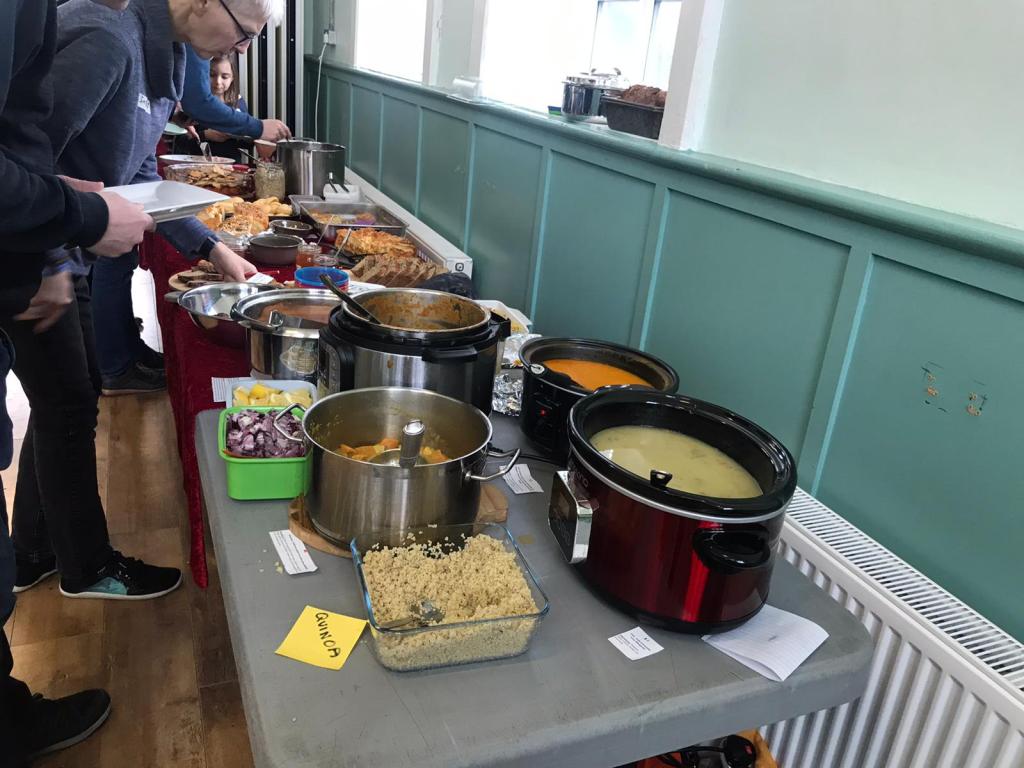
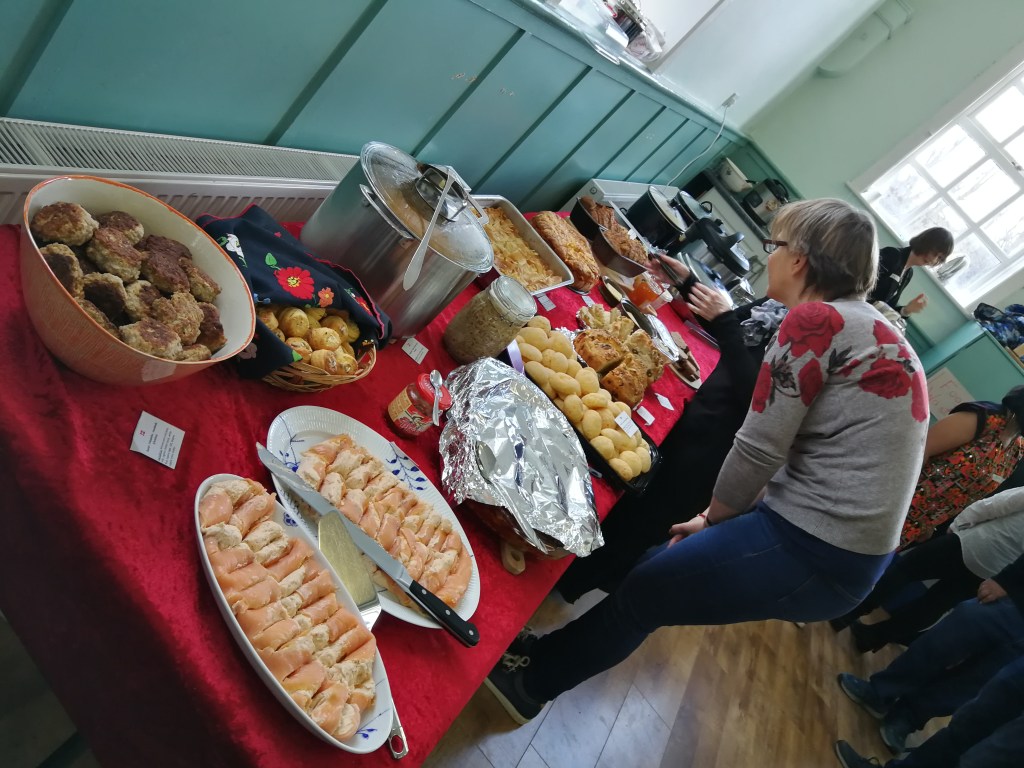
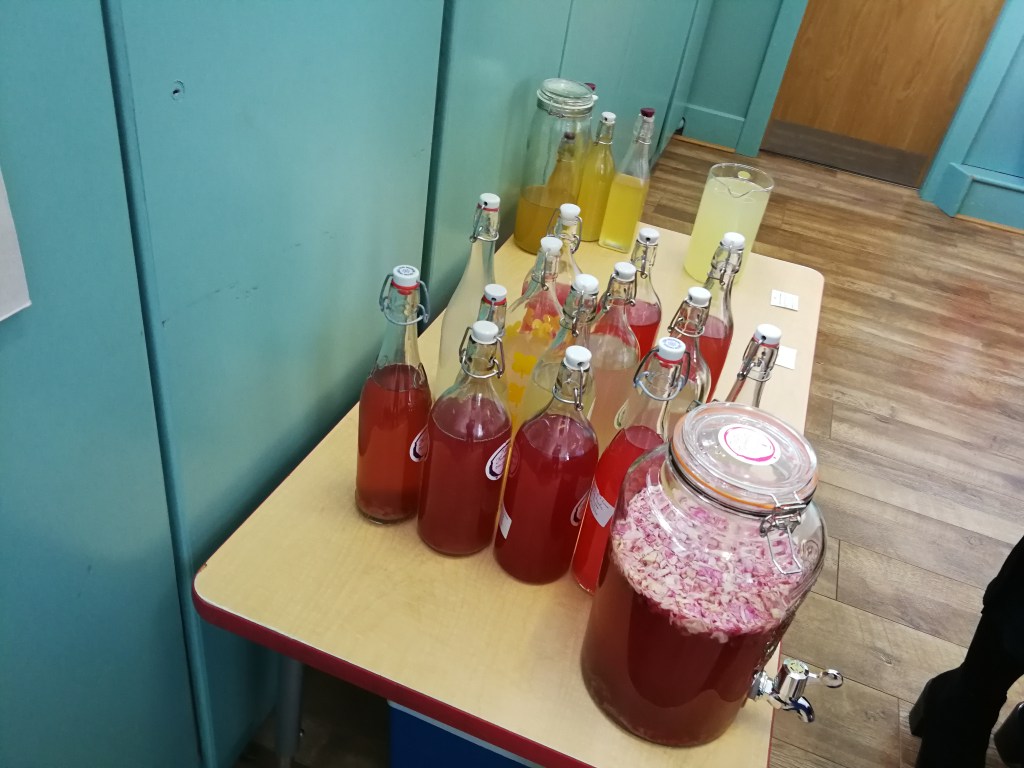
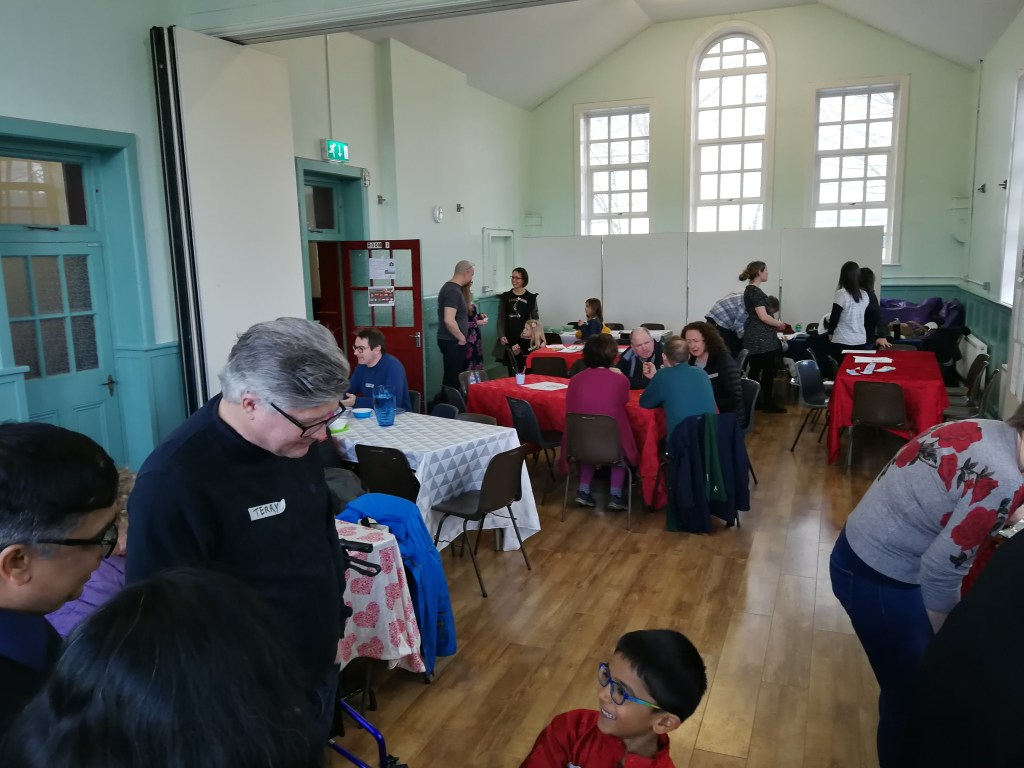
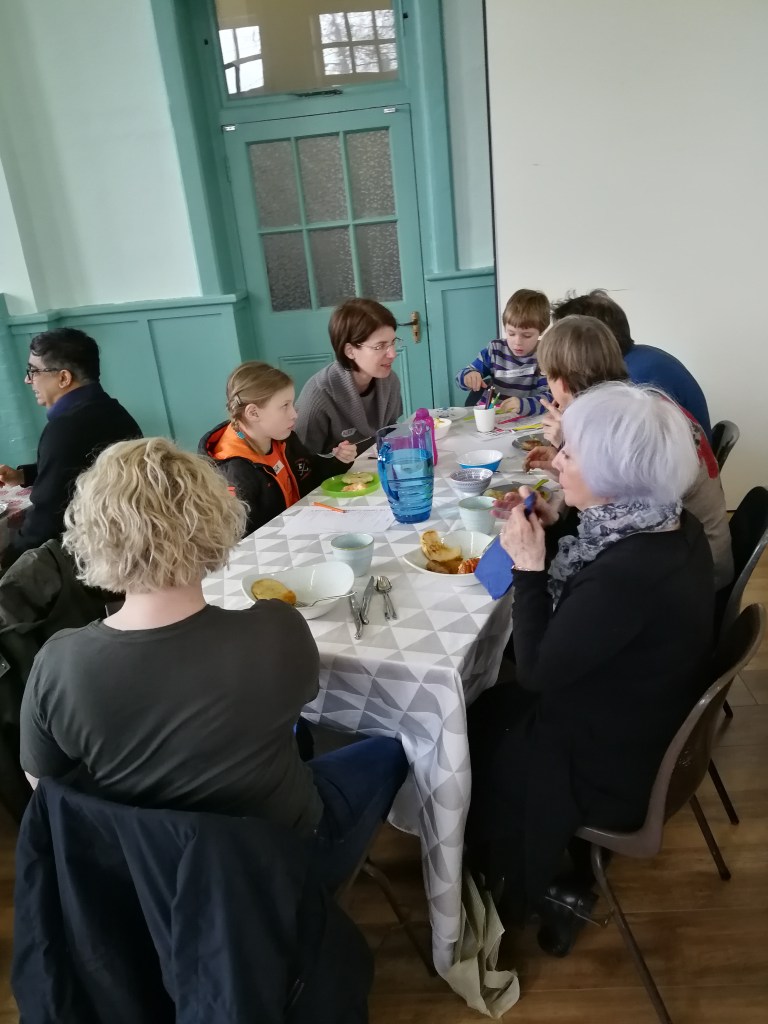
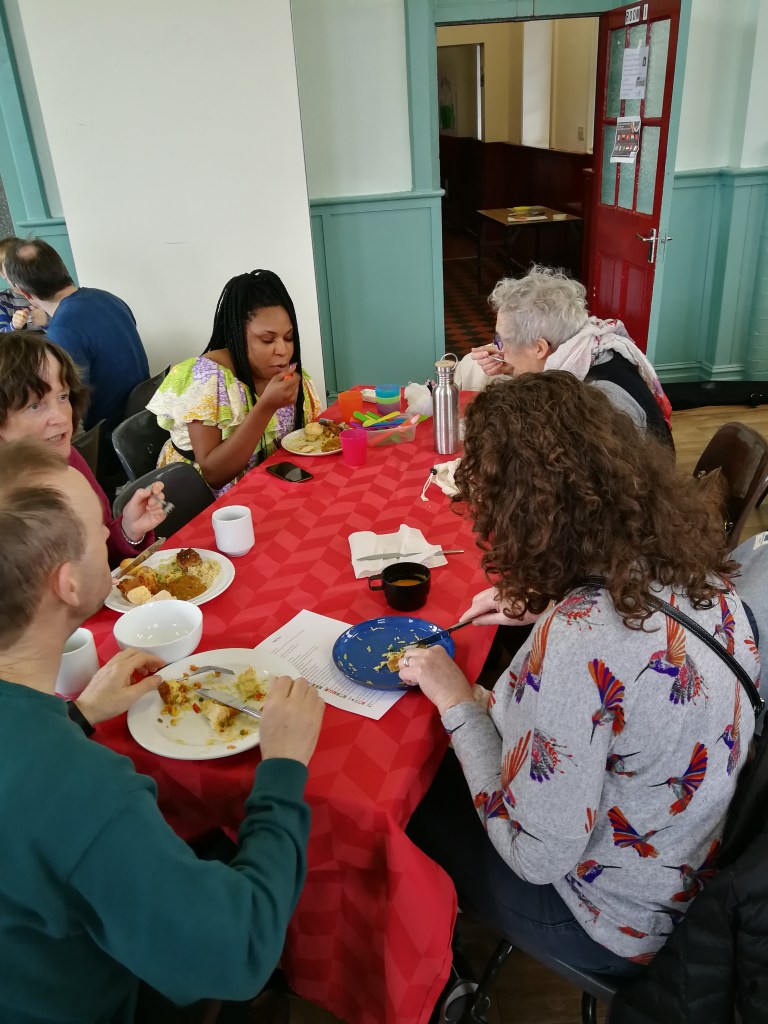
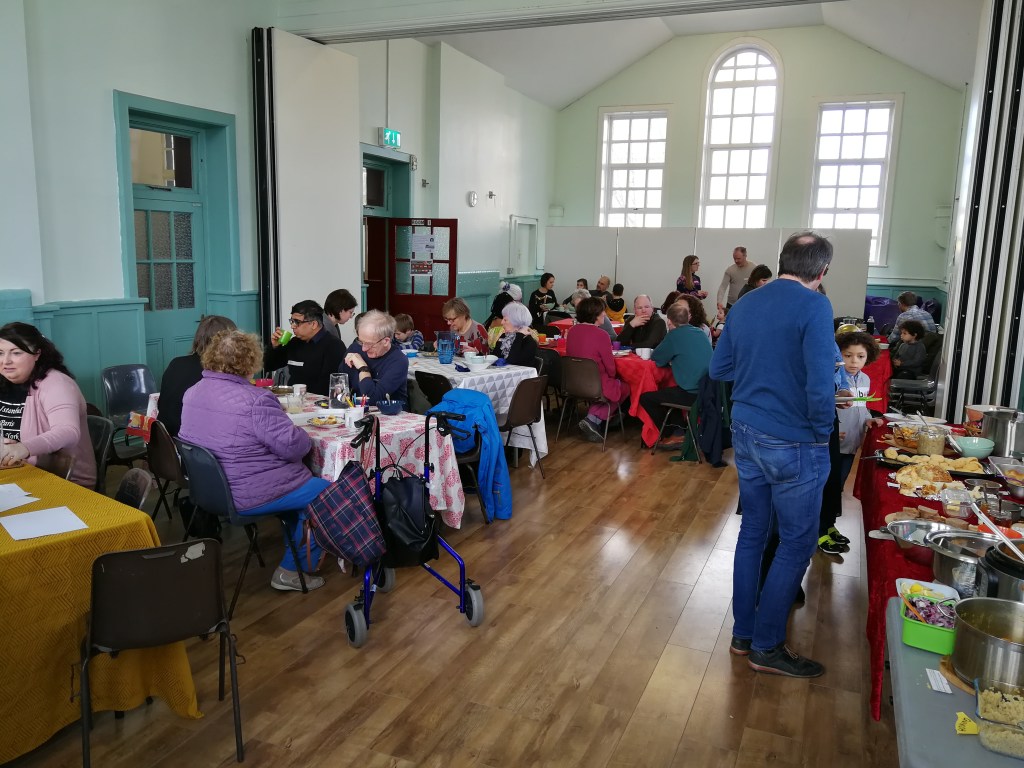
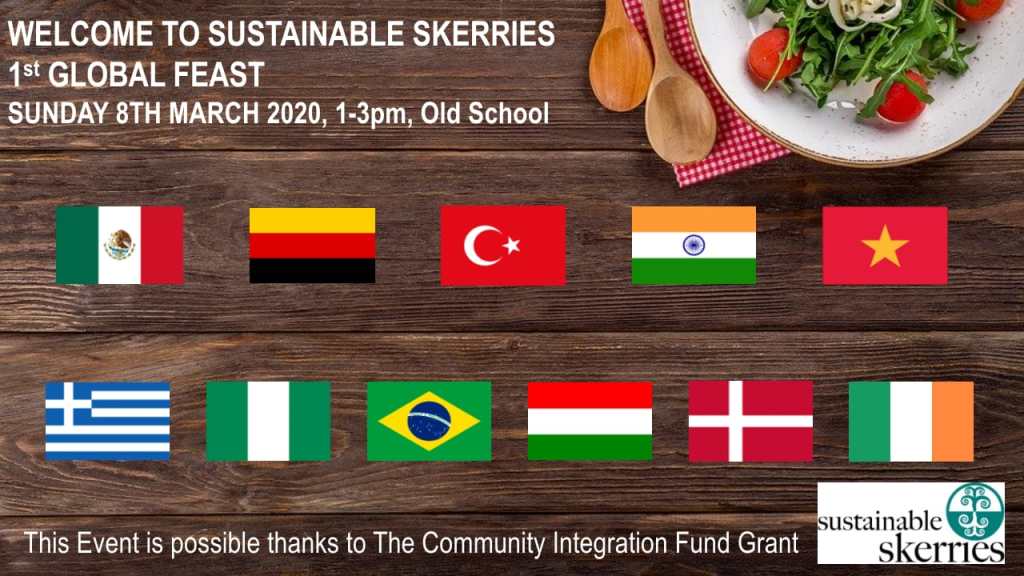
Whether they preferred cooking or eating, or both – the people of Skerries were invited to the 1st Sustainable Skerries Global Feast on Saturday, 8 March 2020. It was a true celebration of all the different cultures here in Skerries. The Old School at Skerries Community Centre was a great venue for this event and really added to the atmosphere.
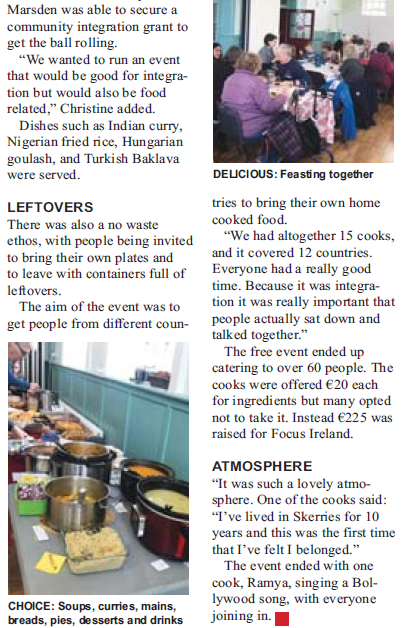
Everyone was thinking global and did their best to buy the ingredients locally. Especially good was the no-waste ethos: The organisers, Christine and Co, had asked everyone to bring their own plate, cutlery, cup… This worked really well, and is something we will certainly try to replicate for future Sustainable Skerries events!
There was space for 15 local people to volunteer to prepare a dish or dessert each, and for just over 60 in total to be at the event. There would have been demand for way more spaces, and once such events are possible again, we hope to run something similar.
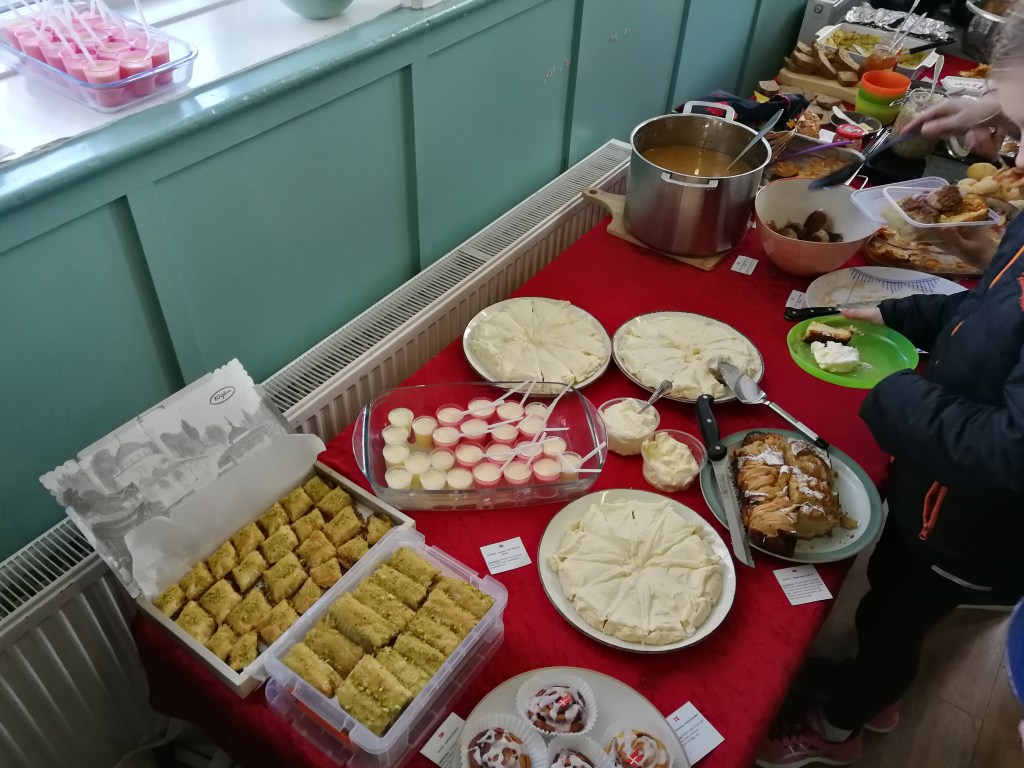
The chefs brought in wonderful food that was laid out buffet style. We all sat around tables of 8 and tucked in. The atmosphere was wonderful, as was the food, and it felt as though not just new contacts, but possibly new friendships were made. Recipes were exchanged, and there was even a bit of singing!
The guests had been encouraged to bring containers in case they’d like to bring some food home. In the end, there were few leftovers, but they were all taken home eagerly. No food waste at this event, that’s for sure. And even better they took their own dirty dishes home! Little did we know that this would be the last in person event for a while.
The event was made possible thanks to funding from the Communities Integration Grant of the Office for Promotion of Migrant Integration.
There was also a great article about this in Skerries News, see below.
Photographs by Sabine, Vivek (2)

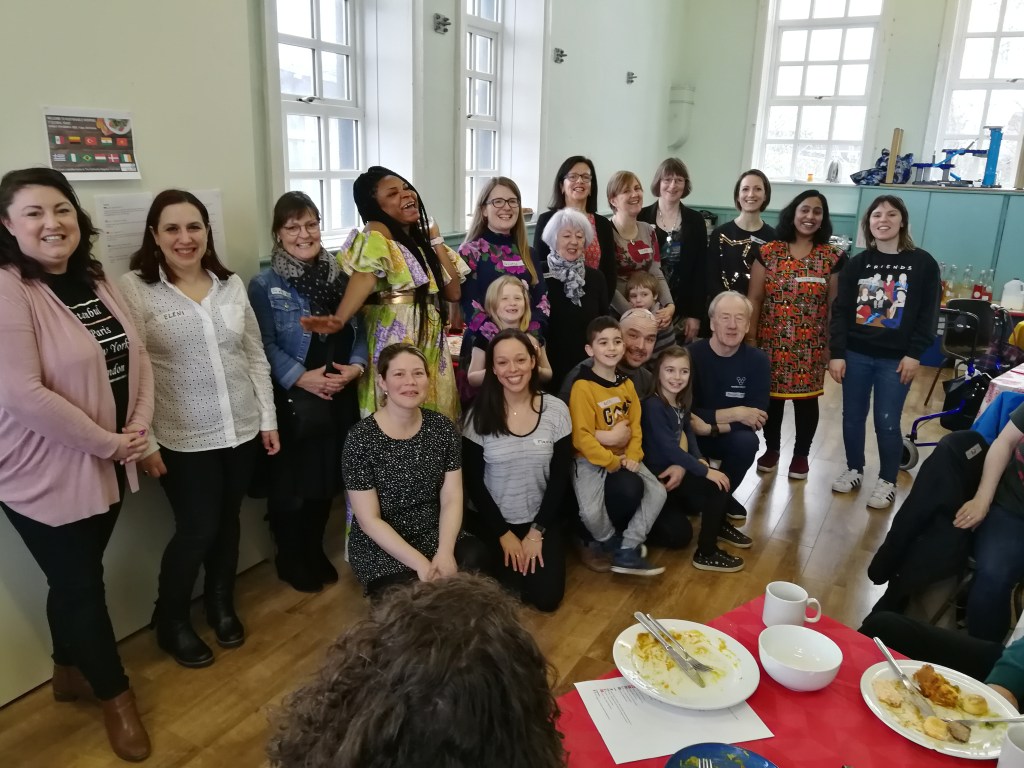
All the chefs! 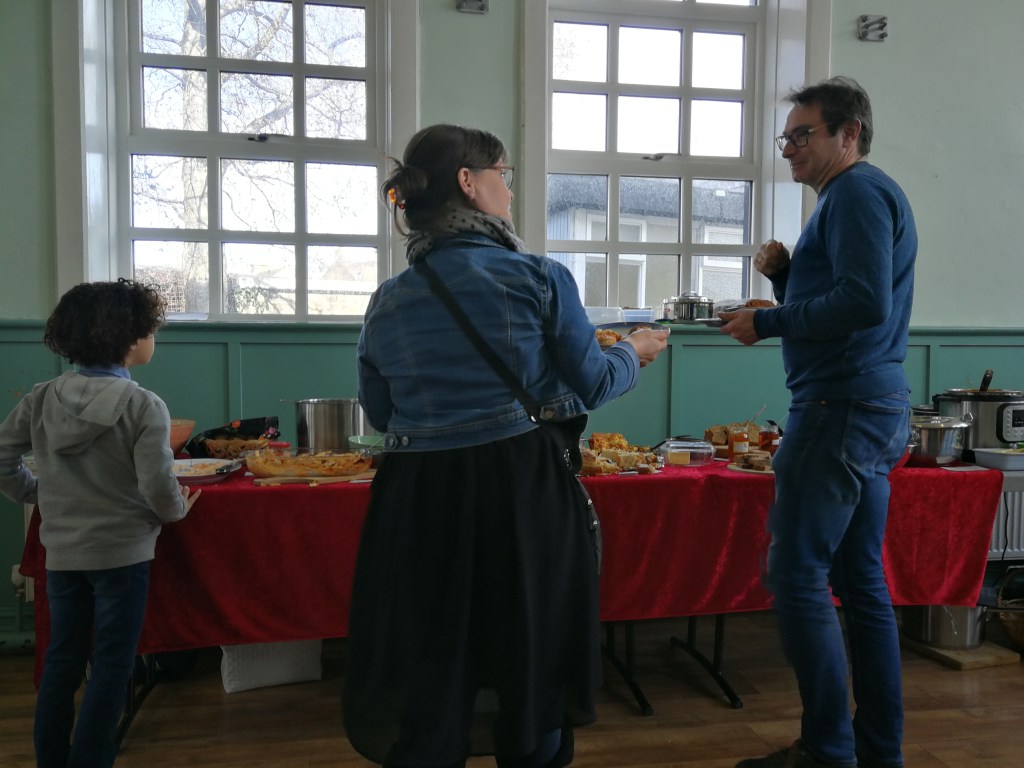
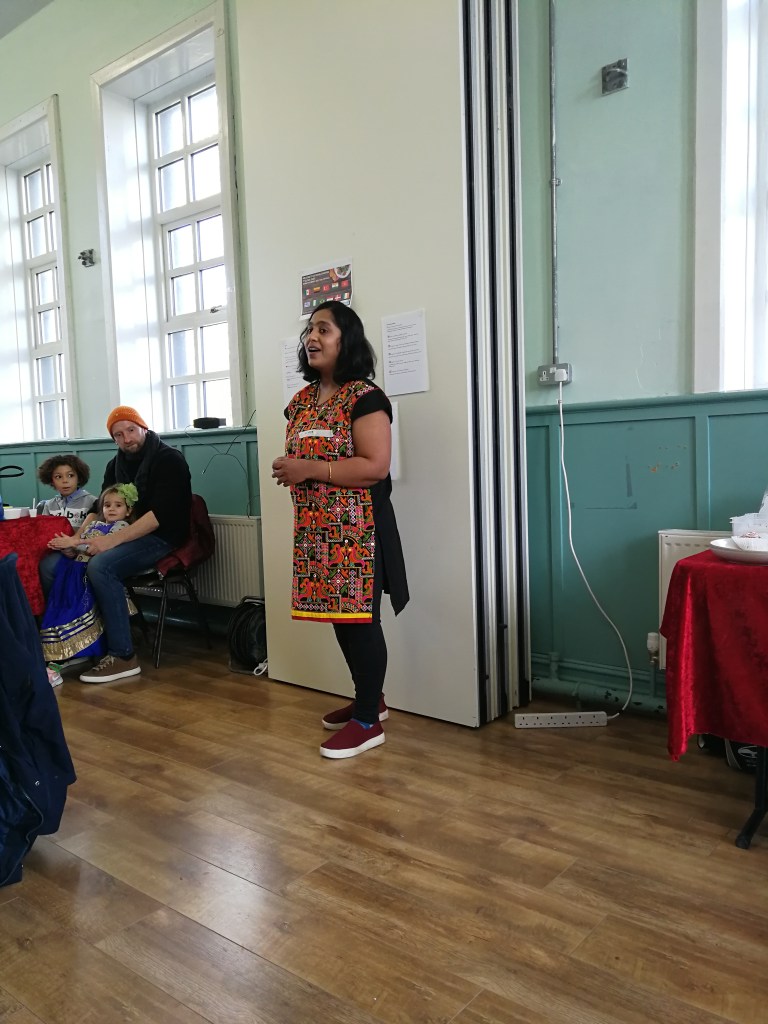
Beautiful singing from India. 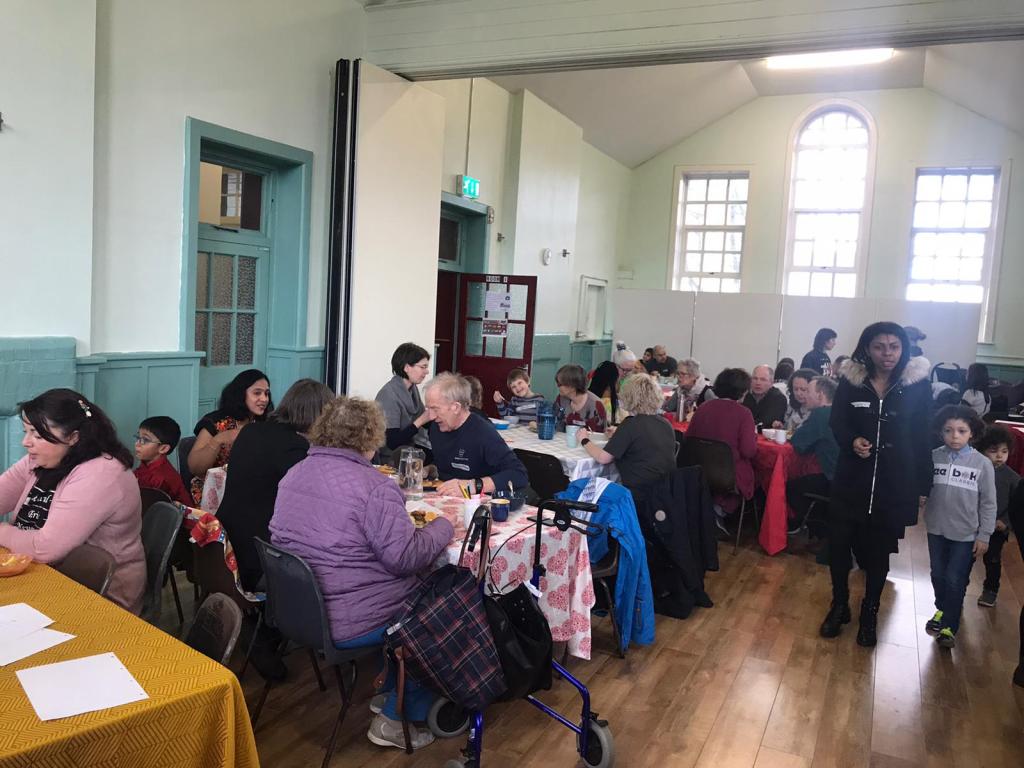

Sat 21 March, 11 a.m. to 4 p.m., Skerries Sailing Club
Formerly the Head Gardener at the Organic Centre at Rossinver, Co. Leitrim, Ireland, Klaus Laitenberger has been growing vegetables organically for 20 years in the UK and Ireland. He has given a couple of gardening courses in Skerries before, which were very well received, so we are delighted to welcome him back. Book early!
Klaus will be giving a full day talk on growing organic vegetables on Saturday 21st March. Venue to be confirmed.
Cost €5, payable at the door. Maximum 50 places.Subsidised by Sustainable Skerries as part of our Communities Integration Fund grant.
To book your space, send an email as soon as possible to marsie.mary@gmail.com – this will soon be fully booked!
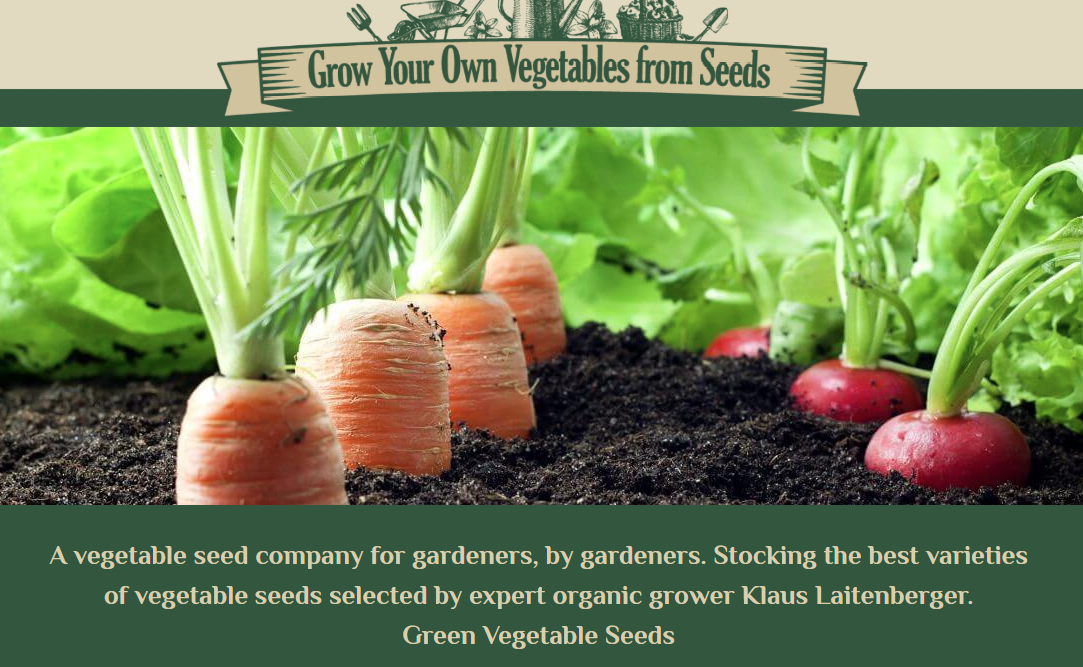
To learn more about green vegetable seeds, growing your own vegetables etc., see his website (click on the image below or go to https://greenvegetableseeds.com/)