Whether you prefer cooking or eating, or indeed like both – you are invited to our 1st Global Feast! It’s a chance to celebrate all the different cultures we have in Skerries.
- Sun 8 March 2020, 1 – 3 p.m.
- Room 1, The Old School at the Community Centre Skerries
- Fully booked – we are hoping to report on this event soon after it takes place, and to run another one in the not-too-distant future!
We have capacity for 64 guests, including as many as 15 people preparing food. We would love to have a mix of our global and Irish cuisine at the event and are looking for cooks to create dishes from different cultures that you make at home. So far we have Danish, Brazilian, Hungarian, Irish, Polish, Italian, Indian, Vietnamese, German and Turkish food being prepared. What a super collection! Can you add to that? Let us know if you’d like to be involved and what dish(es) you think would work to share on the day. We would recommend that the food is prepared in advance to ensure smooth running on the day. Since it is a public event we would advise that all ingredients are listed.
WE HAVE REACHED THE CAPACITY OF COOKS, TOO, THANK YOU!
Cooks will receive €20 towards your ingredients, thanks to funding from the Communities Integration Grant of the Office for Promotion of Migrant Integration. This is a free event, but there will be a donation box with moneys collected going to a relevant charity.
We look forward to making this booked-out Global Feast the first of many!

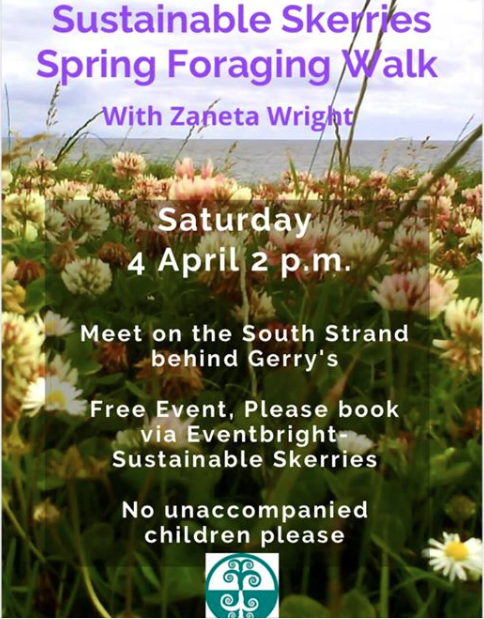
Zaneta will lead a foraging walk, starting at Skerries South Strand.
This event is funded through our Communities Integration Fund grant.
Zaneta is no stranger to Sustainable Skerries, as she was one of our founding members! She now lives in rural Ireland, from where she runs her company, Rerooting the Future, and we are very happy to welcome her back for a visit to our town for this foraging workshop.
Foraging is just one of the many things she teaches (they also include fermentation, making your own body care products, cooking with reduced food waste…).
Zaneta will lead a foraging walk on Saturday 4th April from 2 p.m., starting on the South Strand. Meet at the public toilets close to Gerry’s Supermarket, be prepared for all weather! The walk will take roughly two hours. It is free, but limited to 30 spaces – secure yours on our Eventbrite page!
Children must be accompanied and supervised by a responsible adult.
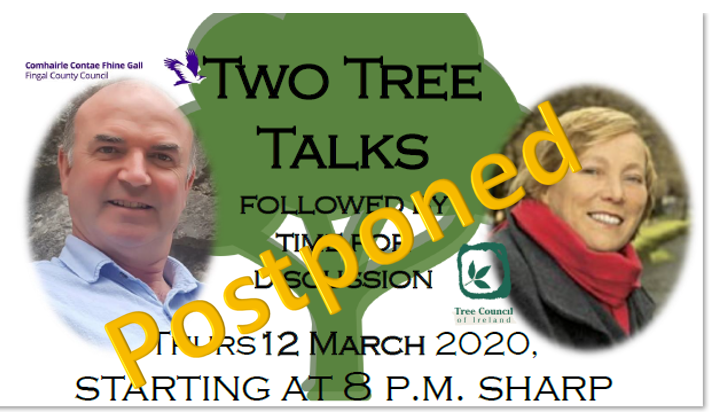
This event has been postponed due to health concerns arising from the spread of COVID-19 (particularly now the WHO is declaring it a pandemic and there is a rapid increase in cases). A new date will be found as soon as possible.
Skerries welcomes Éanna Ní Lamhna (The Tree Council) & Kevin Halpenny (Fingal County Council) for a Tree- and Biodiversity- Focused Evening
Are you interested in trees and how they can contribute to life and biodiversity in our town?
On Thursday 12 March, at 8 p.m. (doors open 7.40 p.m.), in the Little Theatre, well-known environmentalist and media personality Éanna Ní Lamhna (Vice Chair of The Tree Council) will talk about “The Importance of Trees” – followed by a presentation by Fingal County Council’s Parks Superintendent Kevin Halpenny.
Kevin is in charge of the current review of Fingal’s Tree Strategy and will be talking about “Biodiversity and the Draft Fingal Tree Strategy.”
After the two presentations, there will be time for discussion and questions and answers.
This promises to be a very interesting evening. It is organised by a number of groups with an active interest in trees in Skerries: The Skerries Community Association, Skerries Tidy Towns, Crann Padraig, and Sustainable Skerries. The organisers hope it will inform significantly their input into the draft Tree Strategy, which is currently being drawn up.
- This is a free event, but space is limited, so please book your ticket here: SustainableSkerries.Eventbrite.ie
Sabine McKenna writes: I’ve been listening to a lot of podcasts. While on a train. While walking. While in the garden. Folding laundry. Packing a suitcase before going away. Doing the dishes. And many of them have recently been sustainability-focused. Here’s a few that might be of interest to others, too!
- Podcasts are on-demand audio programs that you can usually listen to on a website or through a podcast app.
- If you’re on a phone, listening through an app is easiest. I use Podbean, my family are more on PodcastAddict; Spotify, Google Podcast, Apple Podcast are others.
- Many podcasts are also available as videos, most often on YouTube – great for those who prefer watching to listening!
By the way, there’s a monthly Sustainable Chat Club here in Skerries which involves the host(s) picking a podcast or two, or a video, to which we listen and about which we then talk. If you’re interested, send an email to SustainableSkerriesNewsletter@gmail.com !
My Top 3 Choices: Podcasts with an Eco Twist
The Rich Roll Podcast: We Can Solve Climate Change
Website: https://www.richroll.com/podcast/paul-hawken-473/
Podcast: Rich Roll Podcast # 473
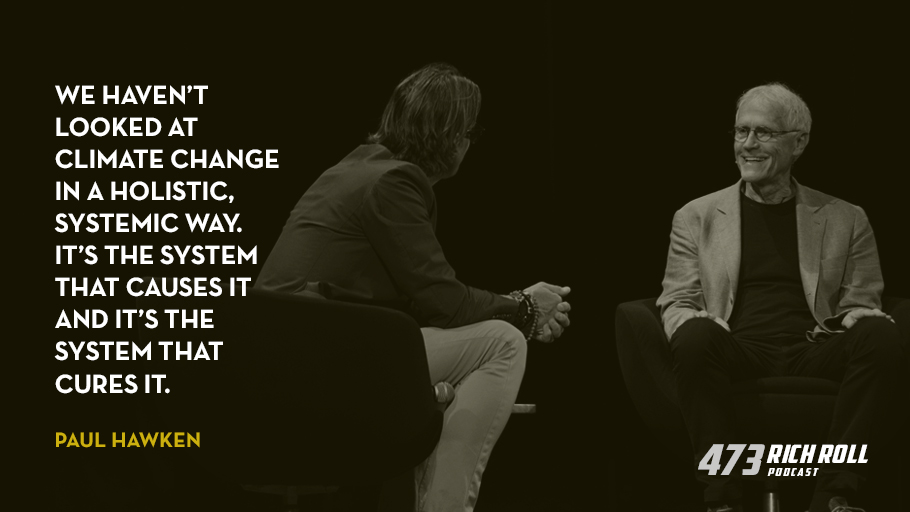
- Climate Change can be solved.
- Paul Hawken talks about how in his book: Drawdown: The Most Comprehensive Plan Ever Proposed to Reverse Global Warming. Google it.
- Paul Hawken and his team of researchers have looked at the proven ways. Guess what the top three are. Then listen. Or take a look at the top 10 here if you don’t want to listen to it all…
Rich Roll is an American podcaster who loves the “long form” podcast. He does in-depth interviews which I find very good for long slow runs, or an extended session in the garden. Here’s a bit of his bio:
A graduate of Stanford University and Cornell Law School, Rich is a 50-year old, accomplished vegan ultra-endurance athlete and former entertainment attorney turned full-time wellness & plant-based nutrition advocate, popular public speaker, husband, father of 4 and inspiration to people worldwide as a transformative example of courageous and healthy living.
Mothers of Invention: You probably have everything you need.
Fashion and climate. Who would have thought that the former president of Ireland, Mary Robinson, was going to co-host this really entertaining as well as educational podcast! She and her co-host, comedian Maeve Higgins, talk about different climate change topics to (mostly) women from around the world.
Season 2 – Episode 8is of particular interest to those who want to be more considerate when it comes to fashion and the environment.
From the show notes:
As a result of long supply chains and energy intensive production, the fashion industry is now the fifth-largest polluting sector in the world constituting 10% of global greenhouse gas emissions. In this week’s episode, we take a look at the $2.5 trillion dollar industry to explore the potential of a triple bottom line: people, profits and planet. This week’s guest host is Vietnamese-born, Thao Vu, an eco-fashion designer and founder of label, Kilomet109. Her return to traditional dying practices, handmade silk production and waste management is opening up conversations on how to rethink what we expect from our clothing. And Céline Semaan is a Lebanese-Canadian sustainability literacy consultant and educator for the fashion industry based in New York. She talks us through the concepts of slow fashion and circularity, and whether it really can affect change in the industry.
Green Dreamer: Restoring the New York Harbor to the thriving marine ecosystem it once was (Interview with Murray Fisher of Billion Oyster Project)
In this podcast episode, Murray sheds light on why restoring oyster reefs will be a crucial step towards restoring the New York Harbor to being one of the most ecologically diverse marine ecosystems as it once was; the power in leading restoration and rewilding projects in the heart of urban landscapes as opposed to in more remote regions; and more.

I love this episode for a number of reasons. It shows wonderfully how environmental challenges can be tackled if people and communities work together. It stresses the importance of education and portrays a very different high school. It is about New York, one of my favourite places on this planet. (Don’t ask, I don’t know myself why that is the case.) And it shows how step by step, a huge project can grow.
Green Dreamer? A very well-produced, easy-to-listen-to podcast that even has an “onboarding” program for those new to it, with daily emails that point you in the direction of those podcasts that might be of most interest to you. And given that there are now 195 episodes, that is a very helpful offer!
By the way, the latest episode seems highly interesting, too (I haven’t heard it yet): Creating community gardens in food deserts to improve access to good health (Interview with Rob Horton of Trap Garden) I think I’ll have to go on a long (podcast) walk tomorrow…
- Are you a podcast or vlog fan? Do you have favourite TEDx talks or YouTube videos that you think we should feature here? Please send an email to SustainableSkerriesNewsletter@gmail.com with your ideas – and maybe you’d like to join us for the next monthly Sustainable Fireside Chat? Same email address!
Sustainable Skerries recently held their second Repair Café, and it was an even bigger success than the first.
The venue was changed for this event; being held this time in the Little Theatre. This gave everyone plenty of space to work and move around in and good light in order to see what they were doing, particularly for the fiddly intricate stuff.
The main focus was once again on clothing and fabric repairs but, given the time of year, it was only natural that Christmas decorations featured heavily as well.
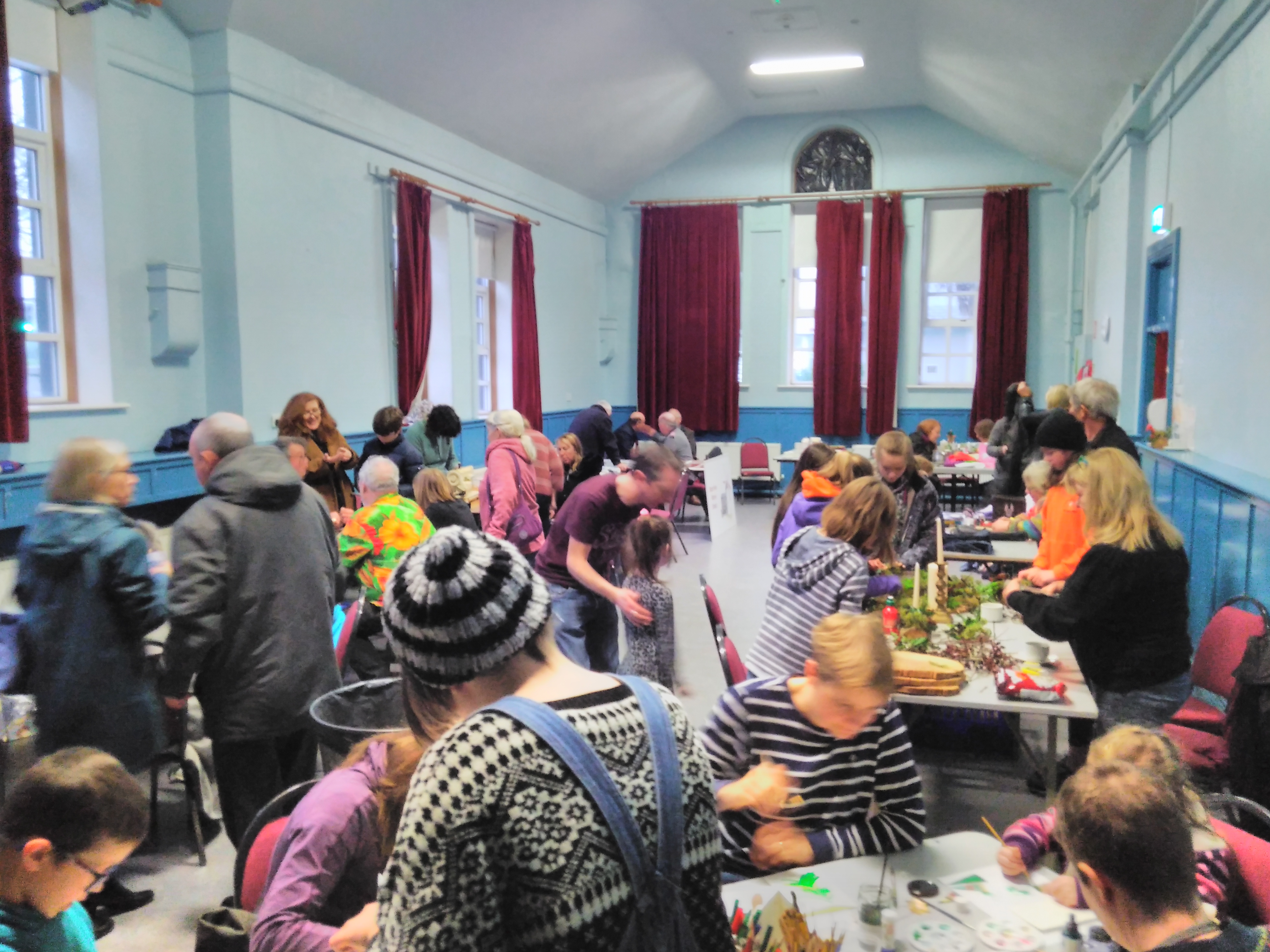
Local artist Niamh Sharkey had a table making Christmas cards, very popular with the adults as well as the youngsters; Connie Lai demonstrated Danish decorations; fabric repairs were facilitated by Ernestine Woelger, Mary Marsden, Nara Fritch and others.
The Men’s Shed had a table, where they demonstrated, amongst other things, restoration projects they had completed for Skerries Mills.
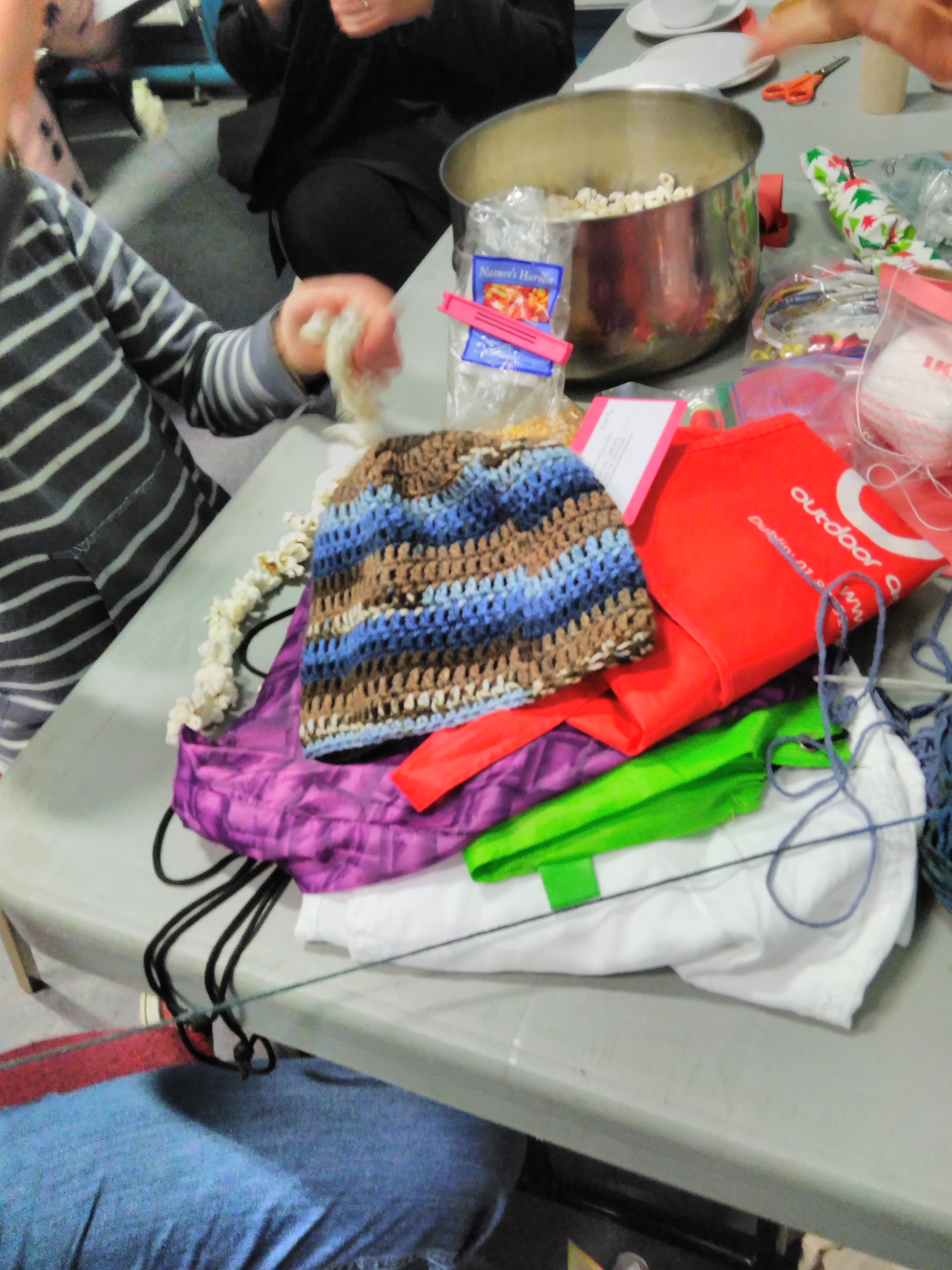
Local artisan silversmith Ed Cooke brought along a toolbox full of mysterious implements and demonstrated jewellery repairs and how to clean antique silver.
Back on the festive front, Marion and Charlie Heasman were showing how to make Christmas table centrepieces from logs decorated with berries and greenery plucked from the hedgerow.
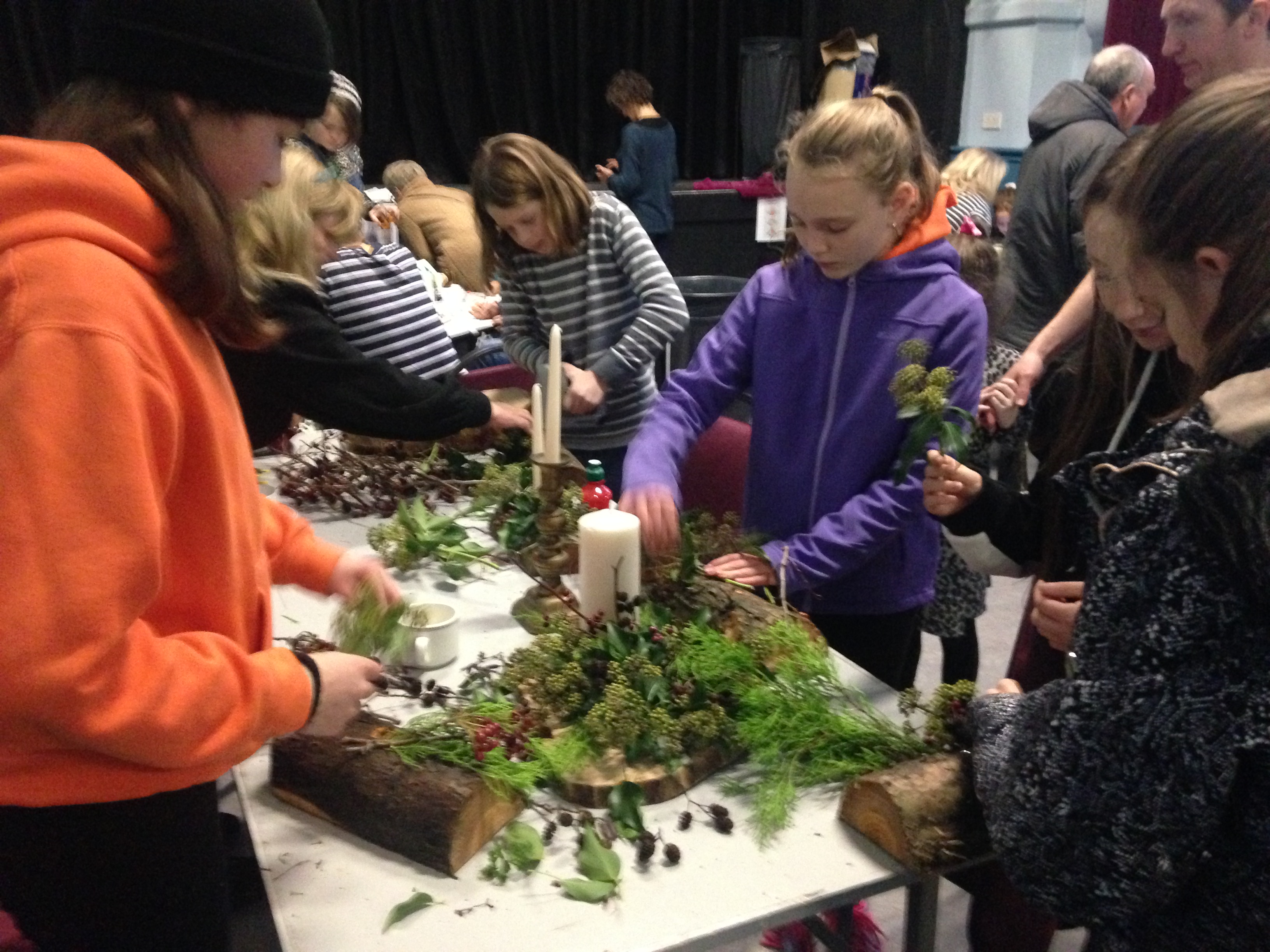
Most importantly, Karen McCaffrey and Niamh Quigley kept everyone supplied with tea, coffee and cake.
Apologies to those I’ve omitted to mention and thanks to everyone who pitched in
The beauty of this sort of event is that we all not only learn how to reduce our environmental footprint but we save money into the bargain. What’s more, it’s fun; the kids in the photos certainly seemed to think so.
Charlie Heasman; 6th Nov 2019
Hi,
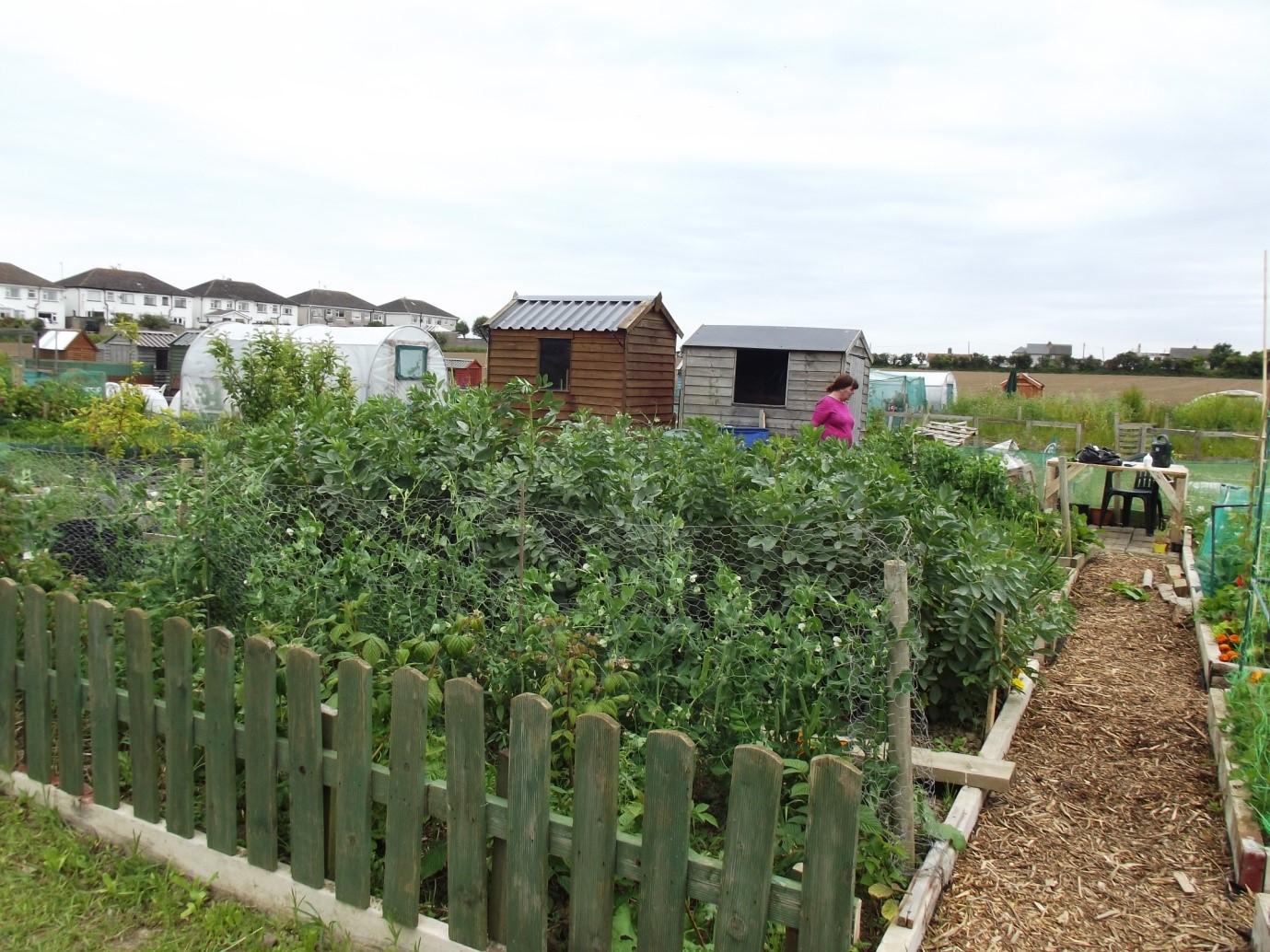
to start off I should apologise for the blatant click bait that is the heading above; allotment gardening cannot save the planet, but I hope to use it as an example to show what can. I’ve gained your attention, hopefully I can hold it and you will read on. You may be surprised….
…When my wife and I took on an allotment some years ago I was interested in vegetables; she was interested in vegetables and flowers. Neither of us were over concerned about soil. This soon changed.
It turned out that our soil was not particularly good; in fact it was mostly pretty bad. This was surprising in its own way because only a few years previous it had been agricultural land, to whit: a field. One would have expected it to be better.
Meanwhile Marion decided that we were going to grow prize winning carrots. Carrots like fine soil with no stones to encourage forking, so she set to work on a small bed. She dug down to a depth of 18″ and put every last ounce of it through a fine sieve, discarding stones as she went.
This took a considerable amount of time and effort but eventually she had a fine tilth that even the most dedicated gardener would be proud of. I remember remarking that if she added some milk and eggs she could probably put it in the oven and bake a cake. We sowed our carrots instead.
They germinated and grew. A bit.
All through the summer we kept them watered but they refused to grow to any decent size. We found out why when we lifted them.
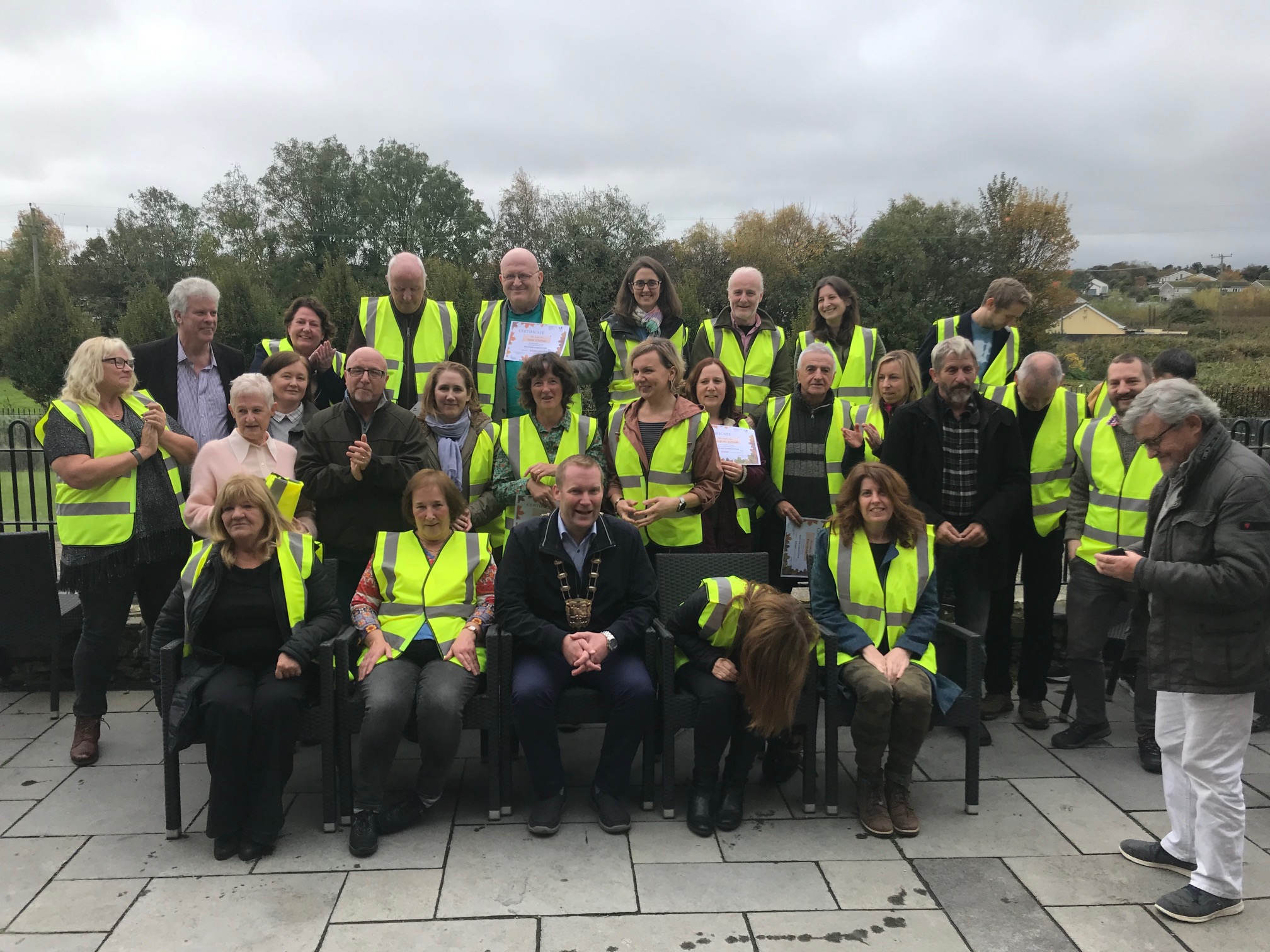
Throughout the month of October Skerries hosted a “Master Composter” course run and sponsored by Fingal County Council.
The course was a two-pronged affair with the twin aims of educating people to waste less food and make compost out of household green waste that would otherwise go for kerbside collection.
The ethos of the first part is pretty simple: globally we waste 40% of food; and we shouldn’t. Not only is it an obvious waste of food, but that same food cost an awful amount of global resources to grow in the first place. Fossil fuels, sprays and chemicals and, an ever diminishing worldwide commodity, water.
To use all these resources and then throw 40% of the product away is a nonsensical irresponsibility. But we all do it, and for all different reasons:
We want our fruit and veg perfectly uniform and in supermarket showroom condition. But what’s actually wrong with a bent carrot or not quite round cauliflower?
We buy too much and what we don’t eat in time goes in the bin. Stuff goes into the fridge, works its way to the back and quietly breeds penicillin before it too gets thrown out. Fridges were never meant to be compost pre-digestors.
We, well some of us, are slaves to ‘use by’ and ‘best before’ dates. A yoghurt that was perfectly acceptable and in date today is not going to kill you if you have it for breakfast tomorrow. Best before dates were never intended to replace common sense; sadly, it would appear that they have.
But even if one cuts one’s waste to a minimum there’s still going to be something for the bin. Those who take the trouble to segregate their waste and use the brown bin (sadly not everyone) can rest assured that it will be composted and turned into something useful. But at a cost. That cost is diesel, road miles and carbon footprint. If something in effect is transported from a house, processed, and then returned as a bag of compost for that same house (or one like it) then we have a waste of energy.
This is the ethos of the second part.
So having done the theory in the comfort of the Mills, we all went up to the allotments to get on with the practical side of things.
Craig Benton was our mentor and he showed us how to set up leaf bins, hot and cold composting systems, and how to make a wormery.
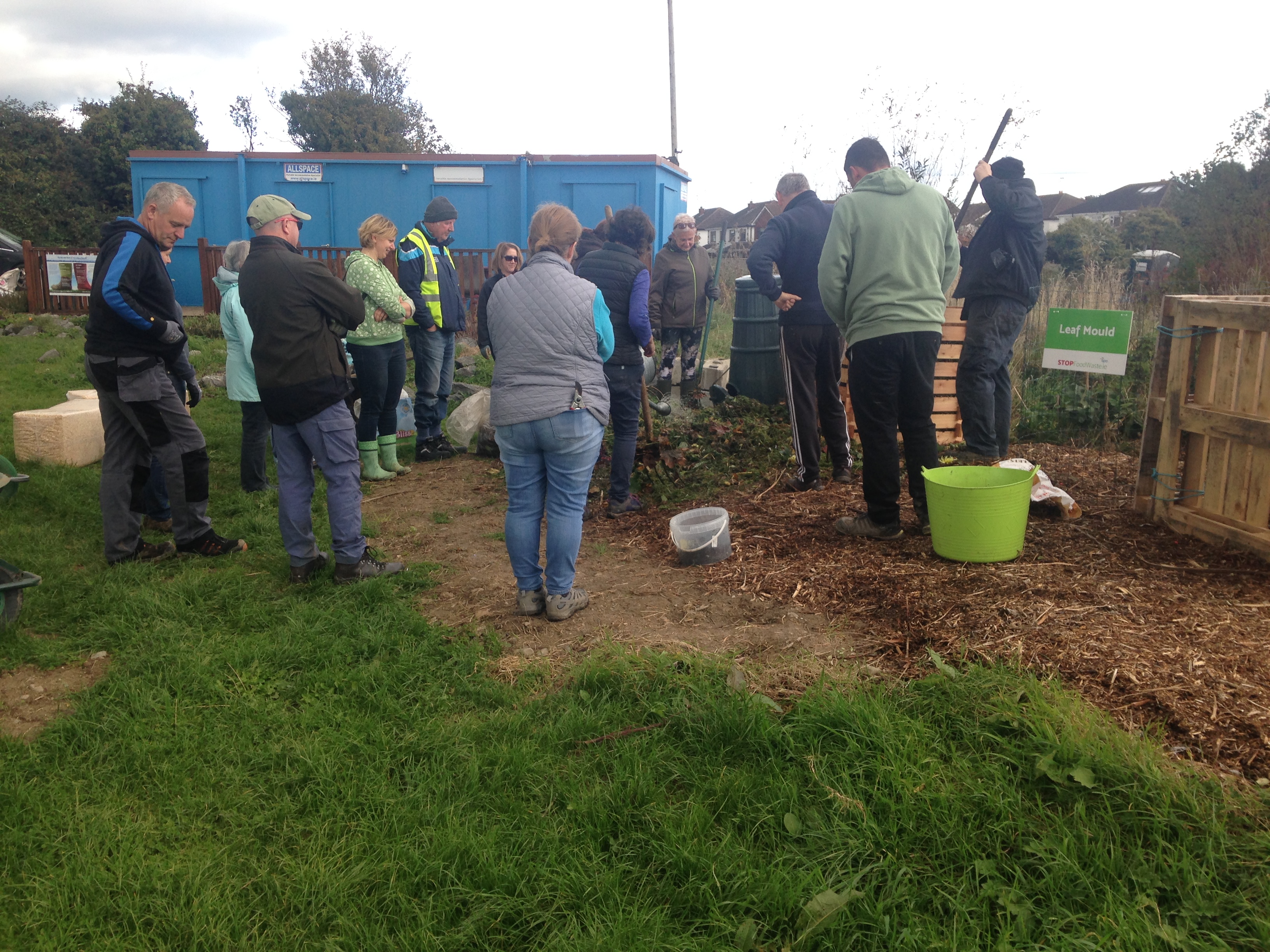
Having done that, a gang of conscripted labourers (or ‘volunteers’ as they are also known) got stuck in and constructed a purpose-built composting facility out of concrete blocks.
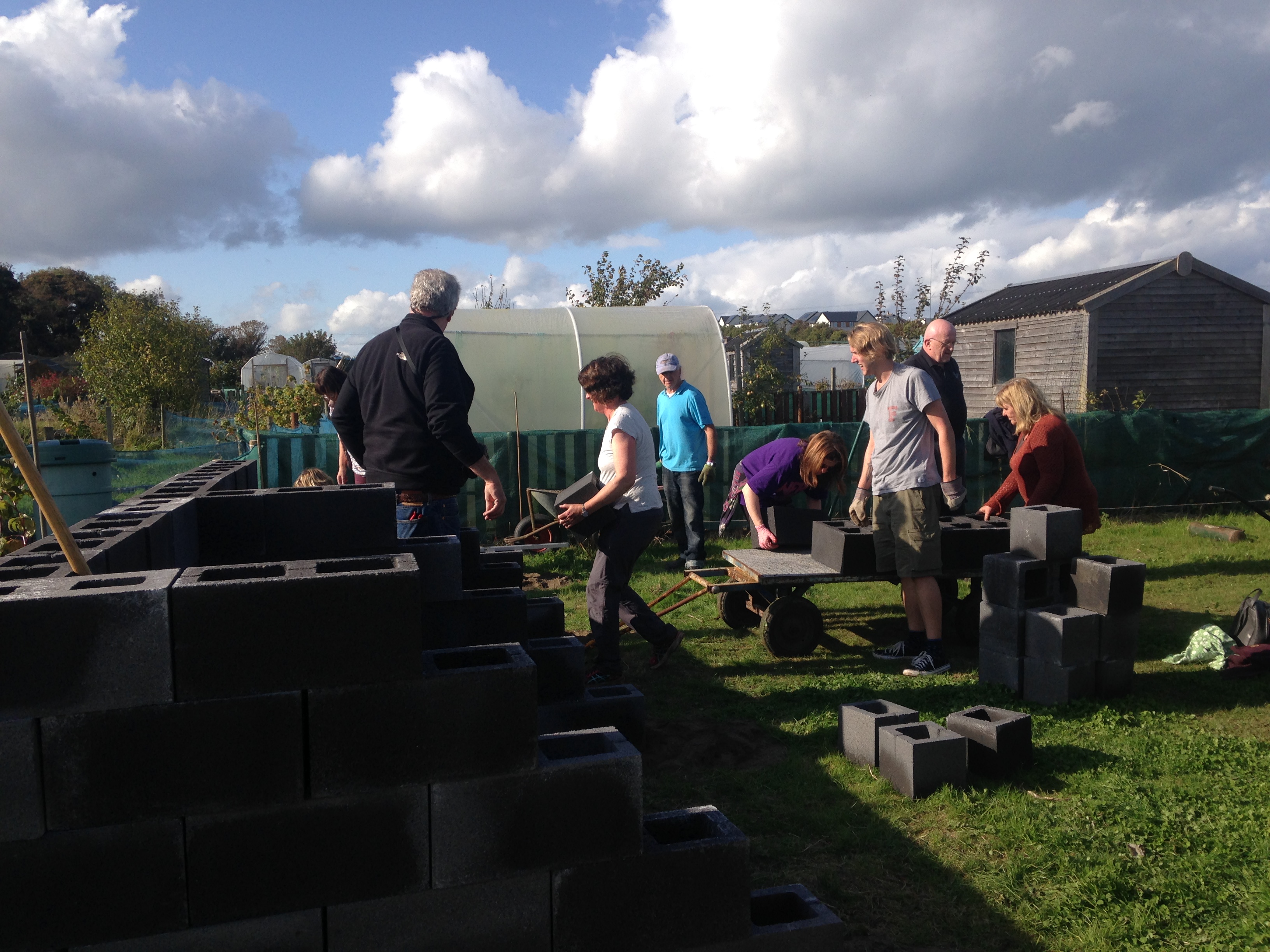
It is intended that this be for the benefit of allotment holders as yet unsure of the alchemical mysteries of composting but who would like to learn as a group. And then share the spoils.
Contact Mary Marsden if you’re interested.
Thanks must go to FCC for funding the initiative, Craig for his excellent tutelage and to Mary for pestering Fingal until they gave in and authorised the course
Back in September Charlie Heasman from Sustainable Skerries was invited to talk at the Wellness Festival in Skerries Mills.
The talk never took place.
Unfortunately he had been allocated the first slot of the day, which proved a little too early for a prospective audience, and no-one turned up.
Here’s what he would have said:
If the first part of this presentation appears to be ‘me, me’ I apologise; I am speaking only from experience, which is all any of us can do…
So where do I start?
…When I was a 14 year old schoolboy back in England I was forced to read a book.
“Forced” might be a little too strong of a term; no-one twisted my arms behind my back or made me sit at a table and not get up until I’d finished, but nonetheless I had very little choice in the matter.
The book was part of my O level English Literature curriculum and if I didn’t read it I was not going to pass. So I sat down with adolescent bad grace, groaned inwardly, and turned to page 1. Two chapters in and something strange had happened: I realised that I was actually enjoying it. In fact I enjoyed it so much that that book has been on and off my bookshelf all my life since.
The book was Cider With Rosie by Laurie Lee. Some of you might know it.
For those who don’t it is an account of the author’s life as a small child growing up in rural Gloucestershire at the end of the First World War. This was a world that had not yet seen a tractor; horses still ploughed the fields. An occasional motor car – an enormous novelty – would occasionally rattle down dusty roads that would not see tarmac for many a year yet, and life continued (for the present) much as it had for generations.
I was green with envy. Laurie Lee had been born in exactly the right place and at exactly the right time to live through and experience the greatest change in history that would ever happen; the arrival in the village of Chad, near Stroud, of the Industrial Revolution. I had missed it by being born in London 40 years too late. There would never again be an opportunity to witness anything like it.
All this occupied my thoughts to a considerable extent and eventually I decided to do something about it.
I left home at 16 and went to work on a small hill farm in Wales.
The horses were long gone but had left reminders of their previous existence in the form of horse drawn agricultural implements – mowers, hay rakes etc – which were now pulled behind either one of a pair of ancient and monstrous Nuffield tractors which required a starting handle to get them going and which I couldn’t because I was too small and puny.
The farm had no mains water. Rainwater was collected from the roofs and water for the house fetched in milk churns from a well a mile away. This didn’t provide enough for the needs of the farm and one of my jobs was to drive the cattle down the mountain twice a day, morning and evening, to drink at a spring.
In truth they took no driving at all, they were quite happy to amble down and be escorted back up. While they drank I sat on a rock and chewed a grass stem. And you can’t get much more bucolic than that.
The farm is still there of course, but with mains water connected, modern farm buildings constructed and a shiny green John Deere tractor with an aluminium Ifor Williams horsebox parked beside the Toyota Landcruiser.
I got there just in time after all; clever me!
Oh, clever me indeed. But there was one thing I got wrong; very, very wrong.
I thought that Laurie Lee had witnessed the greatest change in human lifestyle that could ever possibly happen. That’s what I got wrong.
I refer, of course, to the digital, electronics and communications revolution which everyone here over the age of 20 has themselves lived through. This change has been every bit as big and very, very few of us would want to give up the benefits: mobile phones, the internet, apps to tell you when the next bus is or what the traffic’s like on the M50, social media, chat rooms, whatsap and twitter, computer games and everything else.
Where it goes next none of us know, but we are removing ourselves further and further away from where we came from, from the natural world.
This might not seem like a problem to many. After all, we can control nature can’t we? And as long as we can manipulate nature to provide us with food and whatever else we need why bother ourselves further?
Nature has become largely superfluous; indeed, messy, unreliable and inconvenient. Nature is muddy footprints in the house, having to rake leaves off the lawn in the autumn, keeping an anxious and watchful eye on the kids in case they get stung by a stinging nettle or fall out of a tree. Nature is rain and the necessity of taking an umbrella on the morning commute; worse, wind and rain blow the umbrella apart and it’s dumped in a bin; leaves on the line cause disruptions and make us late getting home in the evening.
Nature is disruptive and, unlike our modern daily lives, cannot be sanitized. Better to distance ourselves from it as far as possible. So we do.
And there’s the problem: we were never meant to.
As a race, as a species, we evolved over thousands of millennia with natural rhythms and a pulse that shaped our consciousness and our psyches. Over the course of just two human lifetimes we have become so clever, so technologically advanced and so self-centred that we feel we can do without it.
But we can’t.
We can replace friendship with Facebook, conversation with texting, emotions with emoticons and customer service with a synthetic voice on the end of the phone instructing us to press buttons 1 through 6. But it’s somehow not the same.
Even going to the bank has lost its charm; I never did enjoy being summoned to be bawled out by my bank manager because I was overdrawn – again, but at least it was personal; he did once admit that it was the likes of me who paid his wages. Now as close as you get is internet banking and the ATM out in the street.
Kids fare no better. Whether by their own choice or because their parents are too afraid to let them outside unsupervised, they spend too much time playing video games inside instead of playing with other children outside.
Supervised “Playdates” are little better. With a hovering adult on hand to step in the moment a squabble threatens to break out the kids learn nothing of the boundaries they can or cannot push when interacting with their peers. One way and another they end up not learning essential social skills.
And we’ve all seen those social media posts: “when I was a lad we climbed trees, played conkers and got stung by stinging nettles; it never did us any harm”. It’s true; I stand before you as living proof that it is possible to survive such dangers and deprivations.
Earlier this year we went camping in the Wicklow Mountains – wild camping; not a campsite – with our daughter and three grandchildren. Before we could even get the tent up 5 year old Loki had managed to run, trip, and end up in a gorse bush.

He was dragged out looking like he’d been mauled by a bear and he howled. His mother and Granny picked out the prickles, smothered him with kisses, he sobbed and off he went. Twenty minutes later he was playing in a waterfall with his siblings. He’d just learned a valuable lesson: don’t mess with gorse bushes.
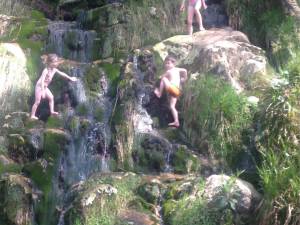
He didn’t; they were still all around the place but they didn’t faze him. He’d learned his first lesson about the natural world and in a very, very small way knew where he fitted into it.
So what about us adults? We’ve been knocking around long enough to know what’s good for us?
And in some ways we have. Many people have swimming with dolphins on their bucket list. Fine; wouldn’t mind doing it myself.
But that’s just one day. After you’ve done that and bored your friends and family to tears with the tale, what do you do next; what do you do with the other 364 days of the year or indeed the rest of your life?
People pick up on all sorts of exotic (to us) forms of meditation and spirituality, believing that if it doesn’t come from a cave in the Himalayas, or somewhere east of that, it’s not worth bothering about. Which simply isn’t the case.
Meanwhile we have Zen, transcendental meditation, feng shui, and 101 different forms of yoga.
The latest that I’ve come across is the ancient (since 1982 in fact) Japanese art of shinrin-yoku. Any guesses as to what it is?
Shinrin-yoku is the art of ‘forest bathing’, whereby stressed-out residents of Tokyo pour out into approved and designated (you heard that right: designated) woods to soak up the ambience and find peace with nature. There are instructors to help them do this, and it costs a lot of money.
We’ve done it here before now for free. In simpler times like Laurie Lee’s or mine it was called one of two things: ‘go for a walk in the woods’ or simply ‘sit under a tree’.
It’s not rocket science, it’s not a mysterious art requiring a lifetime of training and self sacrifice. You don’t need an instructor or pay to go on a course and no-one needs to give it a fancy name. Just do it.
You can do it alone or in company. If the latter, you don’t even have to impose a vow of silence. All talk of the outside world, the world you have just left behind, is banned: no work, no money worries, shortage of school places, the car’s coming up for its NCT. None of that; but if you want to draw your companions attention to some small detail or something you’ve seen but they’ve missed, that’s absolutely fine.
And detail is important. Look, really look, at what’s around you. Smell it, feel it and listen to it too. You might find yourself asking questions like what and why?
What sort of tree is that? Why are those birds flocking to that bush? What are they feeding on? What are woodlice for? What’s the point of wasps?
When you start answering these questions and begin recognising the trees and plants around you a woodland ceases to be a tangled green mess and becomes a living forest of which you are part and which you understand.
Take your phone with you, I mean it, just put it on silent. You’ll need to know the time after all. Maybe mess around with the compass. After all, even Neanderthals needed to navigate. I have an app on mine which is brilliant. Point it at a plant, take a photo, and it comes back with the name and all the info about it.
Want to learn more and faster? Extend your trip by Googling what you’ve seen when you get home; technology is not all bad after all.
And when you’ve got good at doing all of that try (having taken all sensible precautions) doing it in the dark. With our primary sense disabled it is utterly amazing how the others – including the ones we’ve forgotten we have – are heightened.
All this works equally well on mountain, moorland, river and stream by the way.
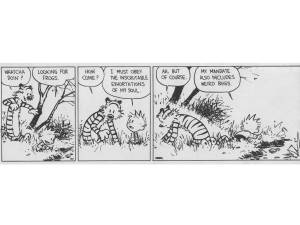
I’ll leave it at that but before throwing the meeting open for comment or criticism I’ll leave the last word to American comic strip writer Bill Waterson who can say it much better and more succinctly than me.
Charlie Heasman; 10/10/2019
Skerries allotment holders have been focusing their attention a lot lately on issues of soil management and sustainability.
First was a visit from Klaus Laitenberger during which he spoke at some length about soil stewardship, or more particularly the lack of it when it comes to modern farming practices. In other words, the long-term unsustainable depletion of soils worldwide due to over reliance on chemical fertilisers.
Currently we have Fingal CC promoting a composting course, the theory side being in Skerries Mills and the practical in the allotments.
There is a surprising amount of overlap in what we are hearing from both parties, which is this: however much it might be convenient (at present) to ignore the fact, modern agricultural food production technologies are unsustainable.
Bad news indeed. Best to ignore it for as long as we can huh?
Speaking as someone who ‘farms’ a mere 200 sq m of soil, and tries in hope to do it properly, I know that even if I get it right I am contributing such a minuscule amount of effort as to be meaningless. I can therefore empathise with a friend who, during the Laitenberger talk, professed that she found it interesting but deeply depressing.
Depressing indeed, why bother?
The answer is that if we all bother we can make a change. But it requires everyone.
Here’s some good news:
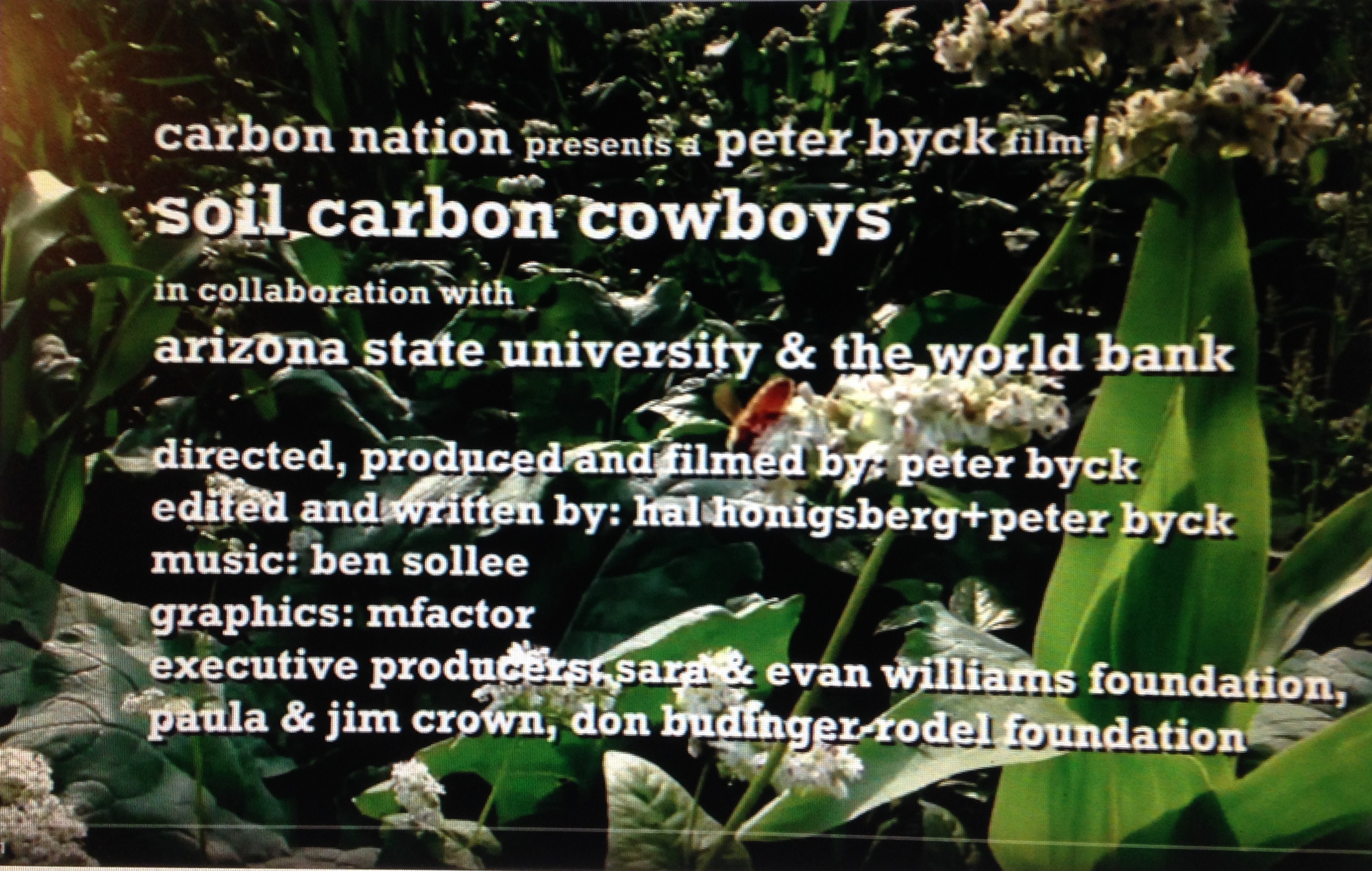
And here’s the link: https://www.youtube.com/watch?v=ZGvVli0OTrQ
It would appear that there are answers; and not just at an urban warrior, tree hugging, brown bread and sandles level. There is still time. Watch the vid. It will take 12 minutes of your life and hopefully both cheer you up and give you cause to fight on.
Sustainable Skerries scooped two awards at County Hall, Swords on Thursday.
The occasion was the Fingal Greener Communities awards presented by Fingal County Council. Forty awards were given to individuals and voluntary groups throughout the Fingal area
Our first was in the Upcycling category in recognition of the Repair Café event earlier this year, for which Ernestine Woelgar must take the lion’s share of the credit.
The second was in the Biodiversity category and was given for the group’s work in promoting bee and pollinator information and education in the town.
More Repair Cafés are planned for the future so watch this space.
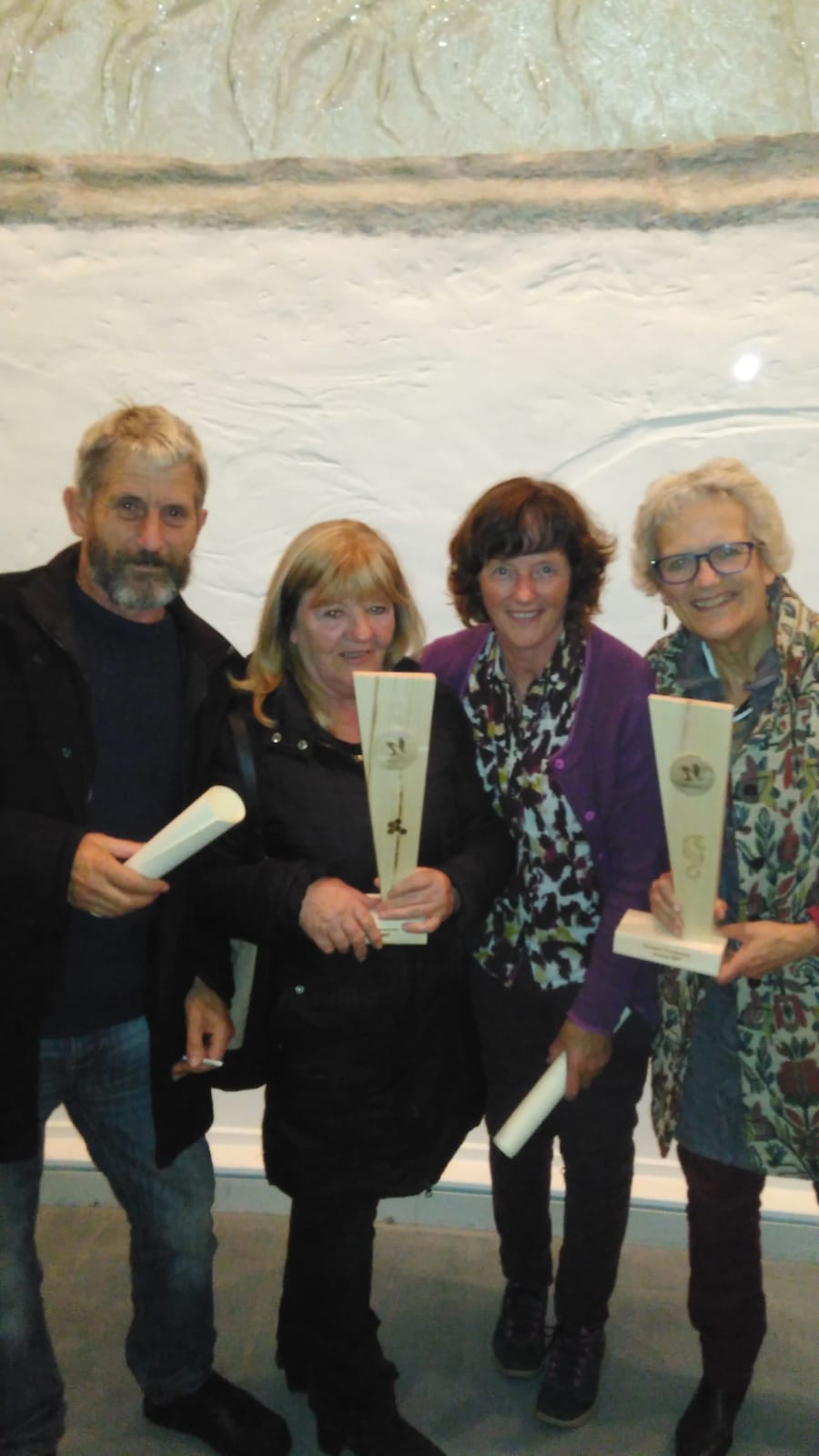
L to R: Charlie Heasman, Marion Heasman, Mary Marsden, Ernestine Woelgar
Our work on pollinators is in fact only beginning.
We were delighted to learn back in September that our application in June to the Community Foundation for Ireland for a biodiversity grant was successful. The proposed project is to promote habitat for bumble bees and other pollinators throughout the town according to the principals of the National Pollinator Plan.
This is a two stage project. Phase 1 begins in early 2020 with surveys, data collection, consultations and public information events. Once this is complete we can actually get on and do the work.
We will be posting regular updates on this website.

