April 2019
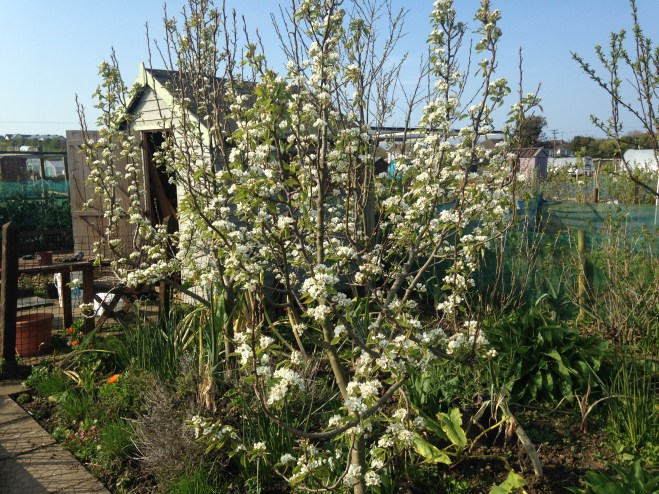
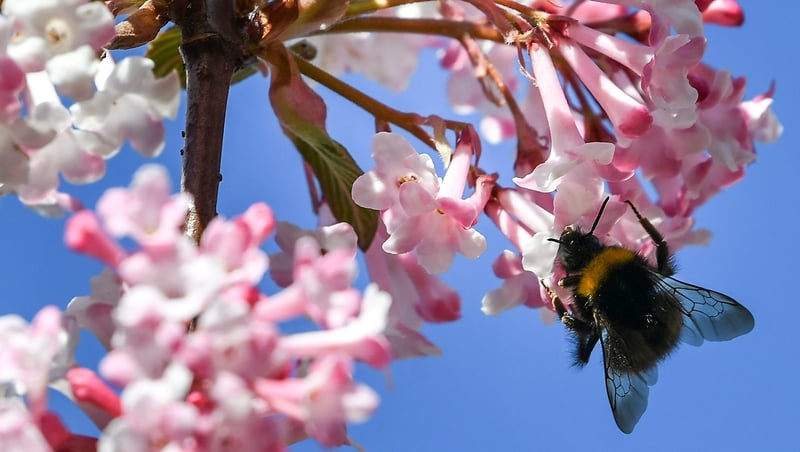
April can in many ways be a frustrating month; it’s supposed to be all about sunshine, sparkling showers and blossom bursting out on fruit trees.
And sometimes it is.

But right now the sun has disappeared, temperatures have plummeted, the early foraging bees are nowhere to be seen and even the dandelions have shut down by folding their flowers tight. A bitter easterly wind makes it feel twice as cold and we may as well be back in the depths of winter. This sort of weather is allowed in March, we expect it; but mid April? Come on!
In truth there is nothing unusual about any of this, it happens pretty much every year and we all have a jolly good moan as if it can’t possibly have happened ever before. When the sun returns in a few days we’ll have forgotten all about it. Meanwhile it’s too damned cold to be outside so I’m finally getting around to updating my blog.
So what’s happening?
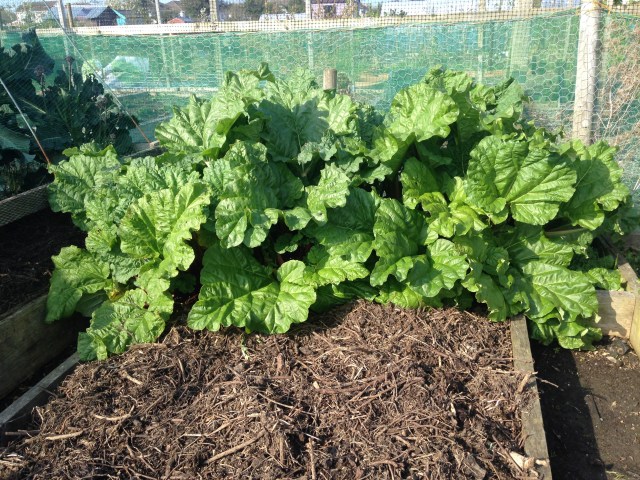
Well, the rhubarb is looking pretty verdant and we’ve had a few feeds off it already with many more to come.

There are two things I love about rhubarb. The first is the taste, good old traditional rhubarb and custard is hard to beat. (We must have forgotten to plant custard last year; we had to go out and buy that part).
The second thing I like about it is that it is so easy to grow; in fact it grows itself. Just throw on some compost once a year, pick away all summer and tidy up the dead leaves in late autumn. That’s it, nothing else to do. It even smothers its own weeds as it grows.
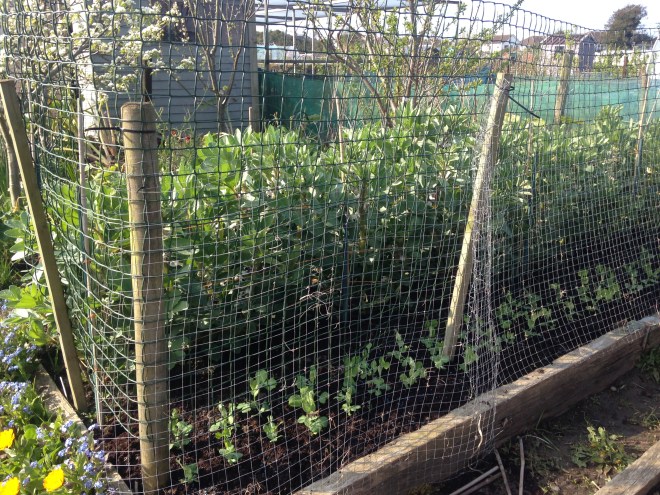
Sown direct into the ground last October, the broad beans are in full flower accompanied by a row of early peas. The latter grown in modules in the polytunnel and planted out a week ago.

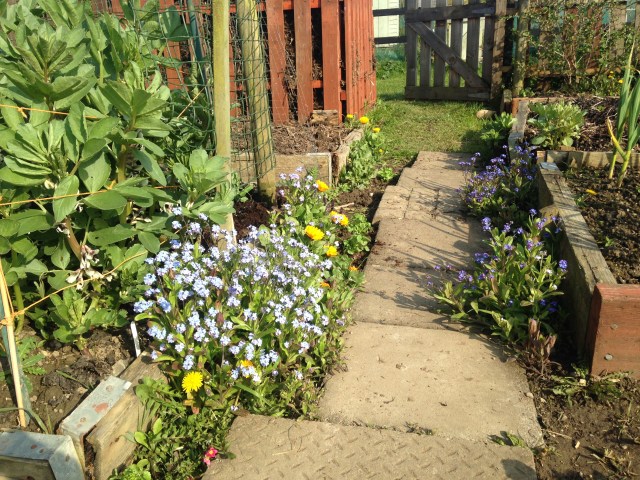
Winter garlic and onions are making good progress and Marion’s weeds, sorry, flowers, dotted around the pathways and encroaching on my vegetable beds brighten the place up.

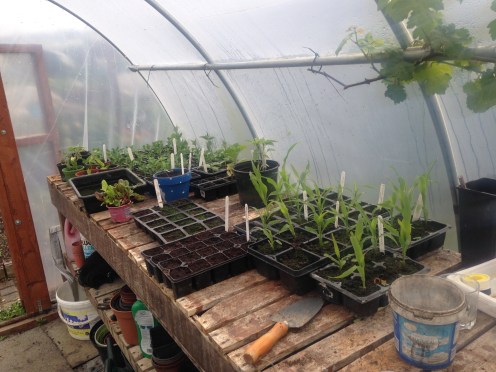
Things are busy in the polytunnel too, with seedlings in modules all growing ready to be planted out in their allotted positions with military timing and position on the appropriate calendar day. (Which is probably the most ludicrous statement I or anyone else ever made on a gardening blog).
This year the whole of the allotments has gone tomato mad, with everyone rushing about swapping Heritage and other unusual varieties. But Hey! That’s what polytunnels are all about. We have that many already that we’d need ten polytunnels to grow them all in, some serious culling will have to be done.
My favourite so far is called Mrs Ruckston’s Bush, or something like that. Definitely have to make room for that one.
Rain forecast for tomorrow but it’s been mostly dry lately so everyone has been up turning the soil.
That’s another nice thing about this time of year, only the diehards are to be occasionally seen in the winter but once March and April come everyone else comes out of hibernation and old acquaintances are renewed and new friends made.
We ourselves have done very little digging this year and intend to do very little more. We’re trying ‘No Dig’.
The principle behind this is that soil does not need to be dug for vegetables, indeed it can be all the better off for being left alone. All the living organisms, including saprophytic fungi, which make it work are better undisturbed. At the same time plants are quite happy to grow in firm soil (there is a difference between firm and compacted). Also, every time you dig you stir up weed seeds; if you don’t dig you, er, don’t.
The idea is entirely new to us but it seems to make sense so we’re giving it a go.
The broad beans and peas mentioned above were planted in this way and I put in our spuds a couple of weeks ago. All that was required was to pull up the sprouts that had overwintered there, rake the bed level again, and drop in the potatoes at the correct spacing to the depth of a trowel. The bed was then covered with two inches of our own compost and that was that. If necessary as the tubers form and if they’re likely to go green on exposure to sunlight, they get another inch of compost.
We’ll see how it turns out.
If it does go all pear shaped we’ll be blaming a certain Charles Dowding. He has a small market garden in Somerset and an excellent series of tutorials on YouTube. Have a look at this one for starters: https://www.youtube.com/watch?v=QVY4SJt4mzg or this https://www.youtube.com/watch?v=zXO_j0vriwk
So that’s us halfway through April. We’re really looking forward to the rest of the year and hope you are too.
Apologies folks but we had a small problem with this website. All fixed now but not much went up for a while, including the Allotment Blog.
It’s back now and to be found by clicking the banner above.
All relevant comments and opinions are more than welcome.
On 24th March 2019, Sustainable Skerries held the first Skerries Repair Café.
Background
Repair Cafés have sprung up all over the world, and are operating in communities from Denmark to Australia. They were founded in response to the fact that too many items of daily life are not repaired anymore and have become disposable, often after short usage. The skills to fix things are in danger of being lost in the face of our convenience, built in obsolescence culture. We throw away too much, we should re-learn how to fix things. Repairing extends the life span of our possessions, reduces waste and saves money.
Repair Cafés endeavour to facilitate a transfer of skills. Members of the repair community are teaching others how to fix things. The emphasis is on the skills transfer, not on the repair only.
The first Skerries Repair Café
We decided to concentrate on clothes, as our obsession with fast fashion means that about 225,000 tones of textile waste are disposed of each year in Ireland alone.
On a sunny Sunday afternoon, ten workstations were set up in the Bus Bar, each volunteer laying out their materials and tools. Tea, coffee and homemade cakes were ready. Already, a lot of information exchange and lively chat was taking place. Come 3pm, a steady stream of people dropped in to get advice and/or see what was going on. The volunteers were kept busy showing people how to hem school trousers, mend old pyjamas, fix teddy bears, embellish a pair of jeans or upcycle a second hand dress. Everybody enjoyed the experience and many participants were asking when the next event would take place.
Thanks
We would like to sincerely thank all our volunteers who made this event happen, the Bus Bar who provided the venue and Friends of Autism & ADHD who donated a bag of clothes for our use.
Future Plans
Sustainable Skerries are planning to regularly hold such events, each one concentrating on a different skill. Please contact us at sustskerries@yahoo.ie and let us know what repair skills you would like to learn and what skills you would be willing to share.
January is perhaps the month when growth is slowest in the allotment, and it may seem like there is nothing to be done. This is not true: there is always something to get on with. Even now the buds on fruit trees and bushes are swelling in readiness for Spring and the wise gardener will be making his or her preparations also.
If you haven’t already done so, now is the time to think about constructing compost bins.

Homemade compost is both natural and free from contaminants (insofar as that is possible in this day and age) and I cannot recommend it highly enough. One assumes that anyone who has taken an allotment has done so because they want natural healthy produce, and this is the way to go. If on the other hand you are the sort who doesn’t mind spray and insecticide residues in their food you don’t have to bother with any of this, such produce is readily available in any supermarket for considerably less time and trouble.
Even farmyard manure can be problematical; herbicides and similar can pass straight through the animals in question and be imported into your patch. One might assume that the quantities would be so small as to be not worth worrying about, as I always did, but last Spring we suffered a severe setback when we applied a batch of cow manure which killed almost everything it touched including potatoes, tomatoes, peas and beans.
We can’t prove it, I wish we’d sent a sample away at the time for analysis, but subsequent internet research showed that the symptoms were typical of aminopyralid sprays, a widely used broadleaf herbicide used in agriculture. Apparently it has been a recurring problem for allotment holders in the UK for the past decade or so.
This had never happened to us before and might never happen again, but we’re not prepared to take the chance. From now on it’s homemade or nothing.
Gathering together enough materials can be a problem for many organic gardeners, but here in Skerries we are lucky. For one thing the sea is only a few rooftops away and seaweed abounds, particularly after a gale of easterly wind. And it’s free!
Seaweed is not a complete fertilizer in itself. For reasons I don’t fully understand it is, apparently, low in both carbon and nitrogen. But it is high in phosphorous and trace minerals and makes a fine tonic for the soil. We don’t so much compost it as spread it as a mulch in the Autumn, this both feeds the soil for next Spring and suppresses the weeds.
A bed mulched with seaweed ready for spring.
We are also lucky because many of our neighbours don’t bother composting at all. They are actively encouraged to throw their green waste into my bins rather than the heap in the carpark. In this way we get more than enough for our needs; (perhaps I am shooting myself in the foot by writing this and encouraging them to use it themselves.
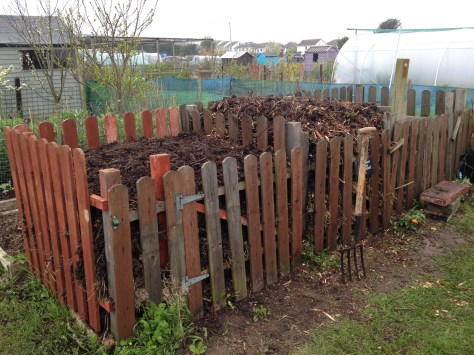
A compost bin does not need to be an elaborate affair; four pallets nailed together will do the trick, but if you have one you really need two. This is because once the first is full you need a second to carry on filling while the first breaks down. Small allotment? No problem. Smaller bins.
We have a fairly big allotment and we have three bins, and there is a gate on each. This means I can get in, fork all the contents out, and then throw it all back in giving it a good mix in so doing.

Compost will break down on its own eventually, but turning speeds the process considerably. There are those who claim they can achieve a twelve week turnaround, fair play to them, six months does me.
So what goes in, and how?
In my case all green matter. I don’t worry unduly about weed seeds or roots because the heating process kills both. With the correct balance of materials and an occasional turning (maybe once a month) the bacteria can heat the pile to 60 degrees C, more than enough to do so.
It’s a very good idea to smash, chop or otherwise break up large woody lumps like cabbage stalks. They are incredibly tough and slow to break down left to their own accord. In fact if you don’t administer justice at this stage they’ll still be there, pretty much intact, when the compost is ready; in which case throw them back into the next batch that you have coming along.
Brown material is also needed. ‘Brown’ means stuff like woody stalks, shredded cardboard or, in my case, woodchip (as conveniently delivered to the allotments by various tree surgeon type companies). Green material is high in nitrogen; brown in carbon. The bacteria need both in order to thrive and do the job. Get the balance right, mix well, and you’re off to a flying start.
Two more things are needed: oxygen and water.
It’s impossible to have too much oxygen, my bins have slatted sides to facilitate aeration and regular turning does the rest. Water is slightly different; in this case you can have too much of a good thing, and if the pile is wet you’ll end up with a soggy, stinky mess. A good guide is to take a handful and squeeze as hard as you can, if you manage to squeeze out one or two drops you’re good. Even if you can’t, but feel you nearly managed it, you’re still good.
Moist is the thing to aim for. Bins should be covered to prevent them drying out in summer or getting waterlogged in winter. If the pile seems a little dry when you’re turning it, get the watering can out.
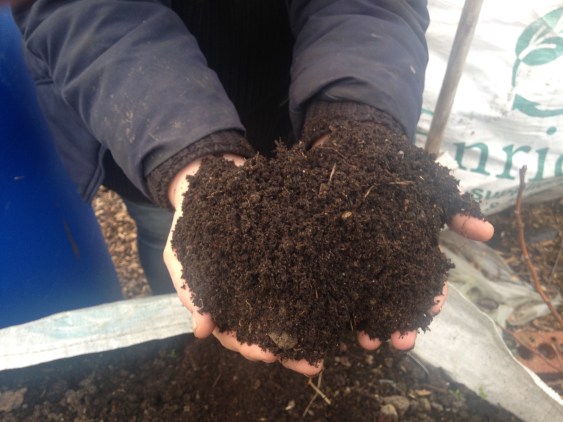
You now have a pile full of worms, woodlice, fungi and creepy crawlies all munching away and turning your garden waste into the best possible fertilizer for your fruit and veg. While I have absolutely nothing against companies such as Enrich who supply tonne bags, you have also done your bit by cutting down on plastic use (the bags) and polluting road transport.
One last thing: proprietary compost accelerators. Don’t bother.
If you have money in your pocket that you don’t want by all means spend it, but it’s not necessary. There are plenty enough bacteria occurring naturally to get things going, and if you really want to be sure, throw in some seaweed.
Happy growing!
This is a very thought provoking Opinion piece from Sadhbh O’ Neill published in The Journal.ie
Sadhbh O Neill is a spokesperson for Climate Case Ireland. She is a PhD candidate and part-time lecturer at the School of Politics and International Relations at UCD.
Climate change is dangerous and poses a threat to us all, so we are taking a High Court case this January on behalf of all Irish citizens, writes Sadhbh O Neill.
2019 WILL SURELY be the year of climate action.
Recent scientific reports by the Intergovernmental Panel on Climate Change gave us just 12 years to make drastic cuts to the greenhouse gas emissions that are responsible for climate change if we are to limit global warming to 1.5 degrees.
Human activities have altered the Earth’s living systems beyond recognition. We have left our mark on Planet Earth in seriously negative ways and climate change is the most visible and urgent threat that we humans have inflicted on the planet.
Ireland is among the poorest performers in Europe for tackling climate change. We cannot continue to hide behind the emissions of other countries and claim we have no duty to act. Individual action, no matter how well-intentioned, will have almost no effect without strong state leadership and multilateral cooperation.
That is why we must challenge our government in a historic high court case starting 22 January.
Human Activity
Once an insignificant speck, humans are now in a sense responsible for the whole planet’s future.
Of course, ‘humans’ are not a homogeneous group. There are huge inequalities and injustices behind the climate story. Colonialism, greed and ideology have all played a role in driving up both emissions and exploitation all over the world and throughout human history.
Yet most inconveniently, climate change presents itself as the challenge we all face together now, and on behalf of future generations, regardless of our degree of responsibility.
Governments are supposed to plan for the long-term, and in the common interest. But as the Swedish 15-year old activist Greta Thunberg reminded UN negotiators, all of the burden, including that of telling the truth about the real and systemic crises that face us, is being left to our children.
While the international climate negotiations have indeed been painfully slow, there is a growing body of scientific evidence and international law that should be guiding our response to climate change here in Ireland.
The Climate Case
Ireland’s performance on climate change so far has been very poor in comparison to the rest of the EU. Our government’s ongoing failure to bend the emissions curve has been repeatedly raised at national and EU level by both independent and state authorities.
The analysis produced by Climate Action Network Europe in June this year placed Ireland in second last in the EU for action and ambition on climate change. Just last month, the Climate Change Performance Index highlighted Ireland as being the worst performing country in Europe for action on climate change.
Citizens are no longer prepared to wait until the government wakes up to the challenge.
Friends of the Irish Environment under the banner ‘Climate Case Ireland’ is taking legal action against the Irish Government’s failure to take the required action to avert dangerous climate change.
Our case is inspired by global climate change litigation, including the 900 Dutch citizens of Urgenda who won their case against the Dutch Government in 2015. The District Court in The Hague ruled that the Dutch government must cut its greenhouse gas emissions by at least 25% by the end of 2020 (compared to 1990 levels).
That ruling required the government to immediately take more effective action on climate change.
We have asked the court to quash the existing climate plan and to require the government to produce an ambitious emissions reduction plan which helps to avert dangerous climate change.
While our case does not specify the means by which targets should be met, there is plenty of research showing that we will all benefit from the energy transition. Climate action demands a mobilisation of both citizens and government actions alike if we are to avert disaster.
Instead, in Ireland, we will face fines for not meeting EU targets – the Institute of International and European Affairs have estimated that Ireland could face fines between €3-6bn by 2030.
Why Ireland?
You might ask – but why Ireland? We are a tiny country, why should our emissions matter?
While China, the US and India are currently the world’s top emitters, the EU has contributed a much higher percentage of the total emissions released into the atmosphere.
And while US leadership would indeed make a big difference it should be noted that many US states are already taking decisive action to reduce emissions in spite of the federal government’s position.
Ireland’s emissions per capita are the third highest in the EU at 13.2 tCO2e per person.
Our energy, heating and transport systems, in particular, are highly dependent on polluting fossil fuels but government plans are not properly assessed for their climate and environmental impacts.
As the 64th largest emitter of emissions in the world, we can hardly expect the 130 countries that emit less than Ireland, to reduce their emissions if we don’t do likewise.
We are among the wealthiest countries in the world with high rates of economic growth and employment. It is vital that we contribute our fair share of the global effort in solidarity with developing countries who will bear the brunt of climate damage.
We cannot afford to wait until there is political consensus for strong policy measures.
The courts have a special role in ensuring that government decisions are compliant with national, EU and international law and in ensuring that human rights are protected. The Dutch case showed that citizens can access the courts to effect a change of direction.
Our case will be heard in the High Court from the 22nd of January and we are taking it on behalf of everyone in Ireland, young and old. We hope that it will inspire the public into supporting our call for greater climate ambition.
Sustainable Skerries are delighted to introduce a new regular feature on our website, “The Skerries Allotment Blog” from Charlie Heasman. We hope to publish this blog monthly, or more if there’s more to say!. Enjoy the read, and please comment, positively, constructively and in good humour.
———————————————————————
“First, a few words of introduction, my name is Charlie Heasman. My wife, Marion, and myself have an allotment in Skerries, an allotment which over time we have become passionate about. When Sustainable Skerries heard that not only can I string a half intelligible sentence together when pushed, but also have Microsoft spell check, they invited me to write a monthly blog. Okay, here goes.
So here we are in December, a time when very little is growing and not a lot is happening, which would seem a mildly surprising time to start. But actually this is not the case.
It’s difficult to think of any enterprise where a bit of forward planning does not go amiss and there is no better example than an allotment. Here at the tail end of 2018 we have time to plan ahead for 2019, and the better we plan now the better our chances of getting it right then. Hopefully!
Marion and myself will have been in Skerries allotments four years this coming March. We had the advantage of not starting off as complete beginners and I will flatter us both by saying that we’ve added considerably more to our knowledge since then. My intention here is to humbly offer to share what we know with others who may find it of benefit.
Of course, there are some who have been there far longer than us and indubitably know far more than us and I’m sure that collectively they’ll be able to disagree with just about every point I make. That’s fine, dialogue is good; there’s a comment box below folks, use it. Let’s get a discussion going.
In the meantime I’m the blogger, I get first say..
…and I say we’ve only been here four years and in that time we’ve seen so many people come, give up, and go.

Why?
The short answer, always given, is that they didn’t know how much time and work it would be. This is true in so far as it goes but, let’s face it, if someone’s looking for both a hobby and a release then tending a mere 50 square meters of land should be a pleasure, not a problem. What is a problem is turning up in April with a trowel and a packet of seeds, scratching with the former and throwing about the latter, and expecting a miraculous crop of vegetables. It’s never, ever, going to happen.
Why? Answer: no planning, no groundwork.
Before even thinking about planting (and we’re all impatient for results, we wouldn’t be human if we weren’t) it is necessary to look after the soil. Get the soil right and the rest will follow; you’d be amazed how true this is. You’ll also be amazed how much easier life becomes and how much more successful you are.

So what’s involved?
Three things: weeds, structure and nutrition.
Take weeds first (as indeed you should). Get rid of them, get rid of them all. If you
don’t, the ones that remain will come straight back in. I’m talking perennial weeds here like couch grass, nettles and buttercups. When we took over our 100 sq m plot it was wall to wall couch grass. We resolved to start digging in one corner and work our way out..
So we did…

There was a certain amount of backache involved…

But fun for all the family nonetheless…

But three months later it looked like this. Okay, I’m boasting.
Forgive me.The point is that if we hadn’t gone at it full bore we’d still be battling the stuff now. By contrast, we’ve seen others in a similar situation meticulously clear a small bed in the middle of such a wilderness, plant in it, and then find to their dismay that the weeds have come straight back in and that they are pretty much right back where they started. So they clear it again, and again, and again, and then give up.
Cleaning that allotment was the first and hardest thing we ever did but boy, aren’t we glad now. While there may be the odd spear of couch grass that still creeps in even now it is easily and quickly dealt with and we can relax.
Sitting here and writing this, a thought has just occurred. We both like to think that with our allotment we are working with, not against, nature. Yes, I think it is so. And yet at this point we were battling against nature: nature wanted the weeds there; we didn’t.
But I can say that we’ve never used, nor will ever use herbicides. It’s all down to the fork and the hoe. I’m both mystified and saddened when I see allotment holders use weedkillers. Why? What’s the point of having an allotment at all? Beats me.
Happily the remaining two factors, soil structure and nutrition, can both fall firmly into the ‘working with’ category.
When we first dug and weeded our patch we thought the soil looked pretty good, a quick application of compost and it would be good to go. In fact it was, as per photo above; but we now know it could have been so much better.
To start off with the clods we dug were hard and heavy, requiring a good few smacks with the back of the fork to break them up, but as we’ve progressively added more organic matter -anything we can get our hands on, cow and horse manure, compost, seaweed – things have improved. Now the soil is so much lighter and actually crumbles off the fork of its own accord, so even digging is so much easier. And if I can get a fork through it with ease then I’m sure the plants can now do the same with their roots. Not only that but it drains quicker in winter and retains moisture longer in summer.

We still occasionally come across an untouched lump in an odd corner of a bed; the sight of it reminds us of the difference between now and then. Today I nipped up with my trusty iphone and after a bit of exploratory digging, recorded the masterpiece here.
Apologies for the poor quality, but hopefully it shows a hard grey lump dug out of softer, darker soil. It too took several smacks to break it up.
One last anecdote:
Back in our early days we heard that carrots require deep, fine soil in order to do well (they do), so Marion set to work preparing a patch. It was an area of about one and a half square metres at the end of a bed. Determined to do the job properly, she dug down 18 inches and put everything through a fine sieve. It took her all day but the resultant tilth looked impressive, talcum powder came to mind. We threw in the seeds and stood well back, ready for the imminent explosion of growth.
Which didn’t happen.
In fact very little grew, and what did was woefully scrawny. When we came to pull up what little was there and dig the bed we found that it had set like concrete. By contrast, and coincidence, that same bed again contains carrots as I write. This time they did explode into a mass of verdant green. The difference? Organic matter.
So that’s my view: with an allotment the more you can put in at the beginning the easier it becomes eventually, and the greater the rewards. To anyone contemplating starting: be warned. To anyone about to give up: don’t.
If you’ve to any extent enjoyed reading this, I thank you and invite you to pitch in with a comment below; as said at the start, it would be great to get a discussion going. If, however, you’re thoroughly bored and feel you’ve been robbed of ten minutes of your life, there are some very good videos on Youtube.
Until next month”…
Charlie.
“World Café”
On Thursday 15th November At 8:00pm
The Skerries Mills.
This is a quick reminder to everyone, Sustainable Skerries will be running a World Café on Thursday evening (15th Nov). This is a very open and relaxed forum, and a great way to get a discussion going on important topics. We will have small groups of five or six people per table, each table will have a question related to sustainability and resilience in Skerries.
We’ll be asking questions like:
- “Where did all our water go? Did you know that 50% of our Water leaks into the ground the ground before it reaches our taps?
- “Are we getting all the goodness we can from our food? How can I compost at home?”
- “Are you fed up with our throw-away culture? Would you like to learn to repair things like our parents did?
- Single Use Plastic, “How did we survive before plastic? Is it the consumer or the producer who drives change?”
- Energy Security, Lights out in NI? Where is our energy coming from?
If you are interested in discussing these topics or would like to learn more about them get in touch with us at sustskerries@yahoo.ie or just come along to the Café on the first floor in the Mills at 8pm on Thursday 15th. See you there.
Another burst water main impacting Skerries. The notice below is from the Irish Water bulletin board.
This is one of the subjects we will be discussing at Thursday’s World Café. Please come along to contribute to the discussion.
Skerries, Dublin
11/11/2018 – 12/11/2018
REF. FIN029128
Burst Water Main – Skerries
- Water OutageWorks have an estimated completion time of midnight. Please take note of the following reference number and enter it into the search bar should you wish to return for an update:FIN029128.
- We recommend that you allow 2-3 hours after the estimated restoration time for your supply to fully return.
- **Update 12:22am**
Due to extent of the damage and repairs required, the works are now expected to be completed by 4am on 12 November.
Repairs to a burst water main may cause supply disruptions to Skerries, Barnageeragh Cove and surrounding areas in Co.Dublin.