Sustainable Skerries welcomes the vision but has deep concerns at lack of staffing and funding for the draft Fingal Biodiversity Plan

With a Climate and Biodiversity Emergency declared in the Dáil in 2019, we need to do better than implementing only a fraction of actions deemed necessary by the draft Fingal Biodiversity Action Plan. This is the main observation made by Sustainable Skerries in their submission. Have you made yours? You have until tomorrow night, as it closes on 5 July 2022, 23:59 h.

Here is ours:

Sustainable Skerries commends Fingal County Council on the vision of, and the many targeted initiatives in, this plan. However, we are deeply concerned that of the 100 actions required to halt the loss of biodiversity in Fingal by 2030, only 30 are prioritised for implementation, due to the financial and staff constraints. Several actions seem to need relatively little extra funding, so it seems that human resources are the bottleneck. Extra staff for the biodiversity team should thus be a priority. Many additional actions might make it to the “prioritised for implementation” list if there were two, or maybe even just one, extra staff in the Fingal County Council Biodiversity Team.

It is understandable that the council faces difficult decisions with regard to funding initiatives in the county, but for something as important as this more efforts must be made to obtain the necessary budget. We would like to see Fingal County Council work with the government to get further, ring fenced, funding to meet our obligations to cope with the biodiversity emergency. For instance, Minister Malcolm Noonan recently launched the “Strategic Action Plan for the Renewal of the National Parks and Wildlife Service”. With the increased resourcing and staffing this plan provides for, there is an opportunity for Fingal County Council to work with the NPWS to implement more than the 30 prioritised actions.   

The current draft of the Biodiversity Action Plan seems to solely focus on actions that can be achieved with direct Council funding,  and does not identify how Fingal Coco might seek to bridge the gap by promoting existing centrally-funded schemes, targeting EU funding,  or maximising biodiversity benefits from privately funded initiatives. 

 It is noted that Action 72 (Explore funding models for carbon offsetting to fund wetland and

woodland development) could be a key and rapidly developing opportunity in this context,  which is why we feel it should be a priority action.  

There are obvious possible synergies with efforts being made outside Fingal in central and local government particularly with respect to the preparation of the numerous guidance documents, procedures and training requirements identified. 

Actions 33-38, especially those which involve producing guidance documents for biodiversity-friendly building and infrastructure projects, are relevant to all local authorities nationally, not just Fingal County Council. One example is Action 38:” Pilot a biodiversity inclusive design for a social housing estate with green roofs, green walls, wetland & pond SUDS, green carparking, nest boxes in facades, wildflower meadows and wildlife friendly shrubs and trees in open space.” 

A priority action to be added to the plan should be to identify partners (including other local authorities and national organisations) and together find new funding streams, thus maximising the potential for efficient use of public money by coordinating with other public bodies to deliver those actions not just in Fingal but nationwide. We note that they are not prioritised in the current draft and suggest that with additional staffing, and by cooperating with other bodies, they could still be achieved.

While we welcome the actions that are being prioritised, some of the actions which appear to have been de-scoped do not require significant funding to make progress in, rather a political will and staff resources for coordination.

Rewilding: There is no overarching objective relating to rewilding of small and marginal areas of public lands – areas that could be essential stepping stones in Fingals ecological network,, a potentially cost free exercise (apart from staffing implications for coordination) that could be begun simply by taking less actions and spending less money

Fingal County Council’s own webinar introducing the plan highlighted the importance of protecting the network which connects Nature Development areas with Special Areas of Conservation. Sustainable Skerries agrees that corridors linking these areas must be protected.  Providing corridors through which wildlife can move about is a priority. One simple, achievable action would be the revision of mowing regimes. Leave some areas completely unmown for the summer, leaving them to become natural wildflower meadows, while reducing mowing frequency on areas that still need to be cut, allowing pollinators a window of opportunity to harvest flowering plants. By extending the mowing interval by even a week, preferably longer, money is saved, staff can be redeployed to other activities, CO2 emissions reduced, fossil fuel usage reduced and nature benefits. A truly win/win situation. Allowing native wildflowers to flourish, which provide essential food for pollinators, will in turn maintain a biodiverse environment for other wildlife.

Coupled with this, there is an opportunity for the plans in Action 6, currently envisaged only for golf clubs, to be extended to other sports clubs as well. Plenty of local clubs (cricket, rugby, GAA, soccer etc) have significant green areas not used for playing on, as well as green areas around the playing fields.

The continued use of herbicide by the council in graveyards is a cause for concern. While this must undoubtedly be handled sensitively there are more appropriate ways to maintain these areas. Fingal County Council must ban the use of herbicides in all contexts across the whole county and work with grieving relatives to address their concerns in the context of the biodiversity emergency we are facing.

Action 40 (Support and promote All Ireland Pollinator Plan Actions for Councils and monitor resulting changes) has as an objective that Fingal County Council increase to only 20% the land in the council’s control to be given over to biodiversity improvement. This is too low, and there is a huge opportunity here for an inexpensive win for Fingal. This seems to cost little or no money, and if managed properly actually saves money for use in other areas of the plan.

Sustainable Skerries is disappointed that Action 18 (Incorporate measures for

biodiversity conservation in the management plans for a Regional Parks in Finga)l has not been prioritised. Such management plans give Fingal County Council an opportunity to set an example in best practice for biodiversity management. If Fingal County Council does not even draw up biodiversity management plans for its own regional parks, how can it expect other organisations to take biodiversity seriously? If funding is an issue please see our point on engaging with the government and NPWS above.

Actions 37 & 38, which cover social and council housing and associated parks and infrastructure, must be prioritised. Again, there are aspects of these actions that are low cost if some imagination is applied. If staffing resources were made available and some ways were found to involve residents directly the plans would be far more successful.

In the cases of privately owned property, altering planning restrictions to make it easier for people to make changes to their own properties in order to build for biodiversity would be welcomed. Furthermore Fingal County Council must be making sure that all of the items mentioned in these actions form part of any new building schemes in the county, as part of the planning process. Where planning of a new estate is with An Bord Pleanála, Fingal County Council must make submissions highlighting these needs.

Actions related to agriculture including overall targeted awareness raising in Fingal are underrepresented in the draft plan. Fingal County Council must do more to engage with farmers, many of whom are well aware of the biodiversity emergency we are witnessing. Fingal County Council itself could support farmers making changes by adopting an “Organic First” policy when purchasing food (for catering etc.). This should be an additional (and implemented) action.

Agroforestry, combining forestry and agriculture, is very promising for biodiversity and climate change mitigation and adaptation. Action 48 (Acquire sites for woodland planting at St Catherine’s park and Ardgillan Demesne and prepare masterplans for the design of these woodlands) should be extended to include a “model farm” scheme.It could be combined with Action 61 (Develop a 400ha demonstration Agri-Environment EIP Scheme with local farmers in Fingal targeting farmland birds and habitats and water quality improvement measures).  A demonstration of regenerative agroforestry would enable farmers to see for themselves how regenerative agriculture can sequester carbon. The biodiversity crisis, after all, cannot be separated from climate change.

We were pleased to see the inclusion of a proposed education centre in Turvey Nature Park and nature education programme for primary and secondary schools. In order for the objectives of this plan to be met and sustained we believe education will play an essential role, otherwise these actions will be misunderstood or poorly prioritised across communities in Fingal in the future. In order to create, design and deliver such nature-based learning for schools, significant resources should be allocated to ensuring that this becomes embedded in curricula across schools in Fingal as soon as possible. Such education programmes should ideally go hand-in-hand with school’s management of their grounds to increase biodiversity and attract wildlife which in turn will create an ideal “classroom” / field site for such education programmes. The creation of education officer roles who liaise with schools directly in coordinating and delivering such programmes is vital to the longevity of this plan. The creation of an education centre in Turvey Nature Park would further embed such learning and act as an ideal site for school field trips / school tours to allow children and adults alike to immerse themselves in wild native Irish landscape and learn hands-on about what they can do in their communities.

Many of the Target KPI’s identified relate to preparation of guidance documents or production of reports.  Given the life-cycle of the Plan, the KPI’s should be extended to include the demonstrable implementation of the guidance measures or report recommendations.   Acknowledging some measures may require additional funding, it is suggested the KPI could commit Fingal to the swift implementation of no/low-cost measures/recommendations,  or the identification of funding routes for more costly or longer-term measures.

In summary, while we have some suggestions for changes, overall, we welcome this plan – and are shocked that only so few of its suggested actions are currently due to be implemented during its lifetime, due to staffing and financial constraints. With a Climate and Biodiversity Emergency declared in the Dáil in 2019, we need to do better than implementing only a fraction of actions deemed necessary.
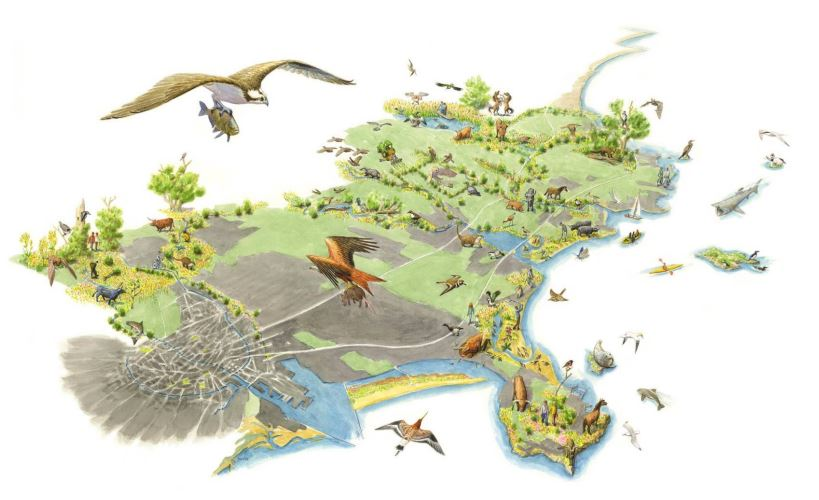
From the draft Fingal Biodiversity Action Plan, title: Fingal Ecological Network by Jeroen Helmer, Ark Natuurontwikkeling. Wouldn’t it be great if Fingal was looking like that…?
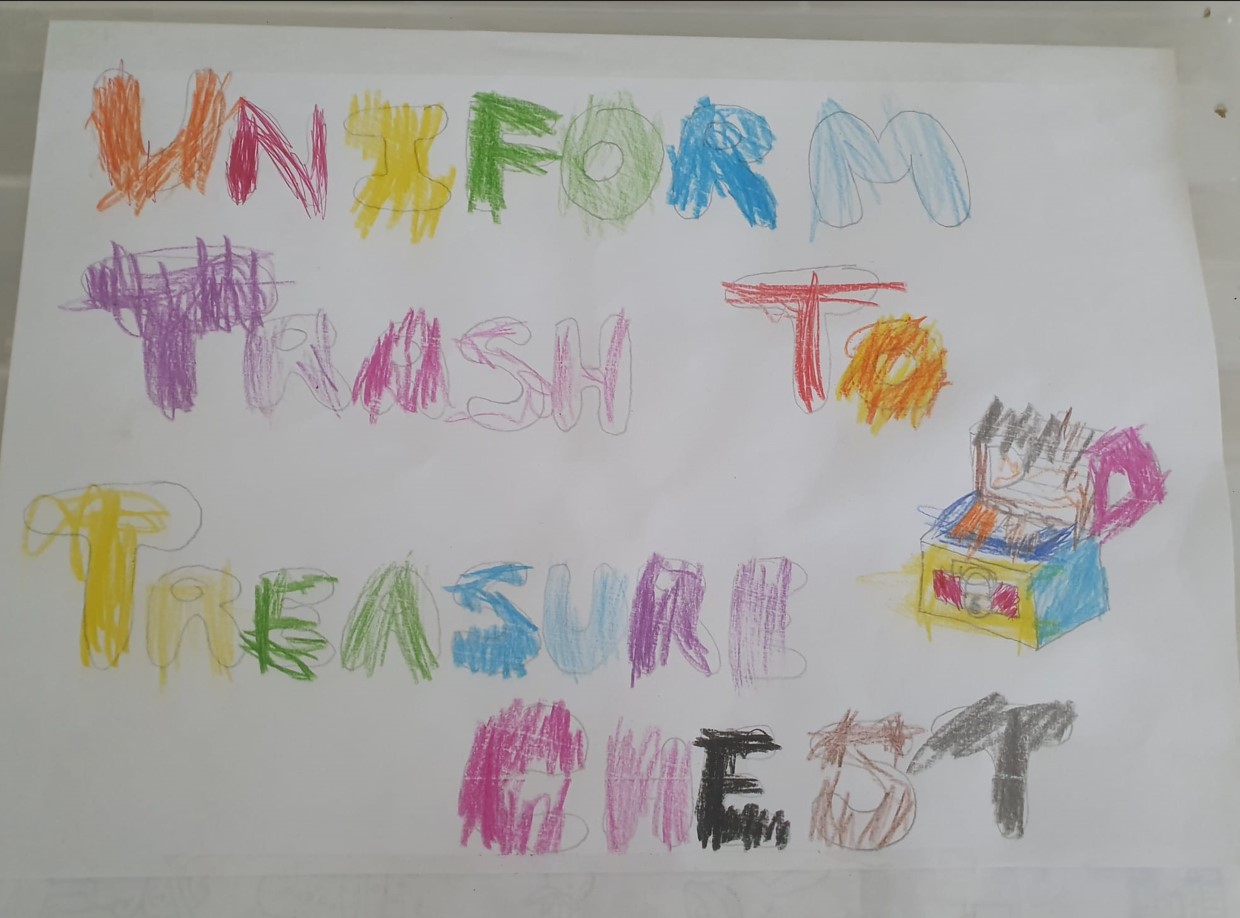
If anyone here has kids in St Pat’s, they will probably know that some parents have taken the initiative to save torn, worn, and / or scruffy uniform items from the bin.

They are sharing the below message in class WhatsApp groups.

REQUEST for old uniforms destined for the bin – Dear Parents,

As we finish up this year many will be passing on old uniforms to friends or family and many will be donated which is great.

For those uniforms and tracksuits that are torn, worn, have holes or scuffs that you plan to throw into bin after this week can we ask that you instead donate them for a uniform upcycling workshop over the summer and next year?

Even those that seem well worn and beyond repair can be used as material for other ones.

You can either

1) hold onto them if you and your kids are interested in attending a fun repair cafe over the summer and message ….. to stay in the loop,

2) donate them now for the repair cafe once they have been washed.

You can drop them to…[address redacted]… where we will take them anytime. Thank you so much. 🧵🧶👍🌍♻️

This went out to the parents of St Patrick’s National School, Skerries.
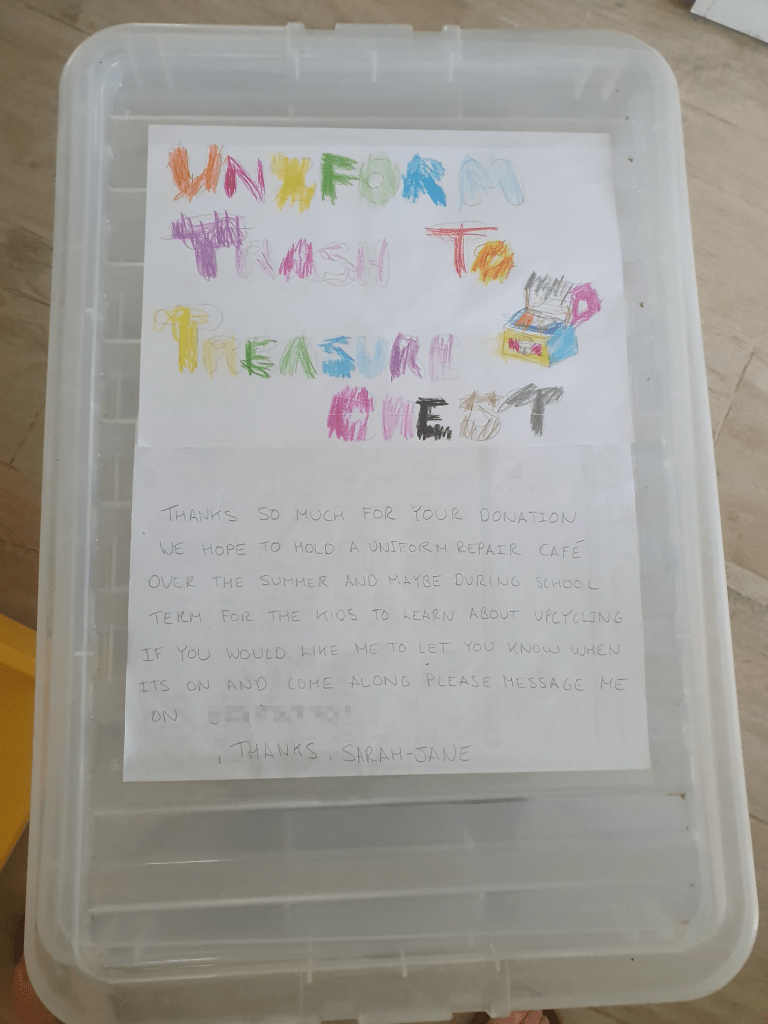
If anyone has kids in Realt Na Mara or even Skerries Community College and wants to do similar collection and / or do repair cafés together, send an email to sustskerries@gmail.com and we’ll put you in touch. (The same applies if your kids do go to St Patrick’s and you somehow missed the WhatsApp messages!)

The parent in question, committee member Sarah-Jane, says: “Just throwing out the requests now to save what we can from the bin this week – we will organise the event then based on how much interest and donations we get. Thanks 👍”

Brilliant idea, don’t you think?

And thank you also to committee member Helen, who kindly provided us with this picture. We think that does certainly come under torn, worn, and / or scruffy!
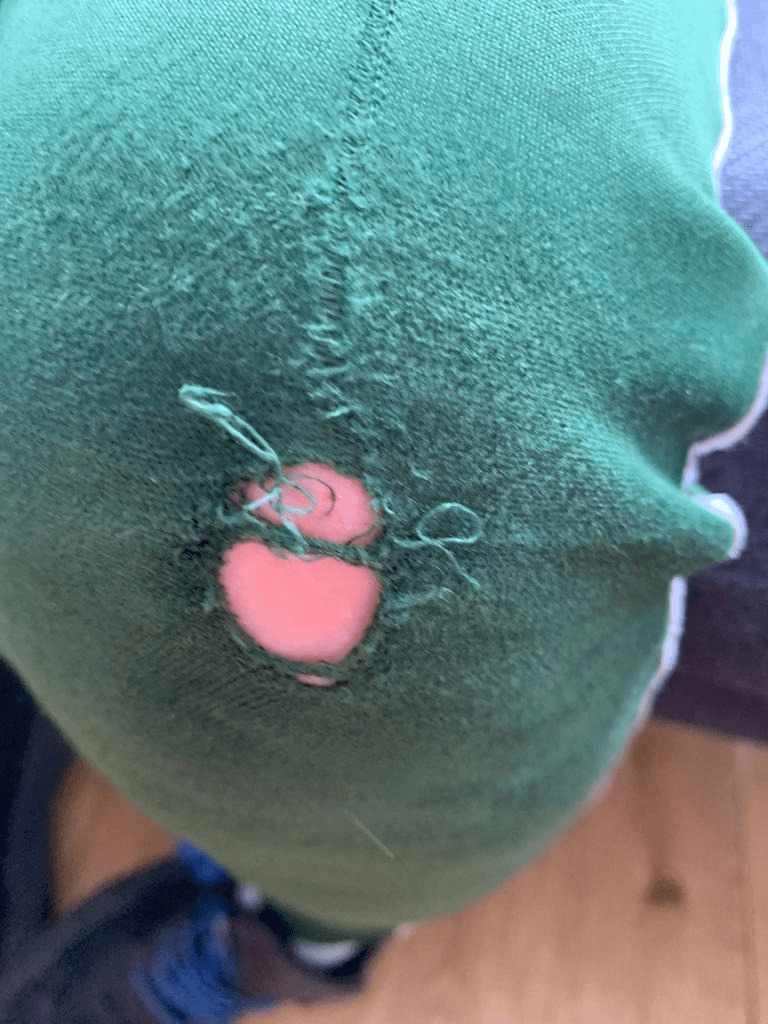
Can’t wait to see what this will look like post-repair café!

For any outgrown uniforms not in need of repair, or for anyone looking to pick up a second-hand uniform, all three charity shops in Skerries are accepting donations and already have a growing stock of great quality uniforms for all schools in Skerries available throughout the summer.

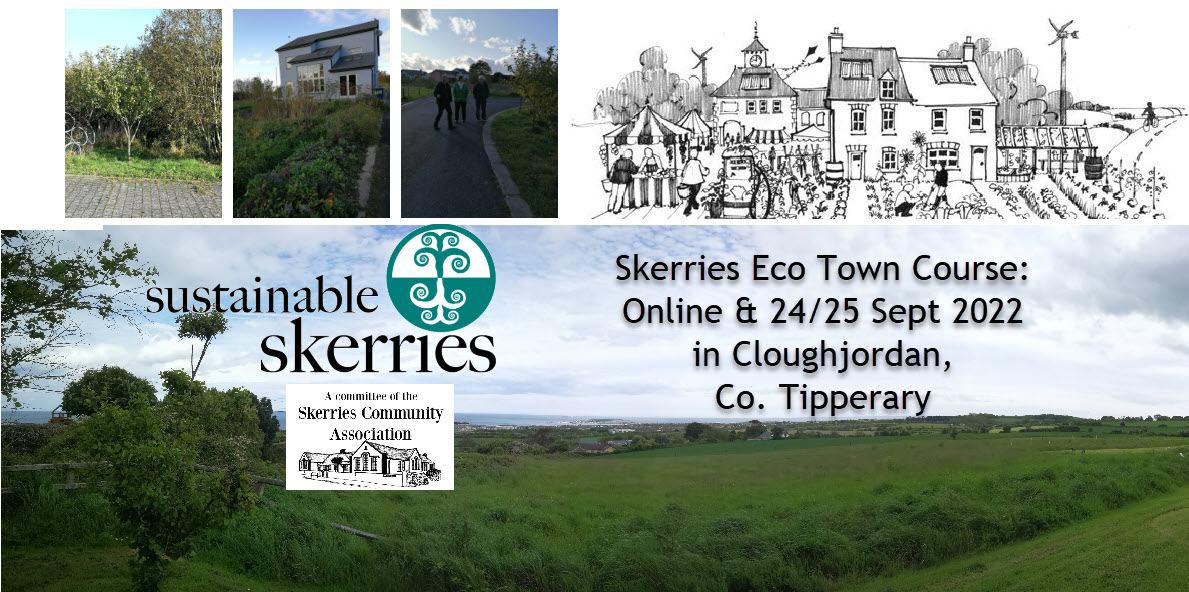
By now we all know that we are living in a double emergency (if not triple or quadruple), given the situation of climate change and biodiversity loss. Wouldn’t you love to come along to the ecovillage in Cloughjordan and learn from them what we in Skerries could do about these emergencies? Sustainable Skerries have organised an eco course for anyone who wants to be involved locally in tackling the problem.

Join our blended course this autumn!  Please sign up as soon as possible while there are still spaces!

💚 Six weekly classes (online) addressing the most relevant aspects of climate action, how to deal with biodiversity loss, resilience, project management and community building: Tuesdays 8 pm from Tue 20 Sep to Tue 25 Oct

💚 Weekend session in Cloughjordan Co. Tipperary on Sat 24 / Sun 25 September: Eight classes in an existing ecovillage (immersive learning) to experience what is possible in real life, including learning from those who are actively involved in the development of the eco village

💚 Cost involved: €75 per person including the weekly sessions, multi-occupancy accommodation and most food in Cloughjordan.
We gratefully acknowledge the support of the EAFRD
– The European Agricultural Fund for Rural Development: Europe investing in rural areas –
and the Irish Department of Rural and Community Development.
FAQs:

I’m not in any community group. Can I still do the course?
Yes, of course, as long as you’re willing to consider getting involved in some way after the course. Please sign up as soon as possible while there are still spaces!

I can’t come for the entire weekend. Can I still do the course?
Ideally, everyone would be there for the weekend as well. This immersive learning from an eco village is invaluable. However, if you can only come for the Saturday or the Sunday, let us know in the comments of the form. Please sign up as soon as possible while there are still spaces!

I already know a lot about biodiversity / climate / sustainable energy… Can I skip that weekly session?
The weekly sessions are no mere information-transfer sessions. They are about sharing what we already know, and applying what we are learning to our life and community in Skerries. Ideally, everyone would attend each session, the weekly ones as well as the weekend. Oh, and: Please sign up as soon as possible while there are still spaces!

How much does this cost?
We’re glad you asked. It will cost about €350 per person, based on 20 people attending. Luckily, we have secured LEADER / EU funding for this, and each participant only pays €75! That covers the weekly sessions as well as some of the meals in Cloughjordan and the accommodation in shared rooms. Great value. Please sign up as soon as possible while there are still spaces!

 What is the accommodation like?
We have full use of Django’s B&B (formerly Django’s Hostel) in the ecovillage of Cloughjordan. We have a number of triple rooms (including double beds and bunk beds), twin rooms and a double room. As we’re writing this, there are also three rooms available on Air BnB, so if you’d prefer not to share, or want to bring along a partner / family member who is not doing the course, secure one of them for yourself. Make sure to register all the same! We need to know who is coming as soon as possible, and:  Please sign up as soon as possible while there are still spaces!

I want to bring my partner / child / dog…
That is fine, but you’ll have to arrange your own accommodation as we don’t have any extra spaces in Django’s…

Will I get a reduced rate if I’m staying elsewhere / not coming to Cloughjordan?
The €75 per person will apply in all cases. If that is not affordable for you, please send an email to Sabine in confidence via sustskerries@gmail.com and we will see how we can help. 

How will we get there, and when does the “weekend” start and end?
We hope to be car sharing as much as possible (travel costs will have to be met by participants themselves). We’ll probably leave around 8, 8.30 am on the Saturday and be back around 7, 7.30 pm on Sunday.

So what is expected of participants?
1.  Please sign up as soon as possible while there are still spaces!
2. Participate in the weekly classes (normally 90 min on Zoom or similar, with a strong participatory element). Extra reading / study is possible and is encouraged, but not “mandatory.”
3. Participate in the weekend in Cloughjordan, unless that is impossible.
4. Participate in a final event, format and date and time to be decided in the group, where we will bring our learning together and then share it with the wider community.

Will a lot of basic information be covered? Will the content be relevant to Skerries, or general in nature?
The Cloughjordan course team is going to tailor the classes to where we are. We are preparing inputs and will ask participants for their contributions, too, describing what is already happening in Skerries and what isn’t. We also will assume a general awareness around climate change, biodiversity loss, etc., and there will be pointers to good online material (short videos, texts etc.) for a refresher / basic introduction.
Please sign up as soon as possible while there are still spaces!

I have another question that is not covered here.
Great! Please send it ASAP to us via sustskerries@gmail.com

Last updated on 22 June 2022 by SMcK
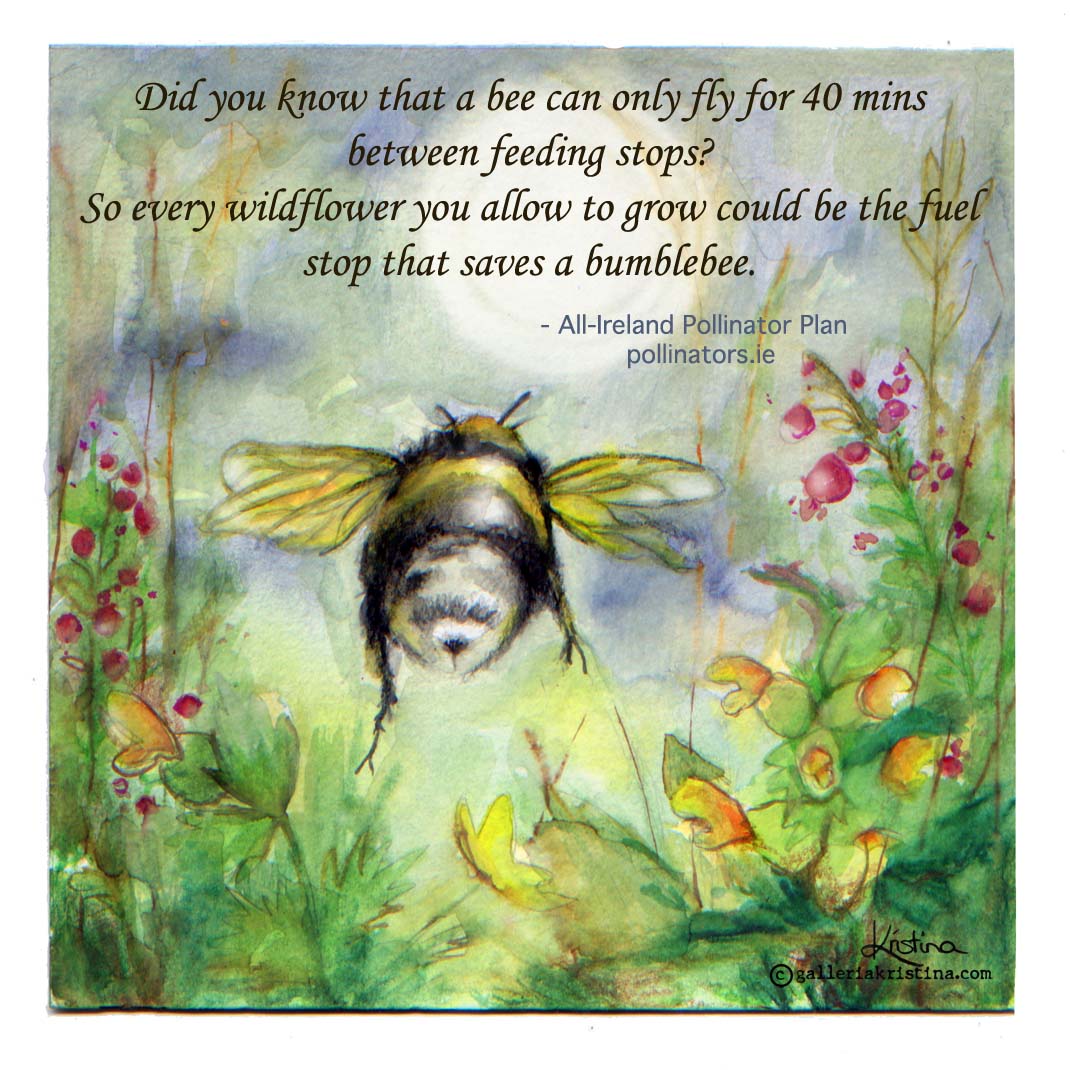
The Skerries Bee Map was the result of a collaboration between members of the biodiversity team of Sustainable Skerries and local artist/illustrator Kristina Keegan.

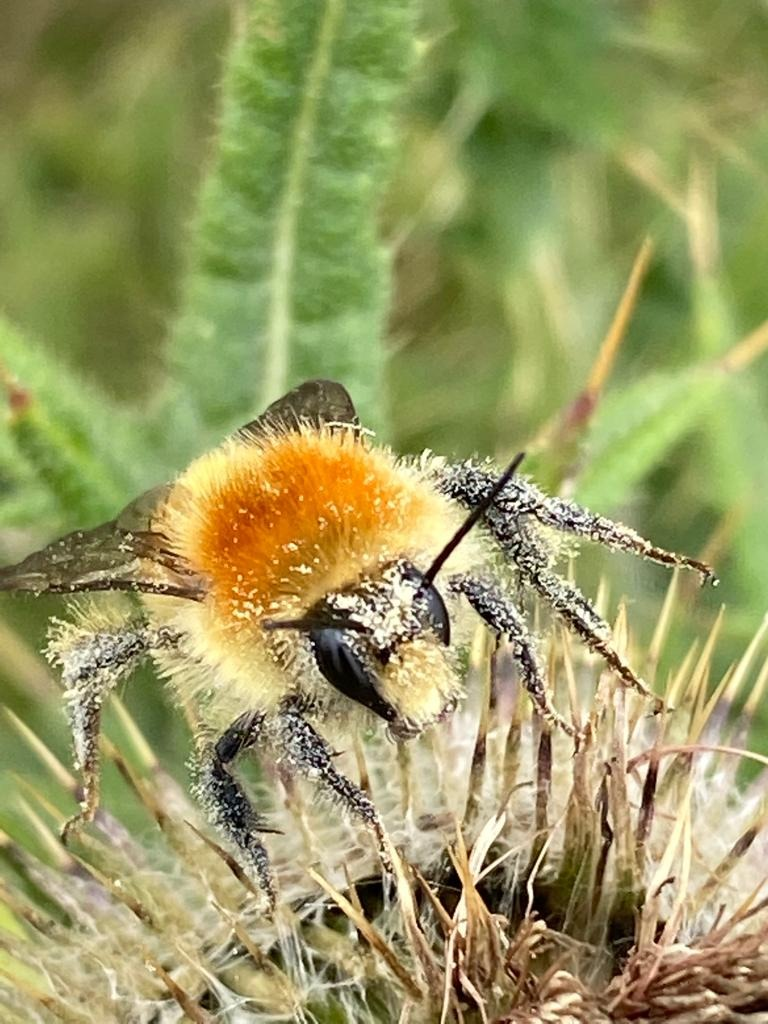
The purpose of the map is to plot the locations (as known to us at this moment in time) of the Large Carder Bee habitats in Skerries, to invite members of the community to build bee corridors to connect these locations and to encourage recognition and conversation around the native Irish wildflowers that the Large Carder Bee and other pollinators feed off.

This map is part of the Large Carder Bee Action Plan. Watch out for more actions!

By studying and illustrating the distinct differences in these species (both flowers and bees) we hope that the Skerries Bee Map will serve as a learning tool in schools and public spaces and spark conversation around sightings of these beautiful plants and insects.

It looks even better in print, and we hope to have copies available at our future events, and we are delighted that it is included in the Skerries News edition of 24 June 2022!
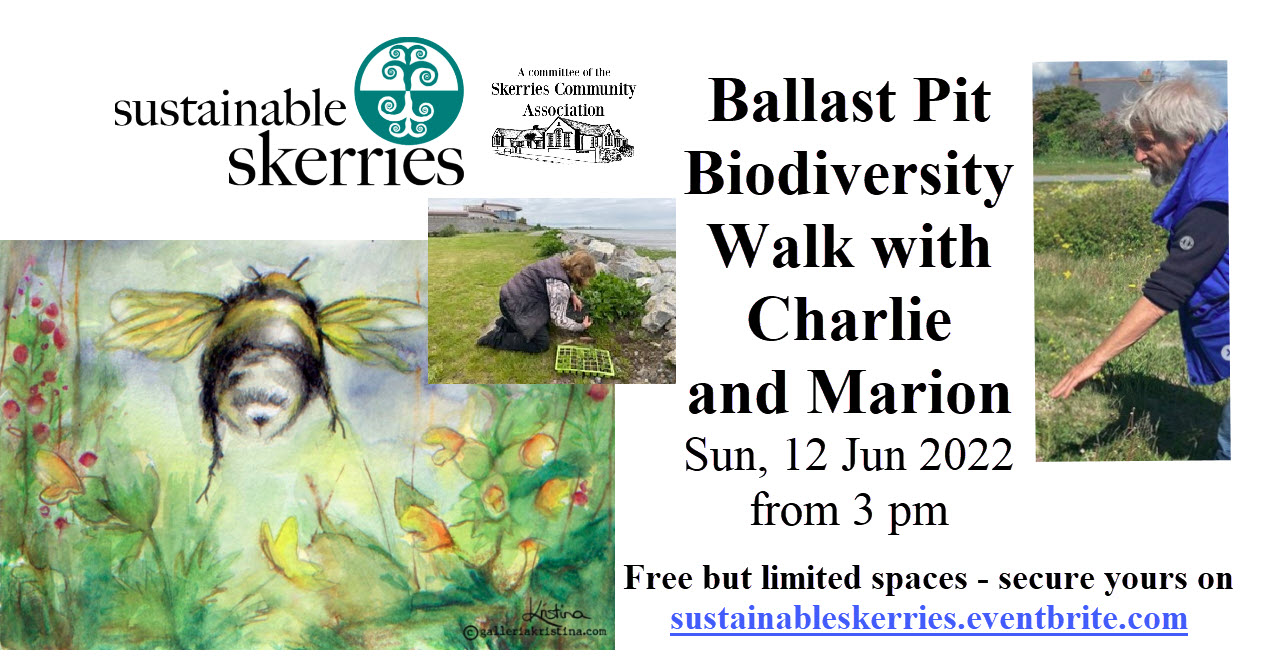
Join Charlie and Marion Heasman on this stroll through the Ballast Bit, starting at the Bottle Bank on Barnageeragh Road.

We’ll explore the Ballast Pit looking not only at bumblebees but also learning about why it is such an incredible natural resource.

For instance, there are 100 different species of wild bee in Ireland and 70% of them have been recorded here. There are rare pyramidal orchids, the very rare Small Blue Butterfly and lots more.

Come and see for yourself!

Free, but please secure a space for yourself on Eventbrite – do so in good time as numbers are limited!

The terrain is uneven. Please wear good walking shoes.

The climate crisis has been growing, but we can’t just sit there and let doom and gloom ruin our lives.
We can do something!

In the book “Regeneration – Ending the Climate Crisis in One Generation,” Paul Hawken says if everybody picks something they’re enthusiastic about and does something about that, that would spread. Don’t go: Oh, what do I have to do? Go: What do I WANT to do? Then go and do it.

At these First Fridays For Future, we want to highlight one thing every time that a part of the community is doing because they love doing it, and spread the word that way. And we hope we will be more and more.

Not in anger, but in hope and positivity.

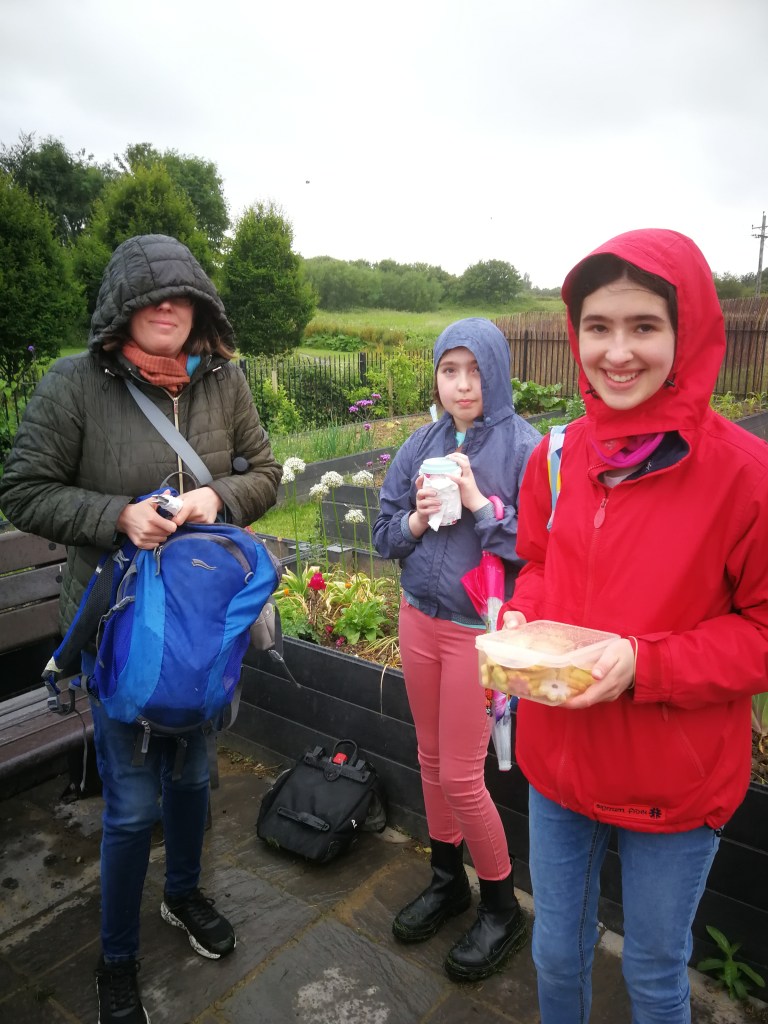
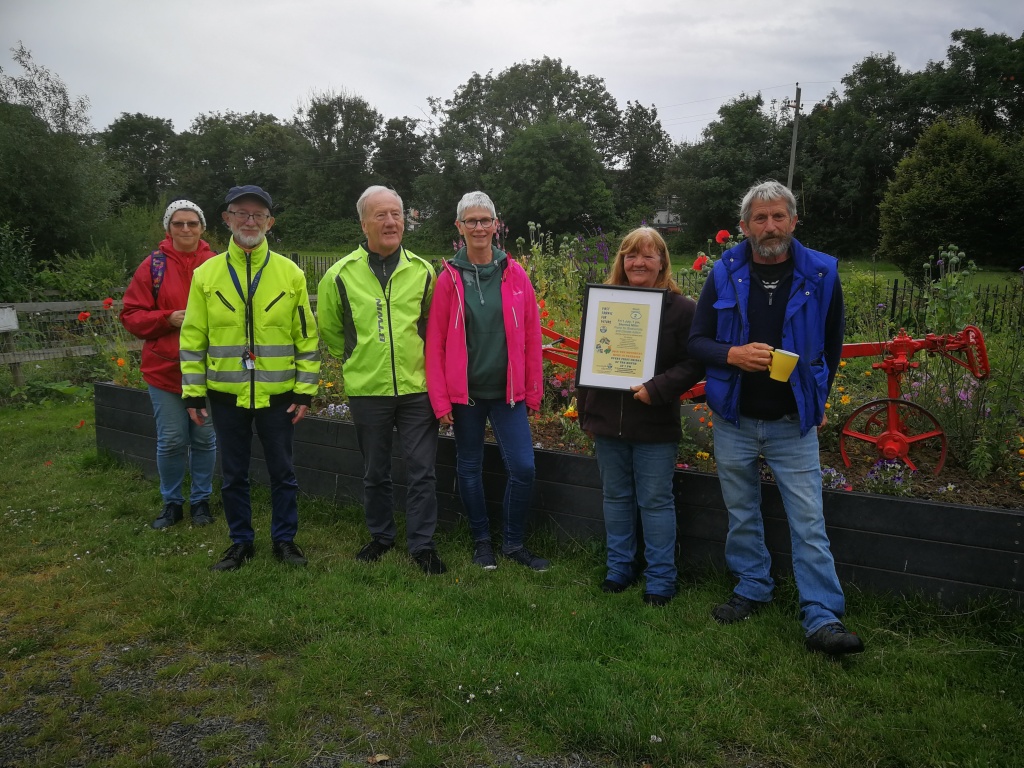
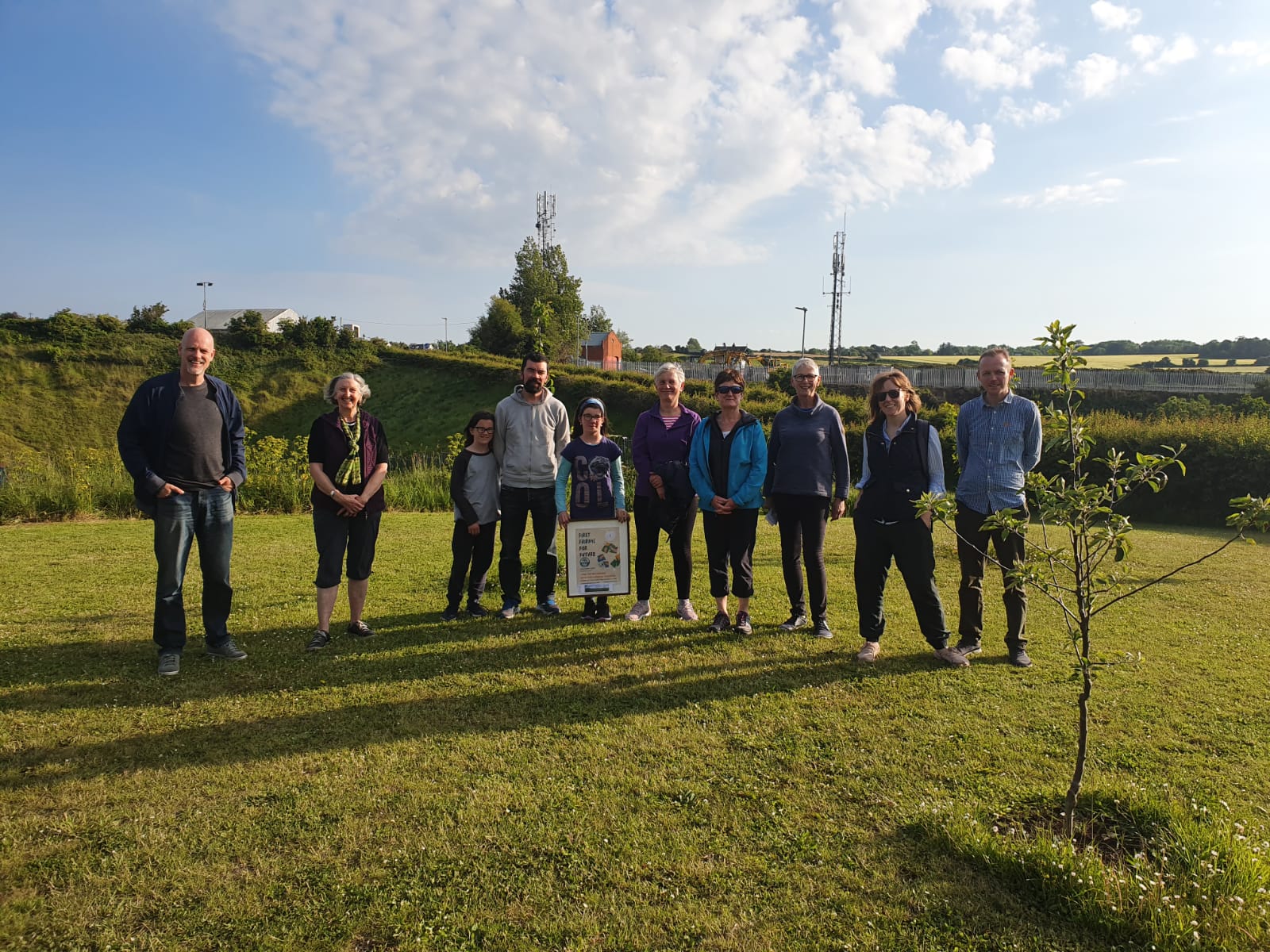
We started on Friday 3 June 2022. You can see here how it went:

Join us for the next First Fridays For Future event:
1 July 2022: A picnic for climate and biodiversity. Meet at Skerries Mills at 7 pm.
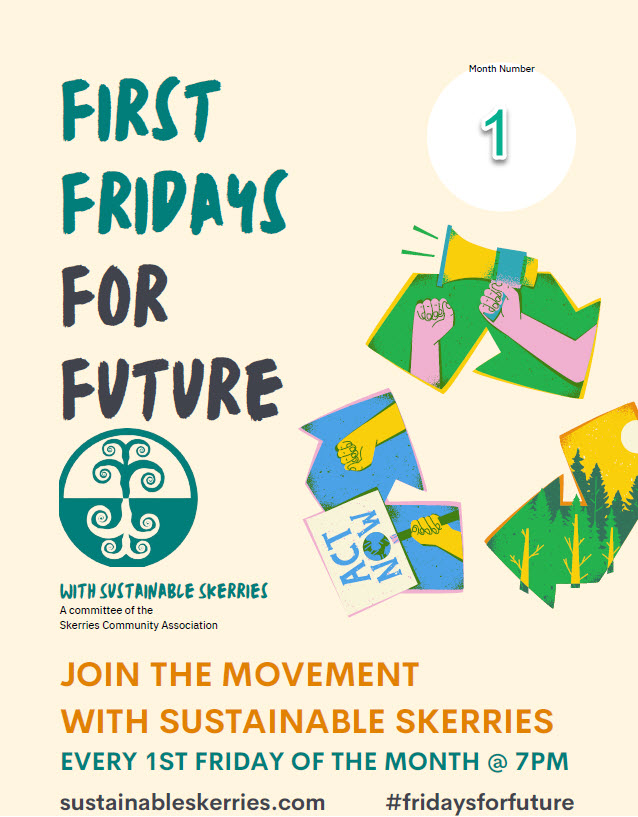
It’s time to set visible signs for our and our children’s future.

Every first Friday of the month, we will meet at 7 pm for 45 minutes or so and share our passion for doing something positive for our lives, for our climate, for biodiversity.

Join us!

We are inspired by #FridaysForFuture, a youth-led and -organised movement that began in August 2018, after 15-year-old Greta Thunberg and other young activists sat in front of the Swedish parliament every schoolday for three weeks, to protest against the lack of action on the climate crisis. She posted what she was doing on Instagram and Twitter and it soon went viral.

Friday 3 June, 7 pm: Three Mini Orchards Walk. Meet at the pedestrian crossing at the Ballast Pit. Bring posters, bring flags, bring your enthusiasm. We’ll talk about ideas for July, August, September… while we walk from the Ballast Pit Open Orchard to the one in Kelly’s Bay to the Mourne View ones.

See you then?!?

Committee member Sarah-Jane, who pulled together the submission made on behalf of Sustainable Skerries in May 2022, writes:

The overall draft plan as published appears to be a comprehensive and well thought out document on which Fingal should be complimented. We are pleased to see that the latest draft has taken into account many of the comments addressed in our previous submission such as the need to support and encourage organic and regenerative farming, the need for surfaces in new developments to be water permeable, nature-based flood mitigation measures, the creation of community bike and car-sharing initiatives, and the cessation of development in areas impacts by sea level rise and coastal erosion. We further welcome the inclusion of changes suggested by councillors including the removal of allotments as an example of rewilding, the inclusion of the 15 minute town, car-free neighbourhoods and the increased target of open space to 18%. 

There are, however, a number of outstanding points of concern that we raise in our submission while also requesting more explicit detail and tangible targets with timelines for many of the existing objectives. At a macro level, we recommend that any further revisions reflect deeply on the true compatibility of extensive economic growth and truly sustainable development in Fingal, particularly in relation to the development of new industrial and retail parks, Dublin airport and the marine sector. We ask that the plan places greater emphasis on the infrastructure and skills that will build resilience across the communities of Fingal in the face of climate change and biodiversity loss while empowering them to restore nature, bridge the circularity gap and create food and energy security. 

We now invite our elected representatives to do their best when it comes to finalising the Fingal Development Plan!

And here is our submission in full:

Submission on the Draft Fingal Development Plan 2023-2029

By Sustainable Skerries, May 2022

General comments and Introduction

This submission is made by Sustainable Skerries, a committee of the Skerries Community Association. Our view is that any development needs to be not only sustainable, but regenerative. While we have consulted with local residents to inform our views, we do not intend to speak for “the” Skerries community. 

We are pleased to see that the latest draft has taken into account many of the comments addressed in our previous submission such as the need to support and encourage organic and regenerative farming, the need for surfaces in new developments to be water permeable, nature-based flood mitigation measures, the creation of community bike and car-sharing initiatives, and the cessation of development in areas impacts by sea level rise and coastal erosion. We further welcome the inclusion of changes suggested by councillors including the removal of allotments as an example of rewilding, the inclusion of the 15 minute town, car-free neighbourhoods and the increased target of open space to 18%. The overall draft plan as published appears to be a comprehensive and well thought out document on which Fingal should be complimented. There are, however, a number of outstanding points of concern that we would like to raise in relation to the following chapters of the draft FDP.

As we outline in our submission below, we would welcome the inclusion of greater detail on timelines /delivery dates, definition of certain terms, and more explicit examples for many of the objectives presented across the plan.   

Thank you for taking the time to consider our submission. 

Chapter 2: Planning for Growth 

We very much welcome plans for compact growth and regeneration to facilitate population growth and the promotion of densities along public transport corridors. We also welcome plans to develop a comprehensive network of signed pedestrian and cycleways linking residential areas to one another, to the village centres, schools, recreational hubs and railway stations. Plans to re-use and rehabilitate existing housing stock in rural areas in preference to new-build and to direct rural generated housing demand to villages and rural clusters with access to quality public transport are also welcome. These developments are positive moves towards reduced car usage (and therefore reduced congestion, emissions and air pollution) and accessibility to efficient public services for all. 

The plan proposes to retain existing tree-lined approaches to all towns and villages to preserve their special character. We ask that this is carefully planned to avoid the retrospective removal of mature trees that are later discovered to be unsuitable for footpaths. 

In terms of zoning, we ask that agriculture should be situated close to where people are living (e.g. land around Skerries town) so that growth is self-sustaining. Areas with high quality soil surrounding towns should be identified for development of further sustainable agricultural practices to build resilience in the area of food security within Fingal and the rest of Ireland. In this, organic and regenerative agriculture should be supported and prioritised wherever possible. 

Chapter 3: Sustainable Placemaking and Quality Homes 

In this chapter we welcome plans to prioritise sustainable active transport modes and to encourage the development of car free neighbourhoods and streets. The promotion of a clean air and noise reduction approach to public realm in town and village centres through pedestrianisation of streets and/or restriction of through traffic where possible and appropriate is also a positive aspect of the plan. The promotion of suitable, appropriately sized enterprises within rural villages to minimise the need for commuting is another welcome step towards reducing congestion, emissions and pollution. We were also pleased to see that the plan will ensure that new residential development incorporates energy efficiency measures and promotes innovative renewable energy opportunities, for example by passive solar design, natural ventilation, and vegetation (green roofs etc) on buildings and makes most effective and sustainable use of water, aggregates and other resources. To ensure this is implemented we wish to see this written into building regulations and strictly enforced to avoid retrospective requirements for retrofitting

Given the intensive use of natural resources and the emissions created from building materials we encourage the measures to support the refurbishment and retrofitting of existing buildings and recommend that this be extended to all areas of Fingal where appropriate. We also welcome efforts to preserve greenbelts in Fingal in order to safeguard valuable countryside. The additional requirement that safe access to a new house be designed so that it avoids the need to remove long or significant stretches of roadside hedging and trees is also a welcome step toward preserving wildlife and natural resources. 

Given the alarming recent findings regarding sea level rise in Dublin which is occurring faster than expected (rise in Dublin-Bay is occurring at approximately double the rate of global sea-level rise, Parnell and colleagues, 2022), it is essential to uphold the new requirement that no new houses are permitted on High Amenity zoned lands which are located between the sea and the coast and even to extend this to building houses beyond this proximity to the sea in conjunction to projected sea-level rise. Furthermore, those living in high-risk areas to sea-level rise, potential flooding and coastal erosion (e.g. Balbriggan, Skerries, Loughshinny, Rush, Portrane, Donabate and Malahide) should be supported and consulted with in order to create plan for community adaptation and, in some instances, relocation

We further recommend the inclusion of additional details for the following objectives: 

Objective SPQHO2: Prioritises sustainable active transport modes by providing safer cycle lanes and community public transport services (particularly when the concept of a 15 minute town is not viable) that meet the needs of its residents. This is particularly important when no provision has been made for new shops and schools close to the new housing developments 

Objective SPQHO4: Enhance the visual amenity of existing town and village centres, minimising unnecessary clutter and proliferation of street furniture and provide guidance on public realm design, including wirescape, shopfront design, street furniture (including native and / or pollinator friendly / ecologically valuable plants and trees), signage and the adequate provision of bins and recycling options. 

Objective SPQHO9: Focus new residential development on appropriately zoned lands within the County, within appropriate locations proximate to existing settlement centres where infrastructural capacity is readily available, and along existing or proposed high quality public transport corridors and active travel infrastructure in a phased manner alongside the delivery of appropriate physical and social infrastructure. Active travel options should also be provided while liaising with the Transport Infrastructure Ireland to ensure public transport options to and from new developments to local amenities such as shops and libraries. 

Objective SPQHO19 Promote and encourage schemes which promote innovative ways of addressing dementia friendly issues in the built environment, such as the provision of community managed gardens.

Objective SPQHO29 Ensure residential new builds include the provision of infrastructure for the harvesting of rainwater where it is feasible and cost-effective. (E.g. the provision of a rain-water harvesting system for every new dwelling) 

Chapter 4: Community Infrastructure & Open Space

We welcome the focus within the plan on expanding community resources available to all and the provision of appropriate recreational, community, social and educational facilities for children, teens and young adults which is essential for a thriving community. The plan further aims to facilitate the development of new schools, the re-development of existing schools and extensions planned as part of the Government’s School Building Programme. These would be very positive and necessary developments for the communities of Fingal and we further strongly recommend that any new community facilities and schools, or the re-development of existing facilities and school, prioritise the provision of access to unstructured play in nature to promote physical and emotional development as well as allowing people of all ages to (re)connect with nature. Many schools and community centres around the country provide excellent examples of this which allow students of schools or patrons of community initiatives to grow food, learn about biodiversity in a real-life setting and work together to protect natural habitats and wildlife. This must be built into the design of infrastructure rather than something that is external to facilities that are predominantly concrete, sterile and unnatural.   

We further welcome that the plan will ensure that the design of schools and other educational centres take account sustainable building practices, water and energy conservation as well as air quality and climate change. This will further allow for educational opportunities within schools and help in curriculum reform which allows young people to learn about sustainable design and living. The requirement for new schools to be designed in accordance with “School Streets” principles will also provide excellent learning opportunities for students regarding climate action in practice and should be strongly supported. These learning opportunities will be further supported by the proposed provisions of a wide variety of resiliently designed, sustainably managed and accessible public open spaces, including allotments, community gardens, parklands and sporting facilities, on a hierarchical basis throughout the County, most of which should ideally be accessible for schools for nature-based learning

There are huge opportunities in Fingal to use public lands, and promote government biodiversity schemes on private lands, to restore appropriate habitats in the county particularly woodlands (including agroforestry), wetlands, grasslands and hedgerows. Tree planting should be carried out with the aim of restoring functioning woodland ecosystems, an opportunity often lost by open parkland tree-planting. In all cases lands will have their past land-use histories to take into account in determining the most appropriate restoration objective.

When it comes to open space, the plan often refers to ‘biodiversity areas’, with the sense that these are to be separate zones. While, as described above, these are essential to begin to restore nature in our county, the opportunities to embed biodiversity in all areas of open-space development should not be lost e.g. landscaping, soil health, green roofs/walls, SUDS, soil banks, natural materials, integrated or artificial habitats. While some of these are mentioned in other parts of the plan, an open space objective that clearly seeks to integrate biodiversity in all use-areas and sets targets for same would be welcome.

Chapter 5: Climate Action 

The Fingal Local Development plan outlines its objectives for the 2023-2029 period in Chapter 5.  The section deals with both the mitigation and adaptation to the impacts of climate change. Over the course of this chapter, transport, energy, resource management and waste are categorised as mitigation while flood defence and nature-based solutions are considered adaptation. The development plan outlines some measures that are very welcome such as the Climate Action Energy Statement (pg. 186) and plans to add green spaces to Fingal County Council owned buildings where appropriate are applaudable (pg. 186).

It is clear from the development plan that climate change has taken centre stage and that the scale of the challenge ahead is becoming clear to the council and the public more broadly. However, the development plan has flaws in both its communication and implementation.  We consider that for this development plan to have the necessary impact in the mitigation and adaptation of climate change these must be addressed. However, given the context of climate change, the impacts on society, economy and security the measures described here provide insufficient urgency and the council must seek to support to the public to make the necessary transition to a low carbon society

These include:

  1. Lack of clear targets and timelines

For the public and business community to transition to a low carbon resilient society it must have a clear schedule indicating regulation changes and incentive availability.  Fingal has proposed many changes but have not provided clear timelines or appropriate detail:

  • 40% reduction in GHG emissions of the council.  Without information regarding the emissions from the council it is unclear whether this emission reduction is the best place to invest.  Does this represent a significant amount of Fingal’s overall emissions?  Nationally, emissions from energy, transport and agriculture are the largest emission sources. 
  • Fingal aims to make Dublin a climate resilient region, by reducing the impacts of future climate change-related events (pg. 179) again provides no details on what the actions are.  
  • Compact and Sustainable Settlement Patterns (pg.184) fails to provide any quantifiable targets.  The public, NGO’s and business community need to know what supports Fingal will put in place to promote renewables, home insulation and how will they address fuel poverty and transition away from solid fuels.
  • Section 5.5.2.1 Climate Mitigation Actions for Buildings pg. 185 also provides no quantifiable targets or deadlines
  • Section 5.5.3 Energy provided only an overview of options.  More quantifiable targets required.  How will Fingal promote transition to renewables? What are its targets?  How will Fingal support residents to transition?  Will Fingal support community energy projects, access to grid and grants for retrofitting?
  1. References to rewilding (in other chapters) ignore that these projects can both promote or hinder carbon sequestration. In certain circumstances, regenerative agricultural practices such as mob grazing can be more effective for biodiversity and carbon sequestration than simply leaving the area to itself for “rewilding”.  Additionally, rewilding as a term is not scientific or sufficiently specific.  We recommend that Fingal outlines areas that are currently under conservation and specify how it intends to nominate further areas for protection. Additionally, where degraded ecosystems exist, we recommend identifying them (e.g. riverine systems/salt marshes/dune systems) and setting tangible targets for the number of hectares to restored, what that restoration process will achieve (e.g. carbon sequestration/habitat creation) and timelines for completion.  Ideally, Fingal can provide mechanisms for public/private and community-based partnerships to complete these works in the aim of informing and driving climate ambition. 
  1. Fingal has proposed no funding opportunities for business sector, Non-Governmental Organisations or research and innovation funding.  To promote the green economy and the transition to low carbon technologies, opportunities and funding for innovation need to be provided and clearly articulated.  One of the major challenges for NGO’s and the commercial sector is start-up funding and capital costs.  If Fingal County Council aims to promote the adoption of climate solutions, then funding should be made available.  For instance, LIFE projects require upfront funding and public/private partnerships could attain this project with the local authority acting as funder.  This would create employment, provide demonstration projects and enable Fingal to meet key milestones in its transition to a low carbon society. Funding opportunities for business sector, Non-Governmental Organisations or research and innovation funding should be included within the plan. 
  1. The development plan states that better land-use management should be responsible for 26% of total carbon dioxide emission reductions over the period 2021 to 2030.  As Fingal is predominately arable land, Nitrous Oxide (N2O) emissions are likely to dominate the GHG emissions from soil.  Further, Chapter 5 makes little reference to agriculture while the council has a significant role in planning and enforcement of agricultural activity. Given Fingal’s land cover is predominately agricultural, pathways to improving farming methods, in particular encouraging farmers to move towards farming with nature, organic farming, and regenerative farming, reducing intensification, and reclaiming and restoring agricultural land should be provided.
  1. Fingal proposes to use Nature-Based Solutions and Green Infrastructure to restore and connect habitats that are rich in biodiversity that provide valuable ecosystem services.  We believe this is a good idea however the trade-offs between biodiversity and GHG emissions need to be properly investigated.  For instance, species rich grasslands can often be net GHG emission sources.   
  1. Coastal management in Fingal is a significant opportunity.  Coastal areas particularly salt marches, sea grass habitats and kelp dominated habitats are often significant sinks.  However, activities like razor clam dredging and eutrophication can alter these habitats from sink to source.  Understanding, protecting, and restoring coastal areas such these areas should be a priority for Fingal.

In summary, we believe that many of the ideas articulated in the Fingal Development Plan represent progress in mitigating and adapting to climate change.  However, the lack of clear targets and timeframes means that the progress made over the period cannot be measured nor can the public plan for these changes.  Additionally, failure to address emissions from agriculture and land-use change mean that meaningfully mitigating emissions from Fingal cannot be achieved.  Finally, references in other chapters to rewilding are ambiguous.  Fingal should clearly identify conservation plans (seeking to protect existing ecosystems) and identify clearly where restoration is required and set targets (number of hectares per ecosystem) and deadlines for completion.  In addition, these projects should be public enabled for public private and community based partnerships.  Finally, by seeking to restore habitats that have high carbon storage capacity (such as wetlands, organic soils, sea grass meadows) this plan would allow Fingal to capitalise on its carbon sequestration potential in the council’s boundaries.  

Chapter 6: Connectivity and Movement 

Our group warmly welcome plans to decarbonise motorised transport, reduce reliance on the private car and facilitate modal shift to walking, cycling and public transport. Particularly welcome and encouraged aspects of this chapter include plans to create slow tourist trails, “Safe Routes to School”, the concept of a 15 minute town, the creation and operation of mobility hubs, car clubs and car-sharing schemes, all of which will lead to an overall reduction of car volumes on roads across Fingal and facilitate safer cycling options. Lack of safety is currently a significant deterrent for people to shift to cycling (where cycling is possible for their commute / trip) and needs to be addressed via all the mechanisms outlined urgently. This will only be achievable if there is a parallel significant reduction in the volume of cars on the roads.  

Chapter 7: Employment and Economy 

1. The previous submission from Sustainable Skerries highlighted that continued economic growth is, in fact, unsustainable. While the latest draft talks about sustainable growth, green and circular economy, the development plan is still presented as one which prioritises economic growth above all else. There is a language of extensive economic growth through this Chapter 7 in particular and we recommend that any further revisions reflect deeply on the true compatibility of extensive economic growth and truly sustainable development in Fingal

2. The majority of references to tourism are leveraging Fingal’s proximity to the airport and therefore focus solely on international tourism and air travel. Aviation is by far the most energy-intensive and high carbon form of travel. Furthermore, an unjust distribution of the global carbon budget is used through air travel whereby only about 11% of the global population travel by air (only 2-4% of global population fly internationally) and 1% of the world population emit 50% of CO2 from commercial aviation (Gossling and Humpe, 2020). We recommend the promotion of and a reemphasis towards domestic tourism and alternative modes of travel by making Fingal easily accessible from all parts of Ireland (and the world by including Ferry ports for international tourists) via public transport and greenways. 

3. The plan aims to create “high quality employment that is well paid and sustainable” (p. 244) yet puts this primarily in the context of office work in industrial parks with minimal mention of employment which serves the community (which are dealt with at length in other chapters) – food growth, food sales and distribution, childcare, elderly care, healthcare, education and other public services. The plan also frequently refers to the high level of education in the area in terms of University degrees yet does not address the relevant skills required by the population to meet targets for building and retrofitting homes in the area for the coming years to meet climate targets. This chapter of the plan emphasises “highly skilled workers” throughout with the aim of developing this aspect of employment in Fingal in areas such as ICT, pharma and financial services with very little attention given to how sustainable employment in public services (and the required skills) can keep up with demand for truly sustainable development. We recommend that any plans for employment in Fingal address first and foremost the jobs (and the development of skills for such jobs) that are most needed to support Fingal and Ireland in meeting its climate targets (e.g. retrofitting homes, repair services to promote the circular economy bill) and creating local and national food and energy security.  In addition, we would like to see more emphasis on employment to alleviate pressure associated with growing populations on existing public services such as childcare, care for elderly, healthcare, and emergency services. 

  1. The section with regard to the rural economy encapsulates the green and circular economy to a much greater extent than plans for areas with higher population. There is a stark contrast between the plans for the highly populated areas of Swords, Balbriggan and Blanchardstown and lower population areas. Objectives for the “rural economy” are presented in a way which repurposes and regenerates what exists while building on local skills whereas plans for unsustainable extensive growth in areas such as Swords and Blanchardstown will results in poor use of land and extremely carbon intensive building activity and alteration of the physical environment while also increasing congestion in the areas and impacting wildlife. 

Policy EEP23 states that the council will provide “Support and protect existing rural economies such as valuable agricultural lands to ensure sustainable food supply, to protect the value and character of open countryside and to support the diversification of rural economies to create additional jobs and maximise opportunities in emerging sectors, such as agri-business, renewable energy, tourism and forestry”. In line with the recommendations made in earlier points, we recommend that the objectives for the rural economy in the FDP, including sustainable agriculture and horticulture, renewable energy, tourism and forestry, are not confined to rural areas and extend beyond areas with populations of less than 10,000

  1. It is very positive to see the inclusion of a section on circular economy within this chapter. However all other sections within the chapter are presented in contrast to the premise of the circular economy and appear to emphasise growth and expansion of new industry and products above all else without consideration for how circular should be embedded into the model of any business operating (particularly manufacturing) in Fingal going forward. We would like to see some explicit examples of how existing and new businesses in Fingal will be incentivised to invest in circular products or services in order to bridge the current circularity gap. For example the plan should emphasise how Fingal will help businesses transition to business models that build on the interaction between product and service such as circular supply models, resource recovery models, product life extension models, sharing models and product service system models. The transition away from fossil fuels and energy efficiency measures can only address 55% of our emissions. The remaining 45% comes from making things.
  1. The FDP aims to “promote sustainable growth opportunities” in the marine sector in towns such as Howth, Balbriggan, Skerries, Malahide and Donabate (p.261). However it is important for the plan to note that overfishing across Irish waters has already driven the collapse of many stocks and therefore threatens fisheries with closure if quotas are not reduced in line with scientific evidence. For example, the population of cod in the Celtic Sea has been reduced by 88% since 1981 (www.birdwatchireland.ie ). 
  1. In Objective EEO35 – ICT, Financial and Banking Sector the plan aims to “Promote the growth of the ICT and financial and banking sector in Fingal by facilitating the conditions conducive to such development including the creation of high quality physical environments offering a range of building and office accommodation types, supported through the provision of the necessary services and public transport infrastructure”. We would welcome more elaboration on how “high quality physical environments” for such industry are characterised and what measures would be taken to ensure they do not result in the creation of low quality natural environments.  
  1. The plan proposes to expand the equine industry in Fingal without any clear rationale or consideration for the ethical and environmental implications of such growth. Animal rescue services in North Dublin have already pleaded for increased supports for their work with horses:https://www.dspca.ie/dspca-and-the-equine-problems-in-dublin We recommend that plans to grow the equine industry are removed from the FDP, and instead the council will engage with animal rescue services to learn more about how they can collaboratively promote animal welfare in Fingal, reducing demand on their services. 
  1. Policy EEP29 – Regenerative Farming & Community Supported Agriculture states that “Support and encourage Organic and Regenerative Farming and Community Supported Agriculture in the Fingal Area”. This however is the only mention of this agricultural method throughout the plan and no follow-up details are provided as to how this would be supported and encouraged. Such details as to how organic and regenerative farming and community supported agriculture would be supported and encouraged, both for new farmers and farmers wishing to move to organic / regenerative,  is required here.  

Chapter 8: Dublin Airport

Throughout the entire draft and in particular in Chapter 8, Dublin Airport is identified as a national asset to Ireland’s economic success / an economic generator and major source of employment in Ireland and, particularly, in Fingal. Overall the plan identifies opportunities to further develop and expand Dublin airport to “maximise sustainable potential whilst also taking into account the impact on local communities, the environment and climate change”.  The plan aims to support an appropriate balance between developing the unique potential of Dublin Airport as an economic generator and major employer in the County and protecting its core operational function as the Country’s main international airport. The plan further aims to ensure that all development complies with the Climate Actions Objectives and the Circular Economy and waste Management Objectives in the Dublin Airport Local Area Plan 2020, or any subsequent LAP or extension of same. The unfortunate reality, however, is that no amount of compliance with such climate action objectives can offset the detrimental impacts to climate change that will result from the expansion of Dublin Airport. Despite its potential for employment and economic growth (limitations of which are discussed in Chapter 7), such expansion only moves Ireland further from its climate targets of 51% reduction of greenhouse gas emissions by 2030 and net zero by 2050. As mentioned above, aviation is by far the most energy-intensive and high carbon form of travel. In total, aviation makes up over 13 per cent of total greenhouse gas emissions in the EU and emissions from the sector are predicted to rise annually between one and four per cent in the coming decades. If global trends continue, aviation may contribute up to 22 per cent of CO2 emissions by 2050. As well as emitting carbon dioxide, aviation emits pollutants such as nitrogen oxides and particulate matter. When released at high altitudes, nitrogen oxides enhance the lining of the ozone layer which leads to warmer temperatures. Soot and water vapour emitted by aircraft can create vapour trails in cold air, and researchers believe the trails could add to the greenhouse effect. Simultaneously, jet fuel emissions also set in motion reactions which can emit methane, a gas estimated to have a warming effect 84 to 87 times greater than that of CO2 over a 20 year period. Research suggests that aviation also has a significant impact on air quality and may cause 16,000 premature deaths annually due to exposure to particulate matter. Almost half of the premature deaths are attributed to emissions from aircraft take-off and landing.

Furthermore, an unjust distribution of the global carbon budget is used through air travel whereby only about 11% of the global population travel by air (only 2-4% of global population fly internationally) and 1% of the world population emit 50% of CO2 from commercial aviation (Gossling and Humpe, 2020).

While we recognise that Ireland and Fingal is massively dependent on Dublin Airport for employment (directly and indirectly via international tourism) and economic expansion, we urge that this plan recognises the urgency and requirement for radical transitions to low carbon societies which ultimately requires reduced dependency on the aviation sector. In doing so a more just transition can be achieved for those dependent on this sector for employment. This applies not only to this chapter of the FDP but all references to the expansion of Dublin Airport as an opportunity throughout the plan. 

Chapter 9: Green Infrastructure and Natural Heritage 

1) Pesticide and Herbicides use

9.6;  Objective GINHO29 Biodiversity and Open Space

Ensure that the management of the Council’s open spaces and parks is pollinator-friendly, provides more opportunities for biodiversity, and is carried out without the use of pesticides where possible.

In the whole document there is only one mention made of pesticide use (or non-use). This is of course to be applauded because pesticides kill not just the insects that they are targeted at but all insects, including those widely known to be beneficial such as pollinators, and others that have their own vital but largely unappreciated roles in the ecosystem. However no mention is made at all about herbicide use (or non-use). There has always been a general perception that because herbicides are used to control plants they do not harm insects.  This is not the case.  An insect coming into contact with freshly sprayed flowers or foliage will definitely be affected and likely die.  Not only that but residues can and do persist within the plants and soil and have a propensity for entering watercourses.  This is not to mention the effect on human health. A similar commitment to cease the use of herbicides on open parks and spaces would be welcomed.  It also might be possible for Fingal to bring its influence to bear on other organizations and businesses occupying Council land.

2. Biodiversity Net Gain Guidance

9.6;  Policy GINHP14 Biodiversity Net Gain Guidance

Promote biodiversity net gain in new developments and develop a planning guidance document on Biodiversity Net Gain.

This will only be effective if the policy is adequately enforced.  Sadly, in many instances in the past this does not appear to have been the case, with developers getting away in numerous cases with reduced or watered down actions thus effectively reneging on their commitments. Development of the guidance should include measurable targets for net gain and any proposals for offsetting rules must be very carefully considered. In line with the mitigation hierarchy any developer must be incentivised to avoid or reduce impacts in the first instance, and must be able to demonstrate that all options have been explored before any offsetting arrangement can be agreed.  Compensation for lost habitat must be delivered at the local scale in order for communities such as Skerries to continue to deliver upon our biodiversity objectives.

Planting guidance for new developments would be welcomed, be it in schools, apartment complexes, housing estates or commercial premises.  As things stand these types of development are invariably landscaped or planted predominately with low maintenance non-native shrubs which only need trimming once a year and have little or no biodiversity value.  A more environmentally planting regime should be encouraged from the start. An example of where this approach has succeeded in the past is the Lusk National School which, when major expansion works were carried out a few years ago, resisted this style of planting in favour of an ecologically beneficial approach.

3. Reduced Mowing Regimes

9.4 Strategic Aims; RPO 7.17 The European Union Biodiversity Strategy 2030 contains specific commitments…… The Commission calls on European cities of at least 20,000 inhabitants to […] limit excessive mowing of urban green spaces and other biodiversity harmful practices. 

While it is very encouraging to see that in practice and Fingal are indeed adopting reduced mowing regimes, there appears to be no mention of this in the Draft Plan. Delaying mowing of roadside verges and underused corners of open space along with reduced mowing of wider areas also has very significant environmental benefit along with reduced operating costs and should be considered a win-win situation.  There will of course be resistance from some members of the public, but attitudes are changing fast and any such resistance must be resisted. The plan should explicitly include details of reduced mowing regimes and how they will be communicated and implemented

4. Ecological Impact Studies prior to Development

9.5.1.1 Biodiversity Objective GINHO4 Green Infrastructure and Development

Resist development that would fragment or prejudice the County’s strategic Green Infrastructure network.

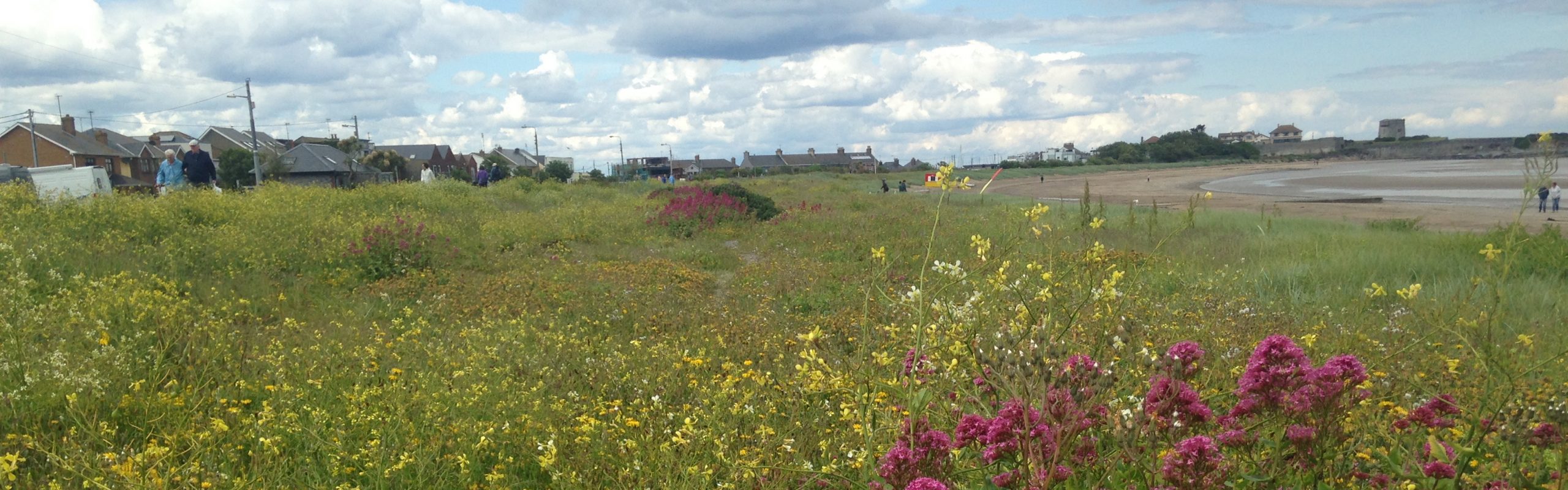
Careful consideration should be given before development is allowed on so-called “waste areas” which are often in fact valuable ecological resources.  A case in point is the Ballast Pit in Skerries which has so far escaped development on several occasions.  The floral community in less-disturbed areas aligns closely with Annex I habitat 6210 (Semi-natural dry grasslands and scrubland facies on calcareous substrates (Festuco-Brometalia) (* important orchid sites) and would have the potential to be restored as such. The Ballast Pit site in Skerries has yielded records of over 70 species of native bee out of a total of some 100 (honey, bumblebee and solitary Bee) and is known to currently contain one threatened bumblebee, one endangered butterfly, viviparous lizards and the rare pyramidal orchid. 

We note and welcome the fact that FCC propose to rezone the Ballast Pit to ‘open space’, a move that will afford it enhanced protection.  However, this would still allow leeway to improve the changing facilities on the football pitch, currently a shipping container, and perhaps replace it with a permanent structure.  Should this be proposed a full and appropriate ecological impact study should be carried out in order to minimise the impact on this valuable and sensitive area. The FDP should include such provisions to any development in these areas. 

5. Definition of Rewilding

Objective GINHO26 Rewilding

Continue to promote and support re-wilding and pollinator initiatives within the County.

Is it clear to the public what is meant with the use of the term ‘rewilding’?  The definition of rewilding provided in Section 9.5.2 probably means little to the layperson,  and in general the term can be sometimes be unhelpful by triggering quite polarising debates as it is often associated with land abandonment or introduction of predators.  A more practical definition of rewilding, in the context of Fingal and its habitats would facilitate transparent tracking of progress against this objective. It is important that the plan clearly identifies the urgent need for the ecologically-appropriate creation, restoration and enhancement of natural local habitats such as species-rich grassland, woodland, healthy hedgerows and small wetlands, on both on public and private lands, and clearly highlights these are actions that can be implemented at a multitude of scales and are not limited to large scale developments or conservation programmes.  

6. Woodland for Non-Recreational Purposes and Private Land

Objective GINHO45 Woodland Development Schemes

Promote, encourage and support woodland development schemes by identifying suitable areas and support other initiatives that aim to establish and enhance woodlands for recreational purposes in partnership with local communities.

The establishment and enhancement of woodlands for non-recreational purposes such as climate mitigation, water regulation and biodiversity should also form part of this scheme.  Any proposals must be considered in the context of earlier comments on climate action so the carbon losses and gains over-time, and ecological consequences of habitat change, are fully understood i.e. putting the right tree in the right place.  As well as opportunities on public lands, the use of the native woodland scheme for private landowners, for which there is very poor uptake in Fingal relative to other counties, should be promoted and encouraged.   

7. Protection of Trees and Hedgerows

Policy GINHP21 Protection of Trees and Hedgerows

Protect existing woodlands, trees and hedgerows which are of amenity or biodiversity value and/or contribute to landscape character and ensure that proper provision is made for their protection and management.

Past developments have failed dismally to protect long-established trees and hedgerows which are consistently ripped out in favour of fencing.  Developers are reluctant to work around woody vegetation as it constrains open movement on construction sites and they would prefer to have a ‘clear working area’ and re-plant, yet these new trees go nowhere close to compensating for lost mature habitats, and developers need to become accustomed to working around trees and tree roots for which there are well-established standards and methods. Underground infrastructure should also not be used as an excuse for wide wayleaves requiring tree removal.  Pipelines can be adequately protected with root barrier membranes and any felled trees immediately above pipelines can be planted with shallow lateral-rooting trees such as hazel or native shrubs such as blackthorn.  ‘Proper provision for their protection and management’ therefore must include clear and measurable standards for developers, with the onus on developers to prove that there is no alternative to removal, or demonstrate why standard tree-protection measures could not be implemented.  Any compensatory planting must be of a significant scale to account for the relative maturity of what has been lost.  It is highlighted that to achieve Biodiversity Net Gain this will become a necessity.

8. Species Protection and Ecological Assessments

Policy GINHP18 Species Protection  & Objective GINHO40 Ecological Assessments

It is noted that ecological impact assessment is only referenced as a requirement where a development might impact rare and protected species or their habitats, or interfere with an ecological corridor.  As an absolute minimum, a preliminary ecological appraisal should be required in the case of any development. Without an ecologist visiting a site, it cannot be clearly deduced what the impacts may be as available desktop data is patchy and skewed toward certain species.  Opportunities to identify ecological enhancement options for many developments would also be missed.  Furthermore, many species, particularly insect groups, are poorly recorded, provided little protection under law, and we are consequently losing opportunities to preserve and restore their habitats.  In the current ‘biodiversity emergency’ there is an urgency to ensure these opportunities are not missed.  Ecological appraisal of all developments has been standard in the UK for many years and Fingal have an opportunity to promote and establish a minimum standard through this development plan.  There is clear and standardised guidance provided by CIEEM, the professional body for Irish and UK ecologists, on preliminary ecological appraisal. It is further noted that Biodiversity Net Gain for developments would need to be underpinned by such an appraisal for it to be meaningful. 

Chapter 10: Heritage, Culture and Arts

We welcome the plans to protect and promote the heritage and culture of Fingal and recommend the following additions to this chapter. 

  1. To develop a ‘Culture Near You’ tool, an online cultural map that brings together, in one place, cultural information about the county, similar to the one in partnership with Dublin City Council, over the lifetime of the Plan.
  2. To explore the possibility of establishing a Cultural Forum for Fingal, led by Fingal County Council and working with other cultural partners.
  3. To encourage greater use of the public realm for cultural events to make towns and villages more attractive for everyone, and to seek provision of new public spaces for outdoor performances that are designed and fitted to host a range of events.
  4. Encourage people with disabilities to participate in the county’s culture as consumers, creators, artists and workers by supporting a high standard of accessibility in new and existing cultural assets

Chapter 11: Infrastructure and Utilities

  1. Reduce Energy Use

Section 1: Written Statement » Chapter 11: Infrastructure and Utilities

It is essential at all times to focus not just on the development of sustainable energy sources, but also promoting the reduction of energy use. Every development plan for infrastructure and roads/transport should have this as a permanent criterion.

References to current draft plan and additions below:

  1. Opportunities – The Council will continue to tackle issues that are contributing to Ireland’s greenhouse gas emissions and will facilitate the delivery of numerous gas and electricity projects providing additional energy capacity across the County, in addition to upholding quality standards in respect of environmental safety, public lighting, air quality and noise management. In an effort to reduce our carbon footprint, it will be necessary to diversify our energy production systems and increase measures for energy saving in the future, leading away from fossil fuels and towards green energy such as wind, wave, solar and biomass, together with smart energy systems and the electrification of transport fleets…
  1. Strategic Aims – Facilitate and promote the development of energy networks to facilitate sustainable growth and economic development and support the transition to alternative,
    renewable, decarbonised and decentralised energy sources, technologies and
    infrastructure. The Council will continue to support the development of a safe,
    secure and reliable supply of electricity and encourage the development of enhanced
    electricity networks, facilitating new transmission infrastructure projects under
    EirGrid’s Grid Development Strategy. Projects to reduce energy use must also be prioritised, which could encompass both individual and community changes in energy habits and leverage new technologies via Smart Grids and Smart Cities. This can significantly improve the efficiency and quality of complex systems such as electricity, water, waste, energy and transport services, thereby reducing their costs while contributing to the “green economy”.
  1. Ensure transport energy efficiency includes cycling

Section 1: Written Statement » Chapter 11: Infrastructure and Utilities

Policy IUP28 – Promote Energy Efficient Development 

Promote more energy efficient development through the location of housing and employment along public transport/cycling corridors, where people can choose to use less energy intensive public transport or cycling, rather than being dependent on the car.

  1. Local Community Sustainable Energy Projects

Section 1: Written Statement » Chapter 11: Infrastructure and Utilities

It should not just be infrastructure developers that must be supported, but also businesses and community groups that could set up sustainable community energy sources. This is part of building energy resilience and lowering dependence on traditional energy sources. We recommend that it should be explicitly stated that land controlled by the county council which is suitable for installing local area sustainable energy generation infrastructure (such as smaller solar farms, windmills, etc) should be marked on specific maps and shared with community groups (such as SEAI Sustainable Energy Communities) to consider for their work.

Reference to specific section in draft Development Plan:

  1.  Energy Policies and Objectives. Fingal will continue to support energy utility providers, businesses and local community groups in their efforts to reinforce and strengthen existing utility infrastructure, transmission / distribution networks and community funded energy generation projects and will support new infrastructure projects and technologies with particular emphasis on renewable, alternative, and decentralised energy sources, and those which are less carbon intensive in line with the Electricity and Gas Networks Sector Climate Change Adaptation Plan (2019). We will continue to support the development of a safe, secure, and reliable supply of electricity and to support the development of enhanced electricity networks and facilitate new transmission infrastructure projects including those under EirGrid’s Grid Development Strategy, to service the existing and future needs of Fingal and the wider Eastern Region and to strengthen all-island energy infrastructure and interconnection capacity.

Policy IUP29 Enhancement And Upgrading Of Existing Infrastructure And Networks

Work in partnership with existing service providers, businesses and local community groups to facilitate required enhancement and upgrading of existing infrastructure and networks and support the development of new energy systems, local community sustainable energy generation projects and transmission grids, which will be necessary for a more distributed, renewables-focused energy generation system, harnessing both the considerable on-shore and off-shore potential from energy sources such as wind, wave, and solar energy. Generate maps to show specific county council areas of unused/dormant land that could be used for local community groups to determine small scale sustainable energy generation projects.

The following is the text of our submission (for the work on which thanks go to our committee member Kristina) to the Draft Active Travel Strategy for Fingal.

Active Travel is a Necessity and Must Be Possible for All

Sustainable Skerries whole heartedly welcomes the draft Active Travel Strategy for Fingal.

Better health and wellbeing, improved local air quality, a more attractive public realm, 

lower travel costs and improved access to education and employment opportunities all bode well for our vision of empowering our community towards a sustainable and resilient future for Skerries.  In order to make Skerries resilient, regenerative and a great place to live for all, now and in the years to come, active travel must be prioritised, but to do so we need to do more than just make sustainable travel more attractive.

To bring about significant changes in our travel behaviour while protecting and promoting the

environment across the county, sustainable travel infrastructure needs to be looked at in a way that truly understands the needs of individual towns and addresses the existing barriers to building active travel into everyday life as part of normal daily routines.

The mounting evidence that a substantial daily shift from car journeys to active travel and public transport can reduce congestion and make sustainable travel choices more attractive is undeniable, but it can lead to a chick and egg situation if the pressure to make better travel choices is placed solely at the door of the individual resident.

That is why putting active travel first in planning, design and delivery of infrastructure and initiatives is something that Sustainable Skerries applauds and is eager to see in practice. 

Existing infrastructure needs to be carefully assessed and connected to new developments to ensure a connected approach is adopted and ensure a more sustainable outcome for Skerries. 

Existing entrances to shops which prioritise those arriving by private car, roads with no pavement for pedestrians, areas where pedestrian access is neither prioritised nor visible, insufficient bike parking, disconnected cycle lanes,  inappropriate placement of ramps where road crossings are not safe, to name but a few, all present opportunities for Fingal County Council to really zoom out and look at our town as a whole, before zooming back in and looking at the way many small changes can be connected to one another to make big changes.

National design guidance being issued to support planners, developers and scheme designers is to be commended, and Sustainable Skerries would encourage Fingal County Council to see the importance and urgency of ensuring such guidance is followed at all times.

Skerries needs a more joined up approach when planners and developers of separate housing estates are told to provide safe routes to schools for its residents.  Unfortunately, there are too many examples where good intentions at the design phase have not materialised into substantial change.

The inclusion of a cycle track in a new housing estate, along with accessible pavements is to be commended, but in many cases in Skerries these stop short of reaching their intended goal.  Some new cycle tracks begin and end on only one stretch of road in the estate and do not connect to any other cycle track outside the estate or on surrounding roads as cycle tracks (and at times pavements) often simply do not exist in these places. Such examples only serve to put an appearance of active travel infrastructure, but do not provide the residents with actual safe ways of getting from their home to the nearest amenities, which in Skerries often means joining a road when leaving the estate that has been designed with the motorist in mind.  Such failures in joined up planning can often serve to actively discourage residents from choosing active travel when leaving their estate, as the contrast between the safety of their newly designed estate and the surrounding roads highlights the dangers pedestrians and cyclists are faced with when undertaking their daily routines.

As housing developments expand throughout Skerries, permeability needs to be addressed if Fingal County Council is to succeed in encouraging more individuals to choose active travel over the private car.  Walled off estates that are kept separate from one another creates problems for pedestrians and cyclists.  Where residents prefer cul de sacs for the obvious benefits of reduced traffic, such boundaries should not be closed to those choosing active travel.  The safety of our children when going about their daily lives is affected by permeability in urban areas.  Where there is an option to choose a boundary that is open to pedestrians, provides connection with neighbouring estates, green spaces and playgrounds without necessitating crossing main roads or walking in secluded areas, these options should always be implemented, both at the design stage and retrospectively. We would like to see the Design Manual for Urban Roads and Streets prioritising active travel in practice. Fingal County Council has highlighted Sustainable Residential Development in Urban Areas.  Sustainable Skerries would like to see the implementation of plans for villages that do not require residents to walk or cycle for more than 15 minutes to access local amenities.

Sustainable Skerries welcomes the National Cycle Manual, but would like to see it implemented and real changes to the infrastructure that respect individuals’ need for autonomy when going about their daily business are urgently needed.

From a biodiversity perspective, any changes to existing infrastructure or implementation of new infrastructure should carefully consider the long term effects of changes made to our flora and fauna.  Wherever trees are cut down (and only if absolutely necessary), these should be replaced with equivalent numbers of  mature trees. Wildflower corridors should be maintained and where pavements and cycle tracks need to be placed on grass verges, increased surface area should be included in the no mow areas to allow more wildflower meadows to establish and bee corridors to be created and maintained.  Natural, pollinator-friendly alternatives should be sought when designing the surrounds of playgrounds, schools, estates, car-parks etc. as opposed to brick walls.  If Fingal County Council aims to make active travel more attractive, then working hand in hand with the rewilding of our environment can achieve this in a sustainable and highly effective way.  

Finally, Sustainable Skerries would like the Council to remember that those without access to a car and whose mobility is impaired actually do make up a substantial number of our residents.  Children are not born with automatic access to cars and individuals of any age can suddenly find themselves unable to drive a car.  Active travel is not just a choice.  Active travel is a necessity.

Last Wednesday (18 May 2022), Dave Goulson, the author of the Sunday Times bestseller Silent Earth: Averting the Insect Apocalypse, joined Sustainable Skerries online for a fascinating talk on insects.

We might not like them, or at least think we don’t like them, but Dave tells us why we quite literally can’t live without them.

We all know that insects pollinate flowers, and agree that this is a good thing, but they do far more than that and he explains exactly what.

Simply put, life as we know it could not exist without them……and it might not for much longer unless we act now.

Insect numbers have been decreasing globally for decades and continue to drop alarmingly, all the evidence, both scientific and anecdotal, points down. 

The situation is far worse than we realise but there is still time to turn things round. Find out all about it here:

Subscribe to our YouTube channel!

Isn’t that encouraging? We can all make a difference.

🐝 Every insect-friendly plant in our gardens or on the verges helps.
🐝 Every bit of insecticide / pesticide not used helps.
🐝 Every neighbour, friend, colleague encouraged to stay away from RoundUp etc. helps.
🐝 Every time we publicly thank the county council for NOT mowing so often helps.

It’s not too late to observe No Mow May – how about leaving your lawn uncut for a bit?!

As Dave said: “Amazing how much life a garden supports if you don’t mow it so much.”


If you are based in Skerries and would like to link in with the work we are doing in Sustainable Skerries, please make sure you’re on our newsletter list. We send out an email roughly once a month plus when there are specific events.
We are planning quite a few of those, including a visit from Éanna Ní Lamhna, and if there are people who’d like to become involved, send us an email to sustskerries@gmail.com
The committee is open for new members!